

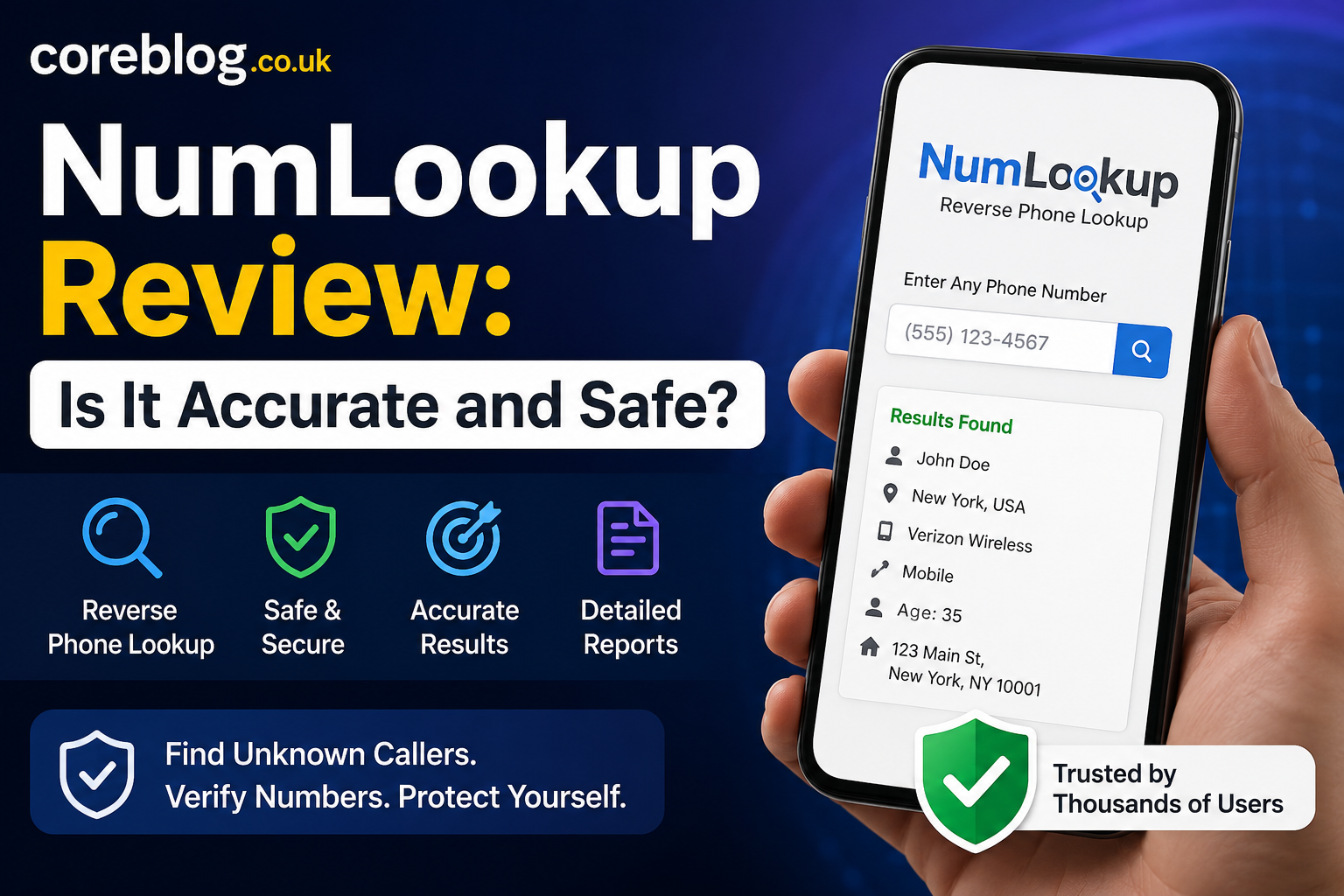
NumLookup Review: Is It Accurate and Safe?
An unfamiliar number appears on your phone. It does not leave a clear voicemail, and you do not recognize the area code. Should you call back, block it, or ignore it?
That small moment of uncertainty explains why reverse phone lookup services have become so popular. People want a quick way to identify unknown callers without answering a suspicious call or replying to a strange text message.
NumLookup is one of the tools designed for this job. You enter a phone number, start the search, and review any available details connected to it. The process sounds simple, but an important question remains: can you trust the information?
This NumLookup Review takes a practical look at the platform’s accuracy, safety, privacy, features, costs, strengths, and limitations. It also explains how to use a phone lookup responsibly, because even a convincing result should not automatically be treated as proof of someone’s identity.
What Is NumLookup?
NumLookup is an online reverse phone lookup service. Instead of searching for a person’s phone number by entering a name, you start with the phone number and try to discover information connected to it.
Depending on the number and the available records, a search may return details such as:
- A possible owner’s name
- General location information
- Phone carrier details
- Line type, such as mobile, landline, or VoIP
- Current or previous addresses
- Possible relatives or associates
- Age or demographic information
- Publicly connected online profiles
- Business contact information
The amount of information varies from one search to another. A listed landline or established business number may produce a clearer match than a recently activated mobile number, prepaid phone, burner number, or internet-based VoIP line.
That difference matters throughout this NumLookup Review. The service may provide a useful clue, but it cannot make information appear when reliable public records do not exist.
How Does NumLookup Work?
Reverse number lookup tools generally collect and organize information from several databases. These may include telephone directories, public records, business listings, property records, consumer indexes, public websites, and publicly visible social profiles.
NumLookup then attempts to connect those records with the phone number entered by the user.
The Basic Lookup Process
Using the service usually involves a few straightforward steps:
- Enter the complete phone number into the search box.
- Confirm that the country code or number format is correct.
- Complete any security verification that appears.
- Wait while the system searches its available records.
- Review the basic result or choose a more detailed report when offered.
This process can take only a short time. However, speed does not automatically equal accuracy. A fast result may still contain an old address, a former subscriber’s name, or information connected to another household member.
Where Does the Information Come From?
NumLookup states that it gathers information from sources such as phone directories, public internet pages, property records, public business directories, consumer indexes, email databases, and publicly available social networks.
This type of data aggregation is convenient because it brings scattered records into one place. However, it also creates a common weakness: the final report is only as current and accurate as the underlying sources.
For example, suppose a phone number was reassigned six months ago. An older directory may still connect it to the previous owner. The result may look detailed and professional while still being outdated.
NumLookup Review: Main Features
A useful review should look beyond the homepage and consider what the service can realistically do for an ordinary user.
Reverse Phone Number Search
The core feature allows users to enter a number and search for a possible identity. This can be helpful when dealing with:
- Missed calls from unfamiliar numbers
- Repeated calls without a voicemail
- Suspicious text messages
- Possible telemarketing calls
- Unknown business inquiries
- Marketplace buyers or sellers
- Old numbers saved without a name
- Calls from unfamiliar area codes
The tool may save time compared with searching the number manually across several search engines and online directories.
Caller Name Identification
A basic search may reveal the name associated with a phone number. This is often the main reason people use a reverse phone search.
Still, the displayed name should be treated as a possible match rather than unquestionable identification. Family plans, business accounts, recycled numbers, shared phones, and outdated records can all cause a mismatch.
Carrier and Line-Type Information
Carrier lookup details can help users understand whether a number appears to be connected to:
- A mobile network
- A traditional landline
- A VoIP provider
- A business telephone service
- A fixed or non-fixed internet number
This information can provide context. For instance, a non-fixed VoIP number may be easy to create and may not be strongly connected to a verified physical address. That does not make every VoIP caller suspicious, but it may justify additional caution.
Location and Address Data
Some reports may show a city, state, address, or location history. This information can be useful when checking whether a caller’s story makes sense.
However, location results require careful interpretation. A city may represent the place where the number was registered rather than the caller’s current location. Mobile numbers also travel with their owners, so an area code does not prove where someone presently lives.
People Search Information
NumLookup may provide broader people-search details, including possible relatives, age ranges, previous addresses, or associated records.
These details can help distinguish between people with similar names. Nevertheless, they also raise privacy concerns. Users should access and handle this information responsibly rather than using it to harass, pressure, or expose another person.
Premium Reports
Basic information may be available without purchasing a full report, while more detailed records may require a subscription or premium option.
A premium report may include additional identity information, address details, age, possible relatives, and publicly connected profiles. Availability still depends on the number and the records found. Paying for a report does not guarantee that every field will be complete.
Is NumLookup Accurate?
This is the central question in any honest NumLookup Review.
NumLookup can provide accurate information in some cases, especially when the phone number has a long, stable connection to a person or business. Established landlines, public business numbers, and numbers appearing in several directories are usually easier to match.
Accuracy becomes less predictable when searching:
- Newly issued phone numbers
- Recycled or reassigned numbers
- Prepaid mobile phones
- Burner numbers
- Shared family accounts
- Numbers registered under a company
- VoIP and app-based phone numbers
- People who have removed public listings
- Individuals who recently moved
- Numbers with limited public history
Why Results Can Be Wrong
A reverse phone database does not contact the caller and ask for confirmation. It matches existing records. If those records are old, incomplete, or connected incorrectly, the lookup result may also be wrong.
Common causes of inaccurate results include:
Number Reassignment
Mobile carriers regularly recycle unused numbers. A lookup may display the previous subscriber instead of the current user.
Shared Accounts
A phone may be used by one family member but registered under another person’s name. Business phones may also be registered under a company owner rather than the employee who called.
Outdated Public Records
Address databases and telephone directories do not always update immediately. A report may show a former residence or old carrier.
Limited Digital Footprint
Some people keep their contact details private. Others use numbers that do not appear in public directories, making a confident match difficult.
Data-Matching Errors
Two records may be combined because they share a similar name, address, household, or contact detail. This can create a report that appears complete but contains mixed information.
How to Check a NumLookup Result
Never rely on one data point. Instead, compare several details:
- Does the name match the voicemail?
- Is the location consistent with the caller’s claim?
- Does the carrier or line type make sense?
- Does the number appear on an official company website?
- Did the caller provide information that can be verified independently?
- Are several reliable records pointing to the same identity?
The strongest result is one supported by multiple independent signals. If the information conflicts, treat the identity as unconfirmed.
Is NumLookup Safe to Use?
From a basic website-security perspective, NumLookup presents itself as a legitimate lookup service rather than a downloadable program. Users can perform searches through a web browser, so there is normally no need to install unknown software.
Still, “safe” has more than one meaning. It includes account security, personal privacy, responsible use, payment awareness, and the reliability of the information received.
Search Privacy
NumLookup says searches are confidential. However, its privacy policy also describes the collection of usage information, cookies, device information, IP addresses, search history, account details, and IP-derived location data.
That does not automatically make the service unsafe. Many websites collect similar technical and usage data. Even so, users should understand that an online search is not the same as leaving no digital record at all.
This NumLookup Review recommends reading the current privacy policy before using the service, particularly when creating an account or purchasing a subscription.
Account and Password Safety
When creating an account, use a unique password that you have not used on another website. A password manager can help generate and store strong credentials.
Avoid sharing your account, and do not enter sensitive information into pages reached through suspicious advertisements, pop-ups, or imitation websites. Always confirm that you are using the correct service before entering payment details.
Payment and Subscription Awareness
Before purchasing any premium report, check:
- The total price
- Whether the charge is one-time or recurring
- The renewal period
- The number of searches included
- The cancellation process
- Whether refunds are available
- Which features require payment
A basic search may be free while deeper reports require a paid plan. Users should read the checkout page carefully instead of assuming that every feature is included at no cost.
Responsible Use
A phone lookup tool should not be used to stalk, threaten, shame, harass, or expose someone. It should also not be treated as permission to contact a person repeatedly.
Reasonable uses may include identifying a missed call, checking a suspicious message, confirming a business number, or reconnecting with a known contact. The purpose should be lawful and respectful.
NumLookup Privacy: What Users Should Know
Privacy is a two-sided issue. You may be searching for information about someone else, while your own information may also appear in the database.
NumLookup states that it collects publicly available information from multiple sources and provides an opt-out process for people who want their public listing removed from its search results.
What Data May Be Collected During Use?
According to the service’s published policy, information collected during use may include:
- Pages visited
- Search history
- Click and interaction data
- Cookie information
- Device identifiers
- IP address
- Network and operating-system details
- Approximate location based on IP
- Account information
- Email address
- Phone number
- Payment information when applicable
Users should consider this before assuming that every lookup is completely anonymous in a technical sense.
Can You Remove Your Information?
NumLookup provides an information-removal or opt-out tool. A person can request that a public listing be removed from the platform’s search results.
Removal from one people-search service does not erase the original records from government offices, directories, social profiles, or other databases. Therefore, people concerned about privacy may need to review several sources, not just one website.
Free Search vs Premium Report
The exact offers may change over time, but the general difference can be understood as follows:
| Feature | Basic Search | Premium Report |
|---|---|---|
| Possible owner name | May be available | Usually included when found |
| Carrier information | May be available | Often included |
| General location | Limited or variable | May provide deeper details |
| Address history | Usually limited | May be included |
| Possible relatives | Often unavailable | May be included |
| Age information | Limited | May be included |
| Public profile connections | Limited | May be included |
| Cost | Free to start | Paid plan or subscription |
| Data completeness | Varies | More detail, but not guaranteed |
The premium option may be worthwhile for someone who needs more context. However, users should not assume that a paid report is automatically current or correct. More fields simply mean more information to verify.
Pros and Cons of NumLookup
This NumLookup Review found several practical strengths, along with limitations that should not be ignored.
| Pros | Cons |
|---|---|
| Simple phone-number search process | Results may be outdated |
| Basic information may be free | Detailed reports may require payment |
| Can help identify unknown callers | Not every number produces a match |
| May show carrier and line type | Recycled numbers can show old owners |
| Useful for suspicious calls and texts | Public-record data may contain errors |
| No complex technical knowledge needed | Search limits or security checks may apply |
| Information is gathered in one place | Privacy concerns come with people-search data |
| Opt-out process is available | A result should not be treated as proof |
Who Should Use NumLookup?
NumLookup may be helpful for people who receive frequent unknown calls or need a quick way to check basic number information.
Potential users include:
- Individuals checking unfamiliar missed calls
- Parents reviewing suspicious contact attempts
- Freelancers verifying potential clients
- Small businesses checking unknown inquiries
- Online sellers screening unusual messages
- Customer-service teams reviewing caller details
- People trying to identify old contacts
- Anyone checking whether a message may be spam
The service is most useful as an early screening tool. It can help you decide whether to answer, block, ignore, or investigate further.
Who Should Not Rely on It?
NumLookup should not be the only source used when a decision could seriously affect another person.
Do not assume that a lookup result proves:
- Who physically made a call
- Where the caller is currently located
- That a person committed fraud
- That an individual owns the phone today
- That every listed relative is correct
- That an address is current
- That a caller is trustworthy
- That a business is legitimate
Phone numbers can be spoofed. A scammer may make your screen display a real bank, government office, local company, or innocent person’s number. In that situation, a reverse lookup might correctly identify the displayed number while failing to identify the actual caller.
How to Use NumLookup Safely
A careful process reduces the risk of misunderstanding a result.
Step 1: Enter the Full Number
Check the digits before searching. One incorrect number can produce an unrelated person’s information.
Step 2: Review the Result as a Lead
Treat the displayed name, location, and carrier as clues. Do not treat them as final proof.
Step 3: Verify Through an Independent Channel
When someone claims to represent a bank, delivery company, government office, or employer, contact that organization using a verified number from an official document or website. Do not use the callback number supplied in a suspicious message.
Step 4: Avoid Revealing Personal Information
Do not provide passwords, verification codes, banking details, Social Security numbers, or card information simply because a lookup appears to confirm the caller’s name.
Step 5: Block and Report Suspicious Calls
When a call involves threats, urgent payment demands, fake prizes, account-verification requests, or pressure to act immediately, end the conversation. Block the number and report the incident through the appropriate channel.
NumLookup Review: Realistic Accuracy Expectations
No reverse lookup database is perfect. The fairest way to judge NumLookup is by asking whether it provides enough useful information to guide the next step.
For a common business number, the result may be clear and helpful. For a new mobile or VoIP number, the search may reveal little or return a questionable match.
A sensible expectation is:
- Use the result to gather context.
- Compare it with other evidence.
- Watch for outdated records.
- Confirm important details independently.
- Never accuse someone based only on a database match.
With that approach, NumLookup can be useful without creating false confidence.
Frequently Asked Questions
Is NumLookup Really Free?
NumLookup offers basic reverse phone lookup functionality that may provide initial information without payment. However, detailed reports or expanded records may require a premium plan or subscription.
Always review the current offer before starting a paid search.
Does NumLookup Tell the Phone Owner About a Search?
The service presents lookups as confidential, meaning the number owner is not normally contacted simply because someone searched the number. However, the platform may retain technical and search-related information under its privacy practices.
Can NumLookup Identify Every Mobile Number?
No. Some mobile numbers have limited public information. Newly activated, prepaid, private, reassigned, or app-based numbers may not produce a reliable owner match.
Can It Identify a Spoofed Caller?
Not necessarily. A lookup searches the number displayed on your screen. When caller ID has been spoofed, the result may identify the innocent owner of that number rather than the person who actually placed the call.
Is the Information Always Current?
No. Public directories, consumer databases, property records, and online profiles may contain old information. Addresses, carriers, surnames, and phone ownership can change.
Can I Remove My Details From NumLookup?
The platform provides an opt-out process for requesting removal of public listings from its results. The request does not necessarily remove the original information from other websites or public-record sources.
Is NumLookup Legal to Use?
Reverse phone lookup tools can generally be used for ordinary, lawful purposes such as identifying unknown callers or verifying contact information. However, users remain responsible for following applicable privacy laws and avoiding harassment, stalking, discrimination, or other misuse.
Is NumLookup Better Than Searching Google?
A search engine can sometimes identify a phone number, particularly when it belongs to a business or appears in spam reports. NumLookup may save time by organizing several types of phone-related data in one report. Using both methods can provide better context than relying on either one alone.
Final Verdict: Is NumLookup Worth Using?
The answer depends on your expectations.
NumLookup can be a useful starting point when an unknown caller, suspicious text, or unfamiliar business number appears on your phone. The platform is easy to understand, basic results may be available quickly, and deeper reports can offer additional public-record information.
Still, this NumLookup Review cannot call the service perfectly accurate. No responsible review should. Phone ownership changes, records become outdated, numbers are spoofed, and some users leave very little public information behind.
The safest conclusion is that NumLookup works best as an investigative clue rather than a final authority. It may help you identify a likely caller, spot a suspicious number, or decide whether further verification is needed. It should not be used to make accusations or reach serious conclusions about someone.
Conclusion
Unknown calls create curiosity, but they can also create risk. A reverse phone lookup service gives users a practical way to gather more information before answering, returning a call, or responding to a message.
As this NumLookup Review has shown, the platform offers a convenient search process, possible caller identification, carrier details, location information, and optional expanded reports. At the same time, results may be incomplete, old, or connected to a previous phone owner.
Use the tool with realistic expectations. Check important details through independent sources, protect your personal information, and never let a polished database report replace common sense.
Have you used NumLookup to identify an unknown caller? Share your experience in the comments, and pass this guide along to someone who regularly receives suspicious calls or text messages.













Leave a Reply