

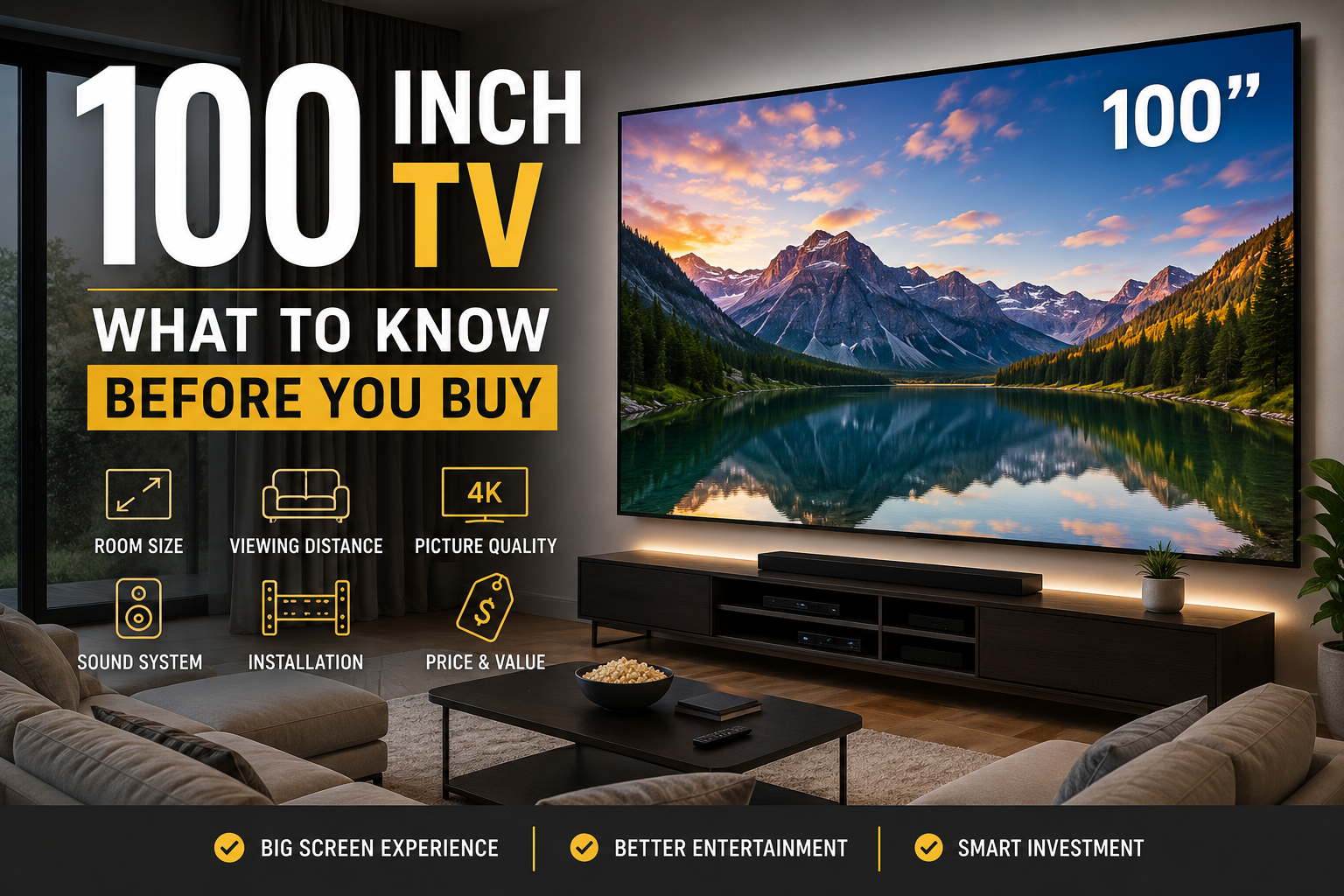
100 Inch TV: What to Know Before You Buy
A 100 inch TV can transform a living room into a genuine home theater. Its enormous screen provides an immersive experience for movies, sports, gaming, and everyday viewing. But a screen this large also requires more planning than a conventional 55- or 65-inch television.
Before buying, you need to consider more than screen size. Room dimensions, viewing distance, wall space, picture quality, brightness, sound, installation, and your budget all affect whether a 100-inch television is the right choice for your home.
The good news is that a 100-inch screen does not automatically mean you need a dedicated theater room. With the right layout and viewing distance, it can work well in a large living room or entertainment space.
This guide explains what to consider before buying a 100 inch TV so you can determine whether the size makes sense for your room and which features deserve the most attention.
Key Takeaways
- A 100-inch TV is best suited to spacious rooms where viewers can sit far enough away for comfortable viewing.
- Screen size alone does not determine picture quality; panel technology, contrast, brightness, resolution, and processing also matter.
- Measure your wall, furniture, doorways, and installation path before purchasing such a large television.
- A 100-inch TV can be an excellent choice for movies, sports, and gaming, but it may be excessive for small rooms.
- Sound quality deserves attention because a huge screen can make built-in TV speakers feel less immersive.
- Compare a large TV with a projector setup if your priority is maximum screen size rather than television convenience.
Main Article
How Big Is a 100 Inch TV?
A 100-inch television is measured diagonally from one corner of the display to the opposite corner. For a typical 16:9 widescreen format, the actual screen is approximately:
- 87 inches wide
- 49 inches tall
- 100 inches diagonally
The exact external dimensions of a television will be larger because the bezel and chassis add to the screen dimensions.
That distinction matters when planning installation. A wall that appears large enough for a 100-inch display may not provide sufficient clearance around the television, especially if you are mounting it or placing furniture underneath it.
A 100-inch TV is also physically much more imposing than a typical large-screen television. It should be treated as a major piece of furniture or home-theater equipment rather than simply a larger version of a standard TV.
Is a 100 Inch TV Too Big?
There is no universal point at which a TV becomes “too big.” The right size depends largely on the room, seating position, personal preference, and the type of content you watch.
A 100-inch screen can feel excessive if you sit very close to it. At a suitable distance, however, the same television can provide an immersive and comfortable viewing experience.
For example, a large room with a sofa positioned several feet away from the screen can be a natural fit. In contrast, placing a 100-inch TV in a compact bedroom could make the screen dominate the entire space.
The best approach is to consider viewing distance rather than screen size alone.
What Viewing Distance Is Best for a 100 Inch TV?
Viewing distance is one of the most important considerations when buying a very large television.
There is no single distance that works for every viewer. Some people prefer sitting closer for a more cinematic experience, while others prefer a greater distance for a relaxed view.
For a 100-inch 16:9 screen, a practical starting point is to consider seating roughly 8 to 14 feet away, then adjust based on personal preference, room layout, and content.
Higher-quality 4K content generally makes close viewing more comfortable because the individual pixels are difficult to distinguish at normal seating distances.
Before purchasing, mark the approximate screen position on your wall and sit in the intended viewing location. This simple test can give you a better sense of whether the screen will feel immersive or overwhelming.
What Room Size Is Suitable for a 100 Inch TV?
A 100-inch TV generally makes the most sense in a medium-to-large living room, media room, basement entertainment area, or dedicated home theater.
However, room size alone is not enough to determine suitability.
Consider these factors:
Wall Width
The screen itself is around 87 inches wide before accounting for the television’s frame. Make sure the wall has enough horizontal space and that the screen will not interfere with windows, doors, shelving, or other fixtures.
Seating Position
Your sofa or chairs should be far enough from the screen to provide a comfortable viewing experience.
Ceiling Height
A very large television can look disproportionate if mounted too high or placed in a room with limited vertical space.
Walking Space
Leave enough room around the television and furniture for people to move comfortably through the room.
Installation Access
The television needs to reach its final location. Narrow hallways, staircases, elevators, and doorways can become surprisingly important when transporting an extremely large display.
4K Resolution Matters on a 100 Inch TV
At 100 inches, resolution becomes particularly important.
A 4K TV has approximately 3,840 × 2,160 pixels. On a screen this large, lower-resolution content can look noticeably softer, particularly when viewed from a relatively short distance.
That does not mean every source needs to be native 4K. Modern TVs can upscale lower-resolution material, and the quality of the result depends on the television’s processing capabilities and the original source.
If you plan to watch:
- 4K streaming content
- 4K Blu-ray discs
- High-resolution sports broadcasts
- Modern console games
- PC games
- High-quality digital video
a 4K 100-inch television can provide an impressive viewing experience.
Picture Quality Features to Look For
The sheer size of a television should not distract you from the fundamentals of picture quality.
Contrast and Black Levels
Strong contrast helps dark scenes retain depth and detail. This can be particularly noticeable when watching movies in a dim room.
Brightness
Brightness matters more in rooms with windows or strong ambient lighting. A very large screen can also reflect more of the surrounding environment, so room lighting should be considered alongside the TV’s display performance.
HDR Support
High Dynamic Range, commonly known as HDR, can improve the difference between bright highlights and darker areas of an image.
However, HDR performance depends on more than simply having an HDR label. Peak brightness, contrast, local dimming, panel technology, and content quality all contribute to the final result.
Motion Handling
If you watch sports or fast-paced action, good motion processing can make a meaningful difference. It can help moving objects appear clearer and reduce distracting motion artifacts.
Upscaling
Much of the content people watch is still below native 4K resolution. Effective upscaling can therefore be especially useful on a 100-inch display.
LED, Mini-LED, and OLED: Which Is Better?
Large-screen TVs are available with different display technologies, although availability varies by manufacturer and model.
LED TVs
Traditional LED-backlit LCD televisions are widely available and can offer strong brightness and good value. They can be an attractive option when you want a very large screen without moving into the most expensive display categories.
Mini-LED TVs
Mini-LED televisions use a more advanced backlighting approach with many smaller LEDs. Depending on the implementation, this can provide improved brightness and better control of bright and dark areas compared with conventional LED designs.
OLED TVs
OLED displays are known for excellent black levels and strong contrast because individual pixels can be controlled independently.
At extremely large screen sizes, however, OLED options can be less common or considerably more expensive than other display technologies.
For a 100-inch TV, compare the complete picture-performance package rather than choosing a display type based on its name alone.
Is a 100 Inch TV Good for Gaming?
A 100-inch TV can make gaming exceptionally immersive.
Racing games, open-world titles, sports games, and cinematic adventure games can particularly benefit from the large display area.
Gamers should look beyond screen size, though. Important specifications and features include:
- Input lag
- Refresh rate
- HDMI connectivity
- Support for modern gaming features
- Variable refresh rate support
- Automatic low-latency features
- Motion performance
If you use a current-generation game console or gaming PC, check that the television supports the connections and gaming features you actually need.
A huge screen cannot compensate for poor responsiveness.
Is a 100 Inch TV Good for Sports?
Sports are another strong use case for a 100-inch display.
The larger viewing area can make it easier for multiple people to follow the action from different positions in the room. It can also create a more stadium-like atmosphere.
Motion handling becomes especially important here. Fast-moving players, balls, cars, and camera pans can expose weaknesses in a television’s motion processing.
Consider the type of sports you watch and the quality of the broadcasts available to you. A large screen makes differences in source quality more noticeable, so good-quality content becomes more valuable.
Sound Matters More Than You Might Expect
A massive picture can make weak audio feel even more obvious.
Built-in TV speakers can be convenient, but a 100-inch display is capable of creating a much more immersive visual experience than its built-in audio may deliver.
For a home-theater setup, consider pairing the television with:
- A soundbar
- A dedicated AV receiver
- A surround-sound system
- A compatible subwoofer
You do not necessarily need an elaborate audio system. Even a good soundbar can provide a more convincing sense of scale than basic built-in speakers.
How to Install a 100 Inch TV Safely
Installation deserves careful planning because a television of this size can be difficult to handle.
Before installation, confirm:
- The wall can support the mounting system and television.
- The mounting hardware is compatible with the specific TV.
- Wall studs or another suitable structural support are available where required.
- Power and cable connections are accessible.
- The screen will be mounted at a comfortable height.
- There is enough clearance for ventilation.
- The installation path can accommodate the television.
If you are unsure about wall construction or mounting requirements, professional installation can be worthwhile.
Do not rely solely on the television’s weight when evaluating a wall. The mounting hardware, installation method, wall structure, and manufacturer’s requirements all matter.
How High Should a 100 Inch TV Be Mounted?
A common mistake with very large televisions is mounting them too high.
The ideal position depends on seating height and personal preference, but the center of the screen should generally be positioned so that you can watch comfortably without constantly tilting your head upward.
This becomes especially important with a 100-inch display because the screen extends substantially above and below its center point.
If the TV is placed above a fireplace, for example, the viewing angle may become uncomfortable. A large screen does not make an overly high installation more comfortable.
100 Inch TV vs Projector
If your primary goal is an enormous image, you may also be considering a projector.
| Factor | 100 Inch TV | Projector |
|---|---|---|
| Picture consistency | Generally easier to maintain | Depends heavily on room and screen |
| Ambient light | Usually easier to handle | Can affect image significantly |
| Installation | Large and heavy | Requires projector and screen planning |
| Brightness | Generally consistent | Varies by projector and environment |
| Convenience | Simple TV interface | Often requires more components |
| Maximum image size | Fixed | Highly flexible |
| Sound | Built in | Usually needs separate audio |
A 100-inch TV is often preferable if you want the convenience of a conventional television with a very large screen.
A projector may make more sense if you want flexibility in image size or are building a dedicated theater environment.
What Features Should You Prioritize?
When comparing 100-inch televisions, avoid choosing based on screen size alone.
A useful priority list is:
- Picture quality
- Room compatibility
- Viewing distance
- Motion performance
- Gaming features, if relevant
- Connectivity
- Operating system and smart-TV features
- Audio options
- Installation requirements
- Overall price and value
The right priorities depend on how you use your television.
For example, a movie enthusiast may care most about contrast and cinematic picture quality, while a sports fan may prioritize brightness and motion handling. A gamer may place HDMI capabilities and input responsiveness near the top of the list.
How Much Should You Spend on a 100 Inch TV?
There is no single price point that represents good value for everyone.
Large-screen televisions can vary substantially in cost depending on display technology, picture performance, brand, features, and market availability.
Instead of setting a budget around screen size alone, decide which features are genuinely important to you.
A less expensive 100-inch TV with suitable picture quality may be a better purchase than a premium model whose advanced features you will rarely use.
It is also worth accounting for additional costs such as:
- Wall mounting
- Installation
- A suitable TV stand
- Sound equipment
- HDMI cables or other accessories
- Delivery
The total cost of ownership can therefore be higher than the television’s advertised price.
Who Should Buy a 100 Inch TV?
A 100-inch TV can be a strong choice if you:
- Have sufficient wall and floor space.
- Prefer an immersive viewing experience.
- Regularly watch movies or sports.
- Enjoy large-scale gaming.
- Have a suitable viewing distance.
- Want a television rather than a projector setup.
- Are comfortable with the installation requirements.
It may not be the right choice if your room is small, your seating is very close to the screen, or you prefer a more understated setup.
A Practical 100 Inch TV Buying Checklist
Before completing your purchase, work through this checklist:
Measure the Room
Measure the available wall width, height, and depth around the intended installation area.
Check Viewing Distance
Measure the distance between the planned screen position and your main seating area.
Measure the Installation Route
Check doorways, hallways, stairs, elevators, and corners through which the television must pass.
Compare Picture Technologies
Look at contrast, brightness, motion handling, HDR performance, and upscaling rather than focusing only on resolution.
Check Your Devices
Make sure your game consoles, streaming devices, sound systems, and other equipment have compatible connections.
Plan the Audio
Decide whether built-in speakers will be enough or whether you want a soundbar or separate audio system.
Consider the Lighting
Think about sunlight, lamps, windows, and reflections in the room at the times you normally watch television.
Review Installation Requirements
Read the manufacturer’s mounting and ventilation requirements before finalizing the installation.
Frequently Asked Questions
Is a 100 inch TV worth it?
A 100-inch TV can be worth it if you have enough space and value an immersive viewing experience. It is particularly appealing for movies, sports, and gaming. For smaller rooms, a smaller screen may provide better comfort and value.
How far should you sit from a 100 inch TV?
A practical starting point is roughly 8 to 14 feet, although the ideal distance depends on personal preference, content quality, room layout, and viewing habits.
Is 4K enough for a 100 inch TV?
For most buyers, 4K is a sensible resolution for a 100-inch television. At this screen size, high-quality 4K content can provide detailed images, while good upscaling can improve lower-resolution sources.
Can a 100 inch TV fit in a normal living room?
It can, provided the room has enough wall space and a suitable viewing distance. Measure the television’s actual dimensions and your room carefully before buying.
Is a 100 inch TV better than a projector?
Neither is universally better. A TV generally offers greater convenience and consistent picture performance, while a projector can provide greater flexibility in screen size and may suit dedicated theater spaces.
Is a 100 inch TV good for gaming?
Yes. Its large display can create an immersive gaming experience. Gamers should also check input lag, refresh rate, HDMI capabilities, variable refresh rate support, and other gaming features.
Do I need a soundbar for a 100 inch TV?
Not necessarily, but external audio can significantly improve the overall experience. A large screen can create a cinematic visual experience that may feel unbalanced if the built-in audio is limited.
Should I mount a 100 inch TV on the wall?
Wall mounting can save floor space and create a clean appearance, but the installation requires appropriate structural support and compatible mounting hardware. Professional installation may be advisable if you are uncertain about the wall or mounting requirements.
Conclusion
A 100 inch TV can turn an ordinary entertainment area into an impressive home-theater-style space, but bigger is not automatically better. The most important question is whether the television fits your room, viewing distance, content preferences, and budget.
Start by measuring the space and checking your seating distance. Then compare picture quality, display technology, motion performance, connectivity, gaming features, sound options, and installation requirements.
If your room can comfortably accommodate the screen, a 100-inch television can deliver an exceptionally immersive experience for movies, sports, and games. If space is limited, however, a smaller high-quality TV may provide a more balanced and comfortable result.
The best purchase is not simply the biggest screen you can fit. It is the screen that works best with your room, your viewing habits, and the features you will actually use.















Leave a Reply