

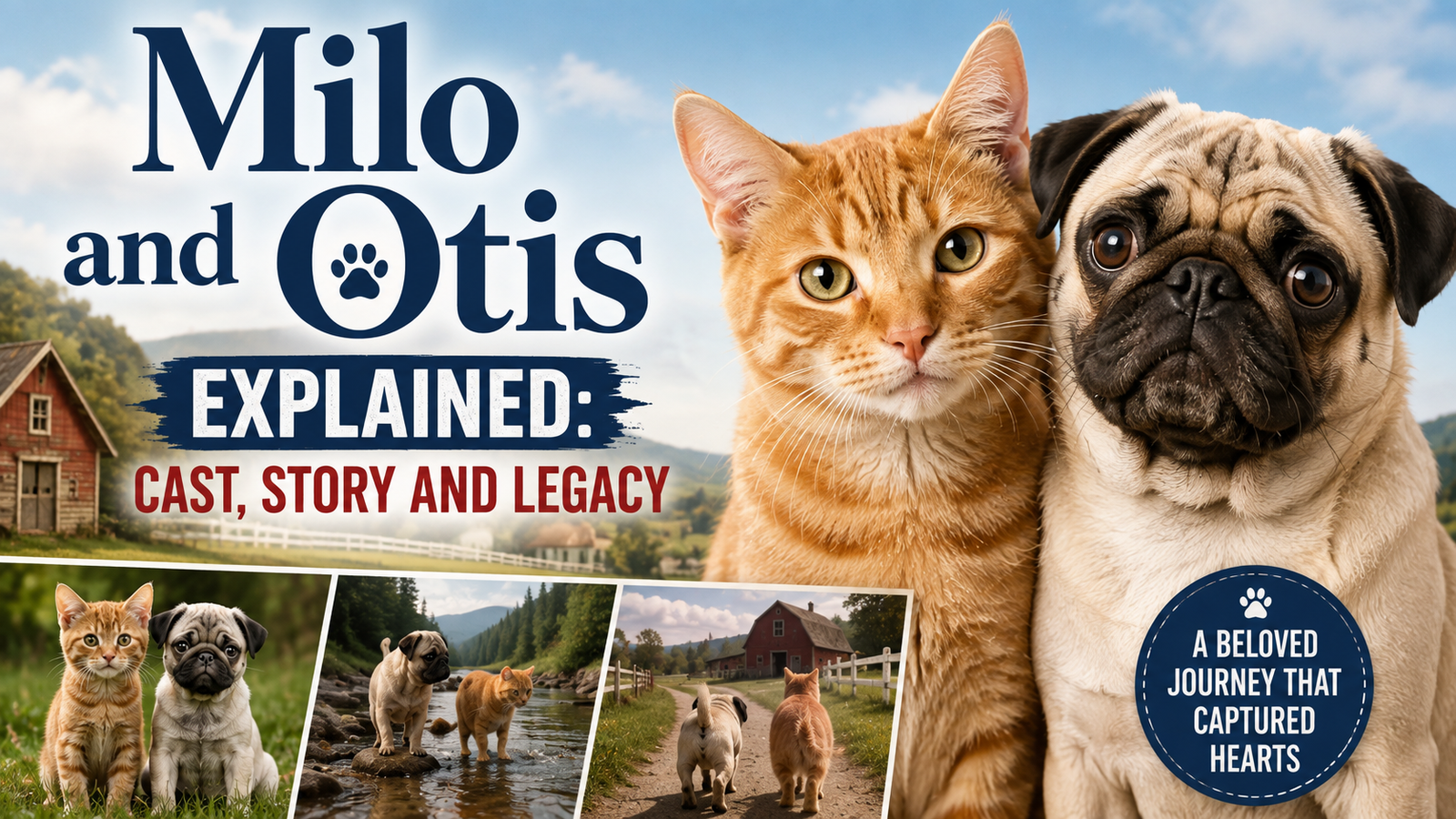
Milo and Otis Explained: Cast, Story and Legacy
Milo and Otis Explained begins with a deceptively simple premise: a curious orange tabby cat and a loyal pug become separated from their home and face an extraordinary journey through the natural world.
Known in English as The Adventures of Milo and Otis, the film has remained memorable for its unusual combination of animal adventure, scenic photography, gentle humor and narration. What many viewers may not realize is that the movie was originally a Japanese production rather than a conventional American children’s film. Its original title was Koneko Monogatari, and the English-language version was later adapted for international audiences.
This guide to Milo and Otis Explained covers the story, characters, cast, Japanese origins, narration, filmmaking approach, themes, legacy and the controversy surrounding the treatment of animals during production. Because some claims about the production have circulated widely over the years, it is important to distinguish documented information from allegations that remain disputed.
Key Takeaways
- The Adventures of Milo and Otis is a 1986 Japanese adventure film directed by Masanori Hata.
- Milo is an orange tabby cat, while Otis is a pug who becomes his companion during their separate journeys.
- The U.S. version was released by Columbia Pictures in 1989 and features Dudley Moore as narrator.
- The original Japanese film was titled Koneko Monogatari and differed from the shorter English-language adaptation.
- Its appeal comes largely from the friendship between the animals and the film’s unusual real-world animal photography.
- The movie’s production has also attracted serious animal-welfare allegations, making its legacy considerably more complicated than its family-friendly image suggests.
Main Article
What Is Milo and Otis About?
At its heart, The Adventures of Milo and Otis is a story about friendship, separation and survival.
Milo is an adventurous orange cat living on a farm. Otis, a pug, lives nearby and develops a close bond with him. Their personalities contrast nicely: Milo is curious and independent, while Otis is more cautious and dependable.
The story changes when Milo becomes separated from his familiar surroundings. Otis follows in an effort to find his friend, beginning a long journey through forests, fields, rivers, mountains and coastal areas.
Rather than relying on a large human cast, the movie puts the animals at the center of nearly every important moment. Their surroundings effectively become additional characters, creating an unusual mixture of nature documentary and fictional adventure.
The basic story is easy for children to understand, but the scale of the journey gives the film a surprisingly expansive feeling.
The Origins of Milo and Otis
One of the most interesting facts about Milo and Otis Explained is that the movie did not originate as an English-language American production.
The original film was made in Japan in 1986 under the title Koneko Monogatari. It was directed by Masanori Hata, who was also involved in the story and filmmaking process. The Japanese production featured narration by Shigeru Tsuyuki, while Kyōko Koizumi provided poetry recitation.
The original Japanese version was longer than the English adaptation. For its international release, portions were removed and the presentation was substantially adapted for English-speaking audiences.
This distinction matters because many viewers who grew up with Milo and Otis may have assumed they were watching an American family movie. In reality, the film’s roots are firmly Japanese.
Milo and Otis Characters
Milo
Milo is the film’s curious feline protagonist.
As an orange tabby kitten, he naturally attracts attention because of his expressive face and adventurous behavior. He frequently wanders into situations that are larger and more dangerous than he seems prepared to handle.
His curiosity drives much of the story. Instead of staying safely at home, Milo explores the world around him, setting the larger adventure in motion.
Otis
Otis is Milo’s canine friend.
As a pug, Otis has a completely different appearance and temperament from Milo. His personality is generally presented as loyal and persistent, particularly when he begins searching for his missing companion.
The contrast between the two animals gives the film much of its charm. Milo represents curiosity and independence, while Otis represents loyalty and determination.
The Animal World
The film also features numerous other animals encountered during the journey. These encounters help turn the movie into something broader than a simple friendship story.
Wildlife, farm animals and other creatures appear throughout the adventure, often creating moments of humor, danger or discovery.
Who Narrated Milo and Otis?
For English-speaking audiences, one of the most recognizable elements of the movie is the narration by British actor and comedian Dudley Moore.
Moore narrated the U.S. version, giving the film a distinctive personality. His delivery helps transform what could otherwise be largely observational footage into a conventional story with humor, dialogue-like commentary and emotional context.
The Japanese version used a different narration arrangement. Shigeru Tsuyuki provided narration, while Kyōko Koizumi was credited for poetry recitation.
This means the English and Japanese versions are not simply the same movie with different voices. They represent different presentations of the material.
Who Made Milo and Otis?
Masanori Hata directed the film and played a central role in its development.
The production also involved several notable creative contributors. Ryuichi Sakamoto was associated with the music for the original production, while Michael Boddicker was credited with music composed and adapted for the U.S. version. Hideo Fujii and Shinji Tomita worked as cinematographers.
The filmmaking approach was unusual because the animals themselves were the primary performers.
Instead of building the movie around human actors interacting with trained animals for short sequences, the production attempted to construct an extended narrative around animal behavior and carefully filmed situations.
That approach helped give the movie its distinctive visual identity.
The Story and Milo’s Journey
The movie’s narrative works because it turns separation into a physical journey.
Milo’s wandering takes him away from the safety of the farm. Otis eventually follows, and the two animals experience different challenges along their respective paths.
The adventure includes encounters with nature, other animals and changing environments. The story repeatedly emphasizes the uncertainty of the natural world.
Rather than presenting a conventional villain, the film’s main obstacles are environmental. Distance, weather, water, predators and unfamiliar surroundings create tension.
That makes the movie different from many traditional children’s adventures. The characters are not simply trying to defeat an antagonist. They are trying to survive, find their way and eventually reconnect.
Why the Movie Feels Different From Other Family Films
One reason Milo and Otis Explained remains an interesting topic is its unusual filmmaking style.
Most family adventure movies use actors, elaborate sets, dialogue and visual effects to control what happens on screen. Milo and Otis instead depends heavily on real animals and natural environments.
This creates several distinctive characteristics:
- The landscapes feel authentic rather than constructed.
- The animals provide most of the visual action.
- The story has a documentary-like quality.
- The narration supplies context that the animals themselves cannot provide.
- Chance and natural movement contribute to the film’s atmosphere.
That combination makes the movie difficult to categorize neatly. It can be viewed as a children’s adventure, an animal film, a nature-oriented production or a narrated comedy-drama.
The Themes Behind Milo and Otis
Although the movie is simple on the surface, several themes make it more memorable.
Friendship
The central idea is the bond between Milo and Otis.
Their friendship provides the emotional reason for the journey. Otis’s determination to find Milo turns a collection of animal sequences into a story about loyalty.
Courage
Both animals repeatedly encounter situations outside their comfort zones.
The movie presents courage less as heroic conquest and more as continuing forward despite uncertainty.
Independence
Milo’s curiosity is essential to the story. His willingness to explore reflects a common childhood theme: discovering the world beyond familiar surroundings.
Reunion
The separation between Milo and Otis gives the movie an emotional destination.
The audience wants to see the friends reunited, which gives the journey a clear purpose.
What Happened to the Animal Stars?
One common question surrounding the movie is what happened to the animals who appeared in it.
The cat associated with the character Milo is credited as Chatran, while the dog associated with Otis is credited as Pû. The production credits also list numerous animal trainers and an animal supervisor.
However, the public record does not provide the kind of detailed modern performer biographies that exist for human actors. It is therefore better to avoid presenting unverified claims about the animals’ later lives as established fact.
This is an important distinction when discussing a movie built around animal performers. Internet discussions often repeat specific claims without identifying reliable original evidence.
The Animal-Cruelty Controversy
The most difficult part of Milo and Otis Explained concerns allegations about how animals were treated during production.
Years after the movie was released, allegations of animal cruelty associated with its production were published in Japan. These allegations have circulated widely online and have led to calls to reconsider the film.
At the same time, the allegations should not be presented as unquestionable fact without qualification. The historical record is complicated, with conflicting accounts concerning what happened behind the scenes. Some claims have never been independently verified to the level necessary to establish every widely repeated story as fact.
That distinction is particularly important because some online versions of the story repeat dramatic numbers and descriptions without providing reliable primary documentation.
What can reasonably be said is that the production has been the subject of serious animal-welfare controversy, and that controversy has substantially changed how many modern viewers evaluate the movie.
For today’s audiences, the issue is not simply whether the film remains visually charming. It is also whether viewers are comfortable watching an older animal-centered production whose filmmaking practices may not meet contemporary expectations for animal welfare.
Why the Controversy Matters Today
The discussion around Milo and Otis reflects a broader change in filmmaking standards.
Modern productions involving animals generally receive much greater scrutiny regarding training methods, supervision, working conditions and safety procedures. Audiences are also more likely to ask how apparently dangerous scenes were achieved.
That makes older animal films worth viewing through a historical lens.
A movie can be culturally significant and nostalgic while still raising legitimate ethical questions. Those ideas do not necessarily contradict each other.
For someone revisiting Milo and Otis after many years, it can be useful to separate three things:
- What the film presents on screen.
- What is reliably documented about its production.
- What has been alleged or repeated without sufficient independent verification.
That approach provides a more responsible understanding of the movie than either blindly celebrating it or repeating every internet rumor as established fact.
The Difference Between the Japanese and U.S. Versions
The English-language release is not identical to the original Japanese film.
The original Japanese production was released as Koneko Monogatari, while the shorter English-language version was adapted for the international market. The U.S. version was released by Columbia Pictures in 1989 and featured a new English script and Dudley Moore’s narration.
| Feature | Japanese Version | U.S. Version |
|---|---|---|
| Original title | Koneko Monogatari | The Adventures of Milo and Otis |
| Original release | 1986 | 1989 |
| Director | Masanori Hata | Masanori Hata |
| Narration | Shigeru Tsuyuki | Dudley Moore |
| Poetry recitation | Kyōko Koizumi | Adapted English presentation |
| Runtime | Approximately 92 minutes | Approximately 75–76 minutes |
| Main animals | Cat and dog | Milo and Otis |
The differences help explain why people who have encountered both versions sometimes describe them as noticeably different experiences.
Is Milo and Otis Based on a True Story?
No. Milo and Otis Explained should not be interpreted as a true story.
The animals are presented within a fictional narrative created and shaped by the filmmakers. However, the production’s use of real animals and real landscapes gives the movie a documentary-like appearance.
That realistic presentation can make the story feel more authentic than a conventional animated or effects-heavy family film.
Why Milo and Otis Became a Nostalgic Favorite
For many viewers, nostalgia is a major part of the movie’s enduring appeal.
The film does not depend heavily on modern technology or complicated plot mechanics. Its central ingredients are simple:
- A cat and a dog
- A strong friendship
- Beautiful natural scenery
- A long journey
- Humor
- Danger
- Separation and reunion
- A memorable narrator
That simplicity allows the movie to remain accessible decades after its original release.
Dudley Moore’s narration is particularly important to the English-language version. His recognizable voice gives the movie a warm, playful quality that many viewers remember as strongly as the animals themselves.
How the Film’s Legacy Has Changed
The legacy of Milo and Otis is complicated.
On one hand, it remains a distinctive example of animal-centered filmmaking. Its imagery, unusual production style and friendship-driven story helped it stand apart from typical family movies.
On the other hand, increased awareness of animal welfare has made audiences more critical of older productions involving animals.
That means the movie now occupies an unusual position. It can be remembered fondly as a childhood film while also being discussed critically as a production whose methods deserve scrutiny.
Its lasting relevance comes partly from that tension.
Is Milo and Otis Still Worth Watching?
That depends on what a viewer wants from the experience.
If the goal is to understand a distinctive piece of 1980s animal filmmaking, the movie is certainly historically interesting. It also remains notable for its unusual visual style and the relationship between Milo and Otis.
However, viewers who are particularly sensitive to animal-welfare concerns may want to research the production controversy before deciding whether to watch it.
The important point is that the film does not have to be treated as either completely innocent nostalgia or completely defined by controversy. A thoughtful assessment can acknowledge both its cultural appeal and the serious questions surrounding its production.
Frequently Asked Questions
What is Milo and Otis about?
The Adventures of Milo and Otis follows an orange tabby cat named Milo and a pug named Otis after they become separated and embark on journeys through the natural world. The story focuses on friendship, loyalty, exploration and eventual reunion.
Is Milo and Otis a Japanese movie?
Yes. The original film was produced in Japan and released in 1986 under the title Koneko Monogatari. The English-language version was later adapted for international audiences.
Who narrated Milo and Otis?
Dudley Moore narrated the U.S. English-language version. The original Japanese version used Shigeru Tsuyuki as narrator, with Kyōko Koizumi credited for poetry recitation.
Who played Milo and Otis?
The movie primarily uses animal performers rather than human actors in the central roles. Chatran is credited with the role associated with Milo, while Pû is credited as the other principal animal performer.
When was Milo and Otis released?
The original Japanese film was released in 1986. The English-language U.S. version followed in 1989.
Is Milo and Otis based on a true story?
No. It is a fictional adventure constructed around real animal performers and filmed environments.
Why is Milo and Otis controversial?
The production has faced allegations concerning animal treatment during filming. Because accounts and claims vary and some widely repeated details lack reliable independent verification, individual allegations should be treated carefully rather than automatically presented as established fact.
Is the Japanese version different from the English version?
Yes. The Japanese original is longer and has different narration and presentation. The U.S. version was shortened and adapted with an English script and Dudley Moore’s narration.
Conclusion
Milo and Otis Explained is ultimately the story of a movie that is much more complicated than its charming title suggests.
At the center are Milo and Otis, an unlikely cat-and-dog friendship that drives an expansive adventure through nature. Behind them is an unusual Japanese production directed by Masanori Hata, later adapted for English-speaking audiences with Dudley Moore’s memorable narration.
The film remains memorable because of its distinctive combination of real animals, natural landscapes, humor and emotional simplicity. Yet its legacy also includes serious questions about animal welfare and the filmmaking practices used to create some of its scenes.
For modern viewers, the most useful way to approach Milo and Otis is with both appreciation and critical awareness. Understanding where the movie came from, how the different versions were created and why its production remains controversial provides a much fuller picture than nostalgia alone.
That combination of cultural history, filmmaking curiosity and ethical discussion is what makes The Adventures of Milo and Otis continue to attract attention decades after its original release.













Leave a Reply