

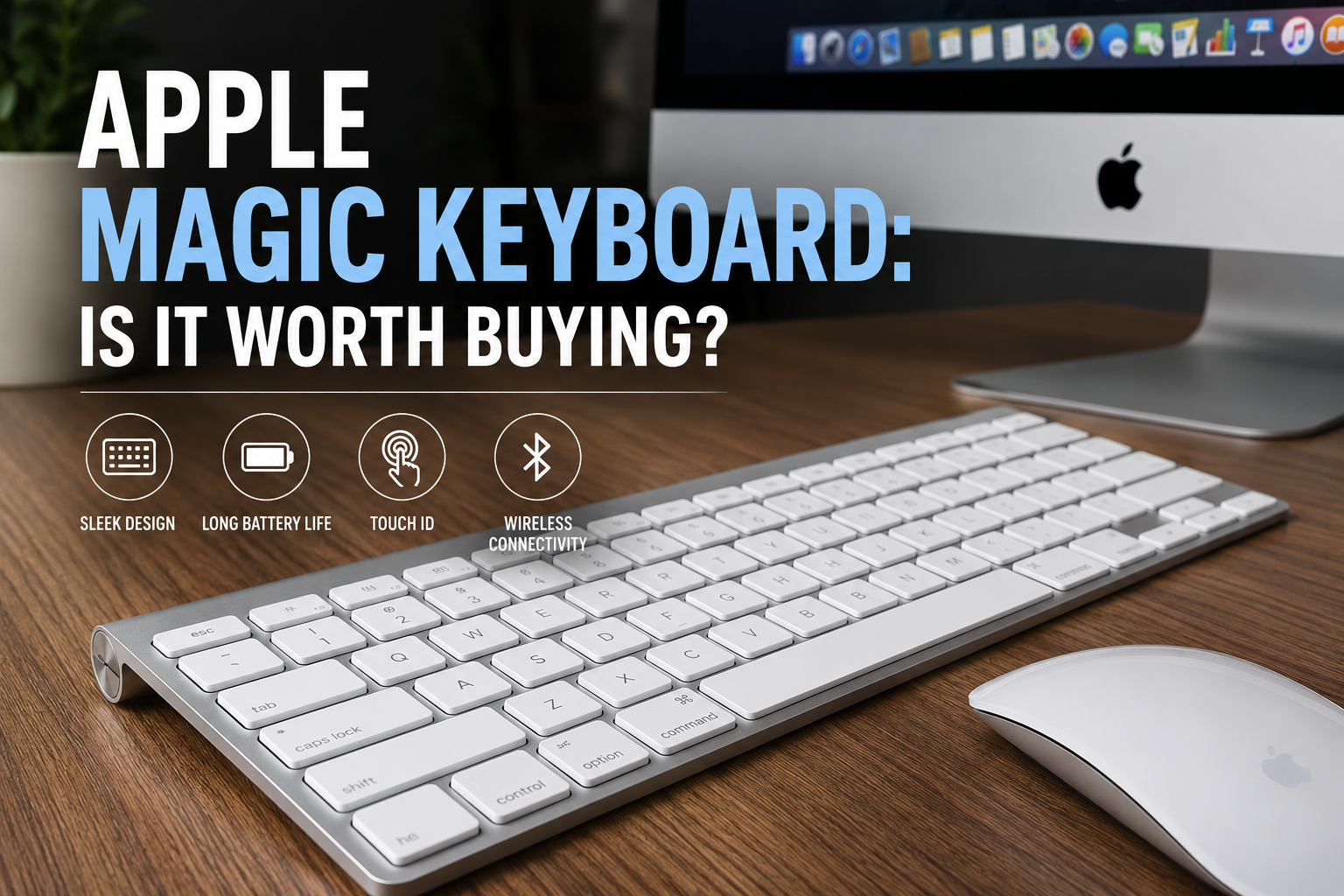
Apple Magic Keyboard: Is It Worth Buying?
The Apple Magic Keyboard is designed for people who want a compact, wireless keyboard that fits naturally into the Apple ecosystem. But with many keyboards available at lower prices, it is reasonable to ask whether Apple’s keyboard is actually worth the money.
The answer depends largely on how you work. Mac users who value a low-profile design, quiet typing, reliable wireless connectivity, rechargeable battery life, and features such as Touch ID may find the Magic Keyboard particularly appealing. Others may prefer a mechanical or ergonomic keyboard that offers more customization for the same budget.
Apple currently offers several Magic Keyboard configurations, including models for Mac with USB-C and optional Touch ID, as well as separate Magic Keyboard products designed for compatible iPad models.
This guide looks at what the Magic Keyboard offers, where it performs well, where it falls short, and which type of user should consider buying one.
Key Takeaways
- The Apple Magic Keyboard is best suited to users who prefer a slim, quiet and minimalist keyboard.
- Current Mac versions use USB-C and offer wireless connectivity and rechargeable batteries.
- Touch ID models can make Mac logins and authentication more convenient, but Touch ID compatibility depends on the Mac and keyboard model.
- Apple claims the battery can last about a month or more between charges, although real-world battery life varies with usage.
- The compact version is a good choice for general productivity, while the numeric-keypad model makes more sense for spreadsheets and number-heavy work.
- It is less compelling if you want mechanical switches, extensive customization, ergonomic features, or the lowest possible price.
Main Article
What Is the Apple Magic Keyboard?
The Apple Magic Keyboard is Apple’s wireless desktop keyboard for Mac and compatible Apple devices. It combines a slim design with low-profile keys, a rechargeable internal battery and Bluetooth connectivity.
The current USB-C Mac versions are available in different configurations. Depending on the model, you can get Touch ID and a numeric keypad, while the more compact version keeps the layout smaller and easier to position on a desk.
Apple’s design philosophy is straightforward: the keyboard is intended to feel like a natural extension of a Mac rather than a highly customizable enthusiast keyboard.
That approach has clear advantages. It keeps the product simple, visually consistent and easy to use. However, users who want hot-swappable switches, programmable keys, RGB lighting or extensive customization will find considerably more options elsewhere.
Apple Magic Keyboard Features
The exact features vary by model, but the current Mac-focused Magic Keyboard lineup includes several useful capabilities.
Low-Profile Keys
The keyboard uses a slim design with a scissor-based mechanism. This gives the keys a relatively short travel compared with many mechanical keyboards.
For people who spend hours writing emails, browsing the web or working on documents, the low-profile layout can feel quick and familiar.
It also keeps the overall keyboard relatively thin, which contributes to Apple’s minimalist desktop setup.
Wireless Connectivity
The Magic Keyboard connects wirelessly using Bluetooth. Apple also includes a USB-C cable with current Mac versions for charging and pairing.
This means your desk does not need another permanently connected keyboard cable.
For users who frequently move between workspaces, that can be particularly convenient.
Rechargeable Battery
Battery life is one of the Magic Keyboard’s practical strengths.
Apple says the current Touch ID version can operate for about a month or more between charges, although actual battery life depends on usage and other factors.
That is considerably more convenient than constantly replacing disposable batteries.
USB-C Charging
Current Mac Magic Keyboard models use USB-C for charging. Apple supplies a woven USB-C charging cable with the keyboard.
USB-C also makes the newer models more convenient for users who already have USB-C accessories and charging cables around their workspace.
Touch ID
Some Magic Keyboard models include Touch ID.
On compatible Macs, Touch ID can be used for tasks such as unlocking the computer, authenticating certain actions and making purchases through Apple Pay.
This is one of the features that can make Apple’s keyboard more than simply a typing device.
However, it is important to check compatibility before buying. Touch ID support is tied to supported Mac hardware and software rather than being a universal feature of every Magic Keyboard.
How Does the Apple Magic Keyboard Feel to Type On?
Typing feel is subjective, but the Magic Keyboard’s design clearly targets users who prefer a quiet, low-profile typing experience.
The keys are relatively shallow and have a scissor mechanism. They are not intended to provide the deep travel or pronounced tactile feedback associated with many mechanical keyboards.
Who Will Like the Typing Experience?
The keyboard is a strong fit for people who:
- Prefer laptop-style keyboards.
- Want relatively quiet typing.
- Write emails, documents and messages regularly.
- Prefer a compact and minimalist workspace.
- Do not need extensive key customization.
It may be less satisfying for someone who specifically enjoys mechanical switches, deeper key travel or highly tactile feedback.
In other words, the Magic Keyboard is not trying to compete with a mechanical keyboard on enthusiast features. Its appeal comes from simplicity and integration.
Is the Apple Magic Keyboard Good for Work?
For general office and productivity work, the Magic Keyboard can be an excellent fit.
Its compact layout takes up relatively little desk space, while the wireless connection keeps the workspace uncluttered. The rechargeable battery also reduces routine maintenance.
For people working with a Mac mini or desktop Mac, the keyboard can be especially attractive because it creates a clean setup without forcing a permanently wired connection.
The numeric-keypad version is worth considering if your work involves frequent data entry.
Apple specifically positions the extended version for tasks such as spreadsheets and finance applications, where a dedicated numeric keypad can save time.
Magic Keyboard With or Without a Numeric Keypad?
Choosing between the standard and extended versions largely comes down to how you use your computer.
| Feature | Compact Magic Keyboard | Magic Keyboard With Numeric Keypad |
|---|---|---|
| Desk space | More compact | Larger |
| Number entry | Standard | Dedicated keypad |
| Spreadsheets | Good | Better suited |
| General typing | Excellent fit | Excellent fit |
| Arrow keys | Compact layout | Full-size arrow keys |
| Best for | General productivity | Finance, data and number-heavy work |
If you rarely enter numbers, the compact model is usually the more practical choice.
If you regularly work with spreadsheets, accounting software or large numerical datasets, the numeric keypad can justify the larger footprint.
What About the Magic Keyboard for iPad?
There is an important distinction between the Magic Keyboard designed for Mac and Apple’s Magic Keyboard accessories designed for iPad.
The iPad versions are more than standalone keyboards. They can function as protective cases and include trackpads, allowing compatible iPads to be used in a more laptop-like configuration.
For example, Apple’s Magic Keyboard for compatible iPad Air models includes a 14-key function row, a large glass trackpad, backlit keys and a USB-C connector for pass-through charging.
That makes the iPad version particularly relevant to users who want to turn an iPad into a portable productivity workstation.
It should not, however, be confused with the standalone Magic Keyboard intended for Mac.
Apple Magic Keyboard Compatibility
Compatibility is one of the most important things to check before purchasing.
Current USB-C Magic Keyboard models with Touch ID are designed for Macs with Apple silicon and supported macOS versions. Apple’s current specifications list compatibility across a broad range of Apple silicon Macs, including MacBook Air, MacBook Pro, Mac mini, iMac, Mac Studio and Mac Pro models.
The exact requirements vary by keyboard.
Older Magic Keyboard models can have different ports, operating-system requirements and compatibility details. For that reason, it is better to check the specifications for the exact model rather than assuming that every Magic Keyboard works identically.
Before Buying, Check These Three Things
- Your Mac model: Confirm whether Touch ID is supported if you want that feature.
- The keyboard version: Check whether it uses USB-C or an older connector.
- The layout: Make sure the keyboard language and physical layout match your preferences.
This is especially important when purchasing an older or second-hand Magic Keyboard.
Apple Magic Keyboard Pros and Cons
A balanced assessment is more useful than simply calling the keyboard good or bad.
Pros
- Slim and minimalist design.
- Comfortable low-profile typing for many users.
- Wireless Bluetooth connectivity.
- Rechargeable battery.
- USB-C charging on current Mac models.
- Touch ID available on supported versions.
- Compact option for smaller desks.
- Numeric-keypad option for data-heavy workflows.
- Strong integration with the Mac experience.
Cons
- Generally more expensive than many basic wireless keyboards.
- No mechanical-switch option.
- Limited physical customization.
- Minimal ergonomic adjustment.
- Touch ID is not available on every model.
- Different generations can have different ports and compatibility requirements.
- Users wanting advanced gaming or productivity customization may find it restrictive.
The biggest question is therefore not whether the Magic Keyboard is objectively the best keyboard. It is whether its particular combination of design, simplicity and Apple integration matches your priorities.
Is the Apple Magic Keyboard Worth the Price?
For some users, yes.
The value proposition becomes stronger when you specifically want Apple’s design and ecosystem integration. Touch ID can also add practical convenience on compatible Macs, while the rechargeable battery reduces maintenance.
However, price matters.
Apple’s current U.S. store lists the USB-C Magic Keyboard without Touch ID at $99, while the Touch ID version is listed at $149. The Touch ID model with a numeric keypad is also positioned as a more expensive option.
That means buyers should consider what they are actually paying for.
If you simply need a keyboard that types reliably, less expensive alternatives can provide excellent value.
If you want Apple’s specific design, compact footprint, wireless experience and Touch ID integration, the premium may be easier to justify.
Who Should Buy the Apple Magic Keyboard?
The Magic Keyboard makes the most sense for a few particular types of users.
Mac Desktop Users
If you use a Mac mini, iMac or Mac Studio, a compact wireless keyboard can make the setup cleaner and more flexible.
Writers and Office Users
People who spend much of their day typing may appreciate the quiet, low-profile design.
Minimalist Setup Owners
If you care about a clean desk and want accessories that visually match an Apple setup, the Magic Keyboard fits that philosophy well.
Touch ID Users
If your Mac supports Touch ID on the keyboard, the feature can make authentication more convenient.
Who Should Skip It?
The Magic Keyboard may not be the right choice if your priorities are very different.
Consider another keyboard if you want:
- Mechanical switches.
- Highly tactile typing.
- Extensive customization.
- Programmable macro keys.
- RGB lighting.
- An ergonomic split design.
- A substantially lower purchase price.
A keyboard is one of the most personal computer accessories you can buy. A model that feels perfect to one person can feel too shallow or restrictive to another.
How the Magic Keyboard Compares With Other Keyboard Types
Rather than comparing the Magic Keyboard with one particular competing model, it is useful to compare it with the major keyboard categories.
| Keyboard Type | Main Strength | Main Weakness |
|---|---|---|
| Apple Magic Keyboard | Apple integration and simplicity | Limited customization |
| Mechanical keyboard | Typing feel and customization | Usually larger and louder |
| Budget wireless keyboard | Low cost | Often fewer premium features |
| Ergonomic keyboard | Comfort-focused design | Larger learning curve |
| Gaming keyboard | Performance and customization | Often unnecessary for office work |
This comparison highlights the Magic Keyboard’s position.
It is not primarily an enthusiast product. It is a polished general-purpose keyboard aimed at people who value convenience, simplicity and a cohesive desktop setup.
How to Choose the Right Magic Keyboard
If you decide that Apple’s keyboard fits your needs, choosing the correct version is the next step.
Choose the Compact Model If:
- You want to save desk space.
- You rarely use a numeric keypad.
- You prefer a minimalist layout.
- You mainly write, browse and perform general office tasks.
Choose the Numeric Keypad Model If:
- You work extensively with spreadsheets.
- You enter numbers frequently.
- You use accounting or finance software.
- You want full-size arrow keys and an extended layout.
Choose Touch ID If:
- Your Mac supports it.
- You frequently unlock or authenticate your Mac.
- You value biometric authentication.
- The additional cost fits your budget.
Consider an iPad Magic Keyboard If:
Your primary device is a compatible iPad and you want a keyboard, trackpad and protective case in one accessory. Apple’s iPad versions are specifically designed around that use case.
Frequently Asked Questions
Is the Apple Magic Keyboard worth buying?
It can be, particularly for Mac users who value a slim design, quiet low-profile keys, wireless connectivity, rechargeable battery life and, on compatible models, Touch ID. It is less compelling if you want extensive customization or mechanical switches.
Does the Apple Magic Keyboard have Touch ID?
Some Mac versions do. Touch ID models can authenticate actions such as Mac login and Apple Pay purchases on supported Macs. Not every Magic Keyboard includes Touch ID.
How long does the Apple Magic Keyboard battery last?
Apple says the current Touch ID model can provide about a month or more between charges. Actual battery life varies according to usage and other conditions.
Does the Apple Magic Keyboard use USB-C?
Current Mac versions use USB-C for charging and pairing. Older models may use a different connector, so buyers should check the exact model before purchasing.
Is the Magic Keyboard good for typing?
For people who prefer quiet, low-profile keys, it can provide a comfortable and precise typing experience. Users who prefer deep mechanical switches may prefer a different keyboard style.
Is the Magic Keyboard good for spreadsheets?
The version with a numeric keypad is particularly well suited to spreadsheets and other number-heavy tasks. Apple specifically identifies the numeric keypad as useful for spreadsheets and finance applications.
Can I use a Magic Keyboard with an iPad?
It depends on which Magic Keyboard you mean. Apple’s iPad-specific Magic Keyboard models are designed for compatible iPad Pro and iPad Air models and include features such as a trackpad and pass-through charging.
Should I buy the Magic Keyboard with a numeric keypad?
Choose it if you frequently enter numbers or work with spreadsheets and finance applications. Otherwise, the smaller model may be preferable because it takes up less desk space.
Conclusion
So, is the Apple Magic Keyboard worth buying?
For the right user, it is.
The Magic Keyboard’s strongest qualities are not flashy specifications but the combination of a slim design, low-profile typing experience, wireless connectivity, rechargeable battery and straightforward integration with the Mac ecosystem. Current models also bring USB-C charging, while supported versions add Touch ID.
Its limitations are equally clear. It is not designed for people seeking mechanical switches, deep customization or specialized ergonomic features. And because Apple’s keyboard carries a premium compared with many basic alternatives, the extra cost should be justified by features you will actually use.
If you primarily use a Mac and want a simple, polished wireless keyboard, the Apple Magic Keyboard is a strong choice. If typing customization, ergonomics or maximum value matters more than Apple’s ecosystem and design, another keyboard may be a better investment.










Leave a Reply