

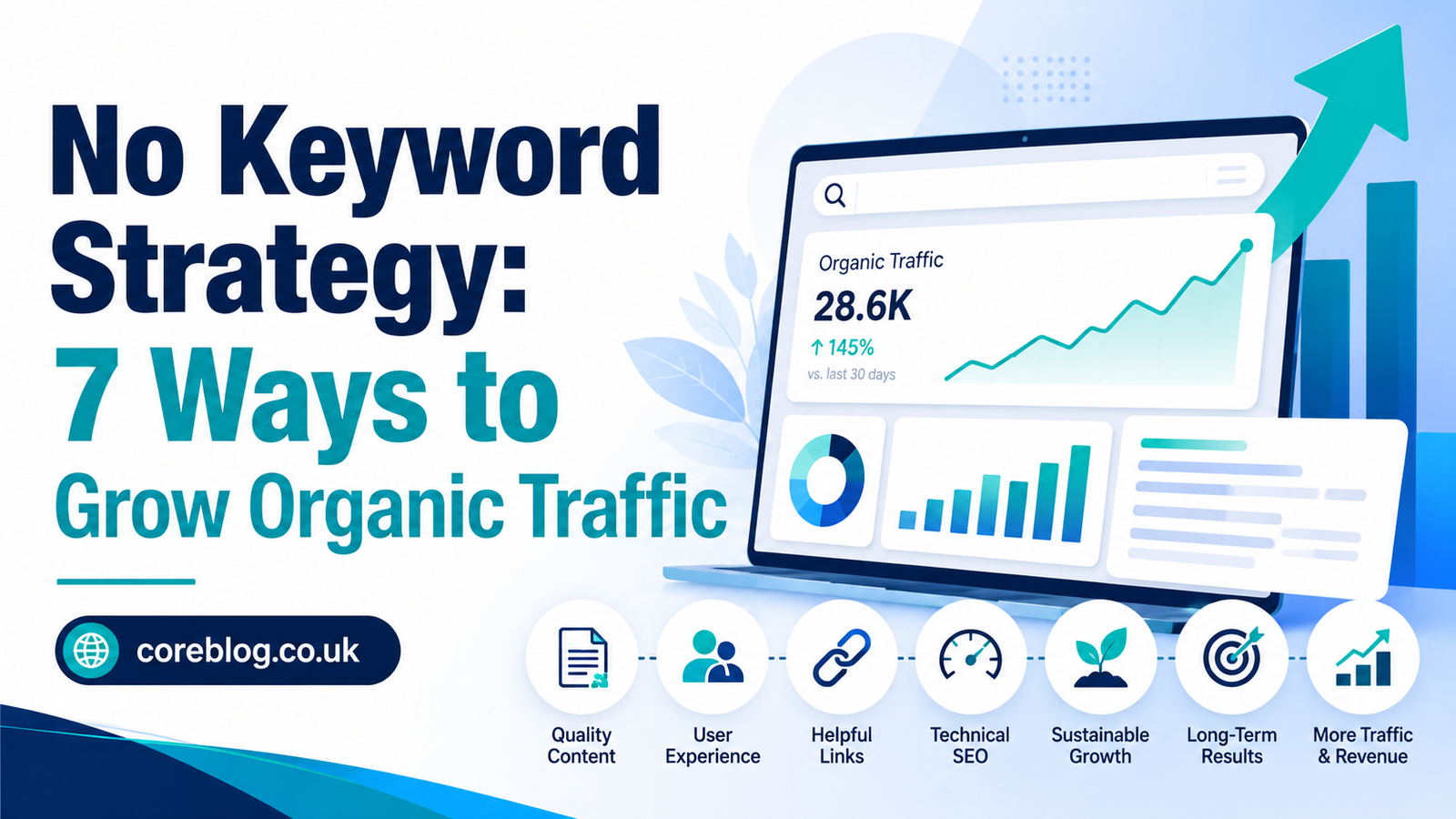
No Keyword Strategy: 7 Ways to Grow Organic Traffic
Most website owners begin content planning with the same question: “Which keyword should I target?”
It sounds sensible. After all, search engines connect users with pages through words and phrases. Yet focusing too heavily on exact keywords can make content stiff, repetitive, and less useful. Writers may end up creating articles for an algorithm instead of real people.
That is where a No Keyword Strategy offers a fresh approach.
This method does not mean ignoring search engine optimization. It means starting with the reader rather than a keyword list. Instead of forcing one search term into every paragraph, you build content around real questions, problems, goals, and experiences.
Modern search engines understand context much better than they once did. They can recognize related ideas, synonyms, user intent, topic depth, and useful answers. Therefore, a page can attract organic traffic even when it was not created around one rigid keyword.
A strong No Keyword Strategy helps you write naturally while still covering the subjects people search for. It can also support topical authority, user engagement, search visibility, and long-term traffic growth.
Let us explore how it works and how you can use it effectively.
What Is a No Keyword Strategy?
A No Keyword Strategy is a content planning method that focuses on topics, audience needs, and search intent rather than one exact target phrase.
Traditional SEO content often begins with keyword research. A writer finds a phrase with search volume, checks its competition, and builds an article around it. That approach can work, but it also creates problems when followed too strictly.
For example, a writer targeting “best home office chair” may repeat the phrase many times. The article may sound unnatural. Worse, it may ignore useful questions such as:
- How much back support does a chair need?
- Which materials last the longest?
- What chair height suits a small desk?
- Are expensive office chairs worth buying?
- How can buyers test comfort before ordering?
A topic-first approach considers the entire user journey. It answers the main question as well as related concerns.
Therefore, a No Keyword Strategy is not “SEO without research.” It is SEO guided by people, context, and helpful information.
How It Differs From Traditional Keyword SEO
Traditional keyword SEO usually focuses on:
- Search volume
- Keyword difficulty
- Exact-match phrases
- Competitor rankings
- Keyword density
- Search engine results pages
- Ranking positions
A topic-led strategy focuses more on:
- Audience pain points
- Search intent
- Customer questions
- Content relevance
- Topic clusters
- Semantic search
- User satisfaction
- Helpful content
- Brand expertise
- Natural language
Both methods can support one another. However, the order changes. With a No Keyword Strategy, you identify the reader’s problem first. Search terms become supporting information rather than the whole plan.
Why Keyword-First Content Often Fails
Keyword research is useful. However, it becomes harmful when it controls every writing decision.
Some businesses publish dozens of posts based on high-volume phrases. Yet those articles receive little traffic, few comments, and almost no conversions. The reason is simple: search demand alone does not guarantee content quality.
It Can Create Repetitive Writing
When a writer must repeat one exact phrase a set number of times, sentences may feel forced. Readers notice this quickly. The page loses its natural rhythm, and the brand may appear less credible.
It Can Ignore the Real Question
A search phrase rarely tells the whole story.
Someone searching for “cheap website hosting” may not simply want the lowest price. They may need fast loading speeds, customer support, website backups, security features, or a beginner-friendly dashboard.
Content that focuses only on price may fail to satisfy that visitor.
It Encourages Copycat Content
Keyword tools often lead many websites toward the same subjects. As a result, hundreds of similar articles appear online with nearly identical headings.
A No Keyword Strategy encourages original angles, personal experience, industry insights, practical examples, and expert opinions. These elements help content stand apart.
It May Attract the Wrong Visitors
High traffic is not always valuable traffic.
A page may rank for a broad search query but attract people who have no interest in the business. A smaller group of highly relevant visitors can produce more email sign-ups, leads, purchases, and repeat visits.
The Benefits of a No Keyword Strategy
A well-planned No Keyword Strategy can improve both content quality and SEO performance.
| Benefit | How It Helps |
|---|---|
| Natural writing | Content feels clear, useful, and human |
| Wider topic coverage | Pages can rank for several related searches |
| Better engagement | Readers stay longer and explore more pages |
| Stronger authority | In-depth content builds trust and expertise |
| More original ideas | Writers avoid copying common competitor topics |
| Better conversions | Content matches genuine audience needs |
| Long-term value | Useful pages can remain relevant for years |
This approach also supports content marketing, brand awareness, organic reach, information architecture, website navigation, internal linking, and audience retention.
1. Build Content Around Real Audience Problems
The first step in a No Keyword Strategy is learning what your audience actually struggles with.
Do not begin with a keyword tool. Begin with customer conversations.
Look at questions people ask before buying. Read support emails, product reviews, community discussions, comments, social media replies, sales calls, and customer feedback.
These sources often reveal more useful content opportunities than a list of search terms.
Find Repeated Questions
A repeated question is a strong sign of content demand.
Suppose you run a digital marketing agency. Potential clients may regularly ask:
- How long does SEO take?
- Why has website traffic dropped?
- Is blogging still worth it?
- How often should a business publish?
- Why are visitors not becoming customers?
Each question could become a useful article, guide, case study, checklist, or video.
The wording does not need to match a popular keyword exactly. The goal is to solve the problem clearly.
Understand the Situation Behind the Question
Readers often have emotional concerns as well as practical ones.
A small business owner asking about falling traffic may feel worried, confused, or frustrated. A helpful article should not simply list technical causes. It should explain what to check first, what can wait, and when expert help may be needed.
That personal understanding creates trust.
2. Focus on Search Intent, Not Exact Phrases
Search intent describes what a person hopes to achieve through a search.
Most searches fall into a few broad groups:
- Informational intent
- Commercial intent
- Transactional intent
- Navigational intent
- Local intent
Someone searching “how to repair a leaking tap” wants instructions. Someone searching “best plumber near me” wants a service. Those visitors need very different pages.
A No Keyword Strategy becomes effective when each article has one clear purpose.
Match the Format to the Reader’s Goal
Choose a content format that suits the user’s task.
Use a step-by-step guide when the reader wants to complete something. Use a comparison table when they need to choose between options. Use a checklist when they need a quick process. Use a case study when they want proof.
Useful content formats include:
- Tutorials
- Buying guides
- Comparisons
- Product reviews
- Expert interviews
- Frequently asked questions
- Case studies
- Templates
- Checklists
- Troubleshooting guides
- Opinion pieces
- Industry reports
The correct format improves user experience and makes the answer easier to understand.
Answer the Main Question Early
Do not hide the answer beneath a long introduction.
Readers appreciate direct information. Give them a clear response near the beginning. Then add details, examples, warnings, and useful context.
This approach can reduce bounce rate and improve content satisfaction.
3. Create Topic Clusters Instead of Isolated Posts
One article rarely builds authority on its own.
Search engines and readers are more likely to trust a website that covers a subject from several useful angles. Therefore, organize content into topic clusters.
A topic cluster includes one broad pillar page and several supporting articles.
For example, a website about email marketing could create a pillar guide called “Email Marketing for Small Businesses.” Supporting pages might cover:
- Building an email list
- Writing subject lines
- Improving open rates
- Creating welcome emails
- Avoiding spam filters
- Measuring campaign performance
- Segmenting subscribers
- Writing sales emails
- Choosing email software
- Cleaning inactive contacts
Each page answers a separate question. Internal links connect the content and help visitors move through the subject.
Why Topic Clusters Work
Topic clusters improve:
- Website structure
- Content discovery
- Crawlability
- Topical relevance
- Internal link equity
- Session duration
- Page views
- Authority signals
- Reader navigation
A No Keyword Strategy works especially well with clusters because it allows you to cover a full subject without forcing every page around a high-volume phrase.
Avoid Content Cannibalization
Before publishing, check whether your website already has a page answering the same question.
Two similar posts may compete against each other. Instead of creating another weak article, update the existing one or choose a different angle.
For instance, do not publish five basic guides about “starting a blog.” Create one complete beginner guide. Then add supporting articles about niche selection, publishing schedules, blog design, audience growth, and monetization.
4. Write From Experience and First-Hand Knowledge
Generic information is easy to find. Genuine experience is harder to copy.
Personal observations, original examples, mistakes, results, and practical lessons can make an article far more valuable.
This does not mean every post needs to become a personal diary. It simply means adding details that come from real work.
Show What Actually Happened
Instead of saying, “Updating content can improve traffic,” explain what you updated.
You might write:
“We reviewed an old guide that had lost traffic over six months. The introduction was vague, several screenshots were outdated, and the article did not answer newer customer questions. After improving those sections and simplifying the layout, reader engagement increased.”
That example feels more believable because it includes a process.
Use Expert Commentary
A No Keyword Strategy can also include insights from people with direct subject knowledge.
You may interview:
- Business owners
- Designers
- Developers
- Doctors
- Trainers
- Accountants
- Teachers
- Engineers
- Industry consultants
- Experienced customers
Expert input supports credibility and adds depth. However, keep explanations simple. Readers should not need specialist knowledge to understand the article.
Share Limitations Honestly
Trust grows when a writer admits that one solution will not suit everyone.
For example, a content tactic may work well for an established website but take longer for a new domain. A premium tool may be useful for an agency but unnecessary for a solo blogger.
Balanced advice feels more reliable than exaggerated promises.
5. Cover a Topic Deeply Without Adding Fluff
Long content does not automatically rank well.
A 3,000-word article can still be weak if it repeats the same idea. Meanwhile, a focused 1,200-word guide may perform better because it answers the question clearly.
Depth comes from completeness, not word count.
A strong article should explain:
- What the subject means
- Why it matters
- Who it is for
- How it works
- What steps to follow
- Which mistakes to avoid
- What tools may help
- What results to expect
- What to do next
Use Related Concepts Naturally
Search engines understand subjects through relationships between ideas. Therefore, include related terms where they help the reader.
An article about organic traffic may naturally discuss:
- Search visibility
- Content quality
- On-page SEO
- Technical SEO
- Backlinks
- Domain authority
- Search queries
- Search engine crawling
- Indexing
- Click-through rate
- User engagement
- Conversion rate
- Content freshness
- Mobile optimization
- Page speed
- Featured snippets
- Rich results
- Content distribution
- Social sharing
- Referral traffic
These terms should appear because they belong to the discussion, not because a tool demands them.
Make the Page Easy to Scan
Most online readers scan before they read closely.
Use:
- Clear headings
- Short paragraphs
- Descriptive subheadings
- Bullet points
- Numbered steps
- Simple tables
- Bold text
- Relevant examples
Good formatting supports readability and helps visitors find the information they need.
6. Improve Existing Content Before Publishing More
Many websites do not need more articles. They need better articles.
A practical No Keyword Strategy includes regular content audits. Review older pages and look for ways to improve their usefulness.
Check for Outdated Information
Update old dates, prices, screenshots, product features, statistics, processes, and recommendations. Remove advice that no longer applies.
Fresh content can improve trust and protect existing rankings.
Strengthen Weak Sections
Look for pages with:
- High impressions but few clicks
- Traffic but low engagement
- Good rankings but poor conversions
- Declining search visibility
- Thin or incomplete answers
- Confusing introductions
- Weak calls to action
- Broken internal links
- Duplicate sections
You may not need to rewrite the entire page. A better title, clearer introduction, useful table, or expanded FAQ section could make a major difference.
Combine Similar Articles
If several short posts cover the same subject, combine them into one complete resource.
This can improve content depth and reduce competition between your own pages. Redirect the weaker URLs when appropriate so visitors reach the updated guide.
7. Measure Outcomes That Matter
Traffic is important, but it is not the only measure of success.
A page can attract thousands of visitors and still provide little business value. Another page may receive only a few hundred visits but generate steady leads.
Track performance based on the goal of the content.
Useful metrics include:
- Organic sessions
- Search impressions
- Click-through rate
- Average engagement time
- Scroll depth
- Returning visitors
- Newsletter sign-ups
- Contact form submissions
- Product sales
- Assisted conversions
- Internal link clicks
- Downloads
- Comments
- Social shares
- Brand searches
Give Content Enough Time
Organic growth is rarely instant.
Search engines need time to crawl, index, understand, and test a page. New websites may need longer to build trust than established brands.
Review early signals, but avoid making major decisions after only a few days. Instead, monitor performance over a reasonable period and improve the page based on real data.
Learn From Pages That Already Perform
Your best-performing pages reveal what your audience values.
Study their topics, format, tone, length, examples, traffic sources, calls to action, and internal links. Then apply those lessons to future content.
Do not copy the page word for word. Identify the qualities that made it useful.
How to Build a No Keyword Strategy Step by Step
You do not need expensive software to start. Use this simple process.
Step 1: Define Your Audience
Write down who you want to help. Be specific about their role, experience level, goals, and common problems.
Step 2: Collect Real Questions
Gather questions from customer support, search suggestions, forums, reviews, comments, sales calls, and community discussions.
Step 3: Group Questions by Topic
Organize related questions into broader themes. These themes can become content clusters.
Step 4: Choose the Reader’s Main Goal
Decide what the reader should understand, choose, fix, or complete after reading.
Step 5: Select the Best Format
Choose a guide, checklist, comparison, review, tutorial, case study, or FAQ based on the reader’s needs.
Step 6: Write a Clear Outline
Arrange the information in a natural order. Start with the main answer, then add steps, examples, mistakes, and next actions.
Step 7: Add Original Value
Include first-hand experience, useful opinions, practical examples, unique data, or expert comments.
Step 8: Optimize the Page Naturally
Write a strong title, create a helpful meta description, use clear headings, add internal links, optimize images, and check mobile readability.
Step 9: Publish and Distribute
Share the page through email, social platforms, online communities, and relevant business channels.
Step 10: Review and Improve
Measure reader behavior and business results. Update the page when information changes or new questions appear.
Common Mistakes to Avoid
Even a strong No Keyword Strategy can fail when it lacks structure.
Ignoring Search Demand Completely
Topic-first writing does not mean publishing random thoughts. Your subject should still connect with a real audience need.
Writing Without a Clear Purpose
Every page should have one primary goal. A page that tries to educate beginners, sell a product, cover industry news, and answer advanced questions at once may confuse readers.
Creating Thin Content
Avoid publishing a post simply because a question exists. Make sure your page gives a useful, complete answer.
Forgetting Basic SEO
You still need descriptive page titles, clean URLs, logical headings, mobile-friendly design, fast loading speeds, image alt text, and internal links.
Publishing and Never Updating
Information changes. Competitors improve. Reader expectations grow. Review important pages regularly.
Does a No Keyword Strategy Replace Keyword Research?
Not entirely.
Keyword research can still reveal how people describe a topic. It can show common questions, language patterns, seasonal interest, and differences in intent.
However, it should support your content decisions rather than control them.
Think of keyword data as a map. It can show possible routes, but it cannot decide where your audience truly needs to go.
The best approach often combines audience research, topic expertise, search intent, content analysis, and light keyword validation.
In other words, a No Keyword Strategy removes the obsession with exact-match targeting. It does not remove careful planning.
Final Thoughts
A No Keyword Strategy gives content creators permission to think beyond search volume and keyword density. It shifts attention toward the things that matter most: useful answers, strong expertise, clear writing, real audience problems, and a smooth user experience.
Begin with people. Learn what they ask, what confuses them, and what they hope to achieve. Then create content that solves those problems better than the pages already available.
Build topic clusters, share genuine experience, update older posts, and track meaningful results. Over time, these actions can strengthen topical authority, improve brand trust, and bring consistent organic traffic.
Keywords still have value. However, they should guide your language, not limit your ideas.
Now review your current content plan. Choose one audience problem that has been overlooked and create the most practical answer you can. After publishing, listen to reader feedback and improve the page.
Have you used a No Keyword Strategy before? Share your experience, and pass this guide to another writer or business owner who wants to create more useful content.












Leave a Reply