
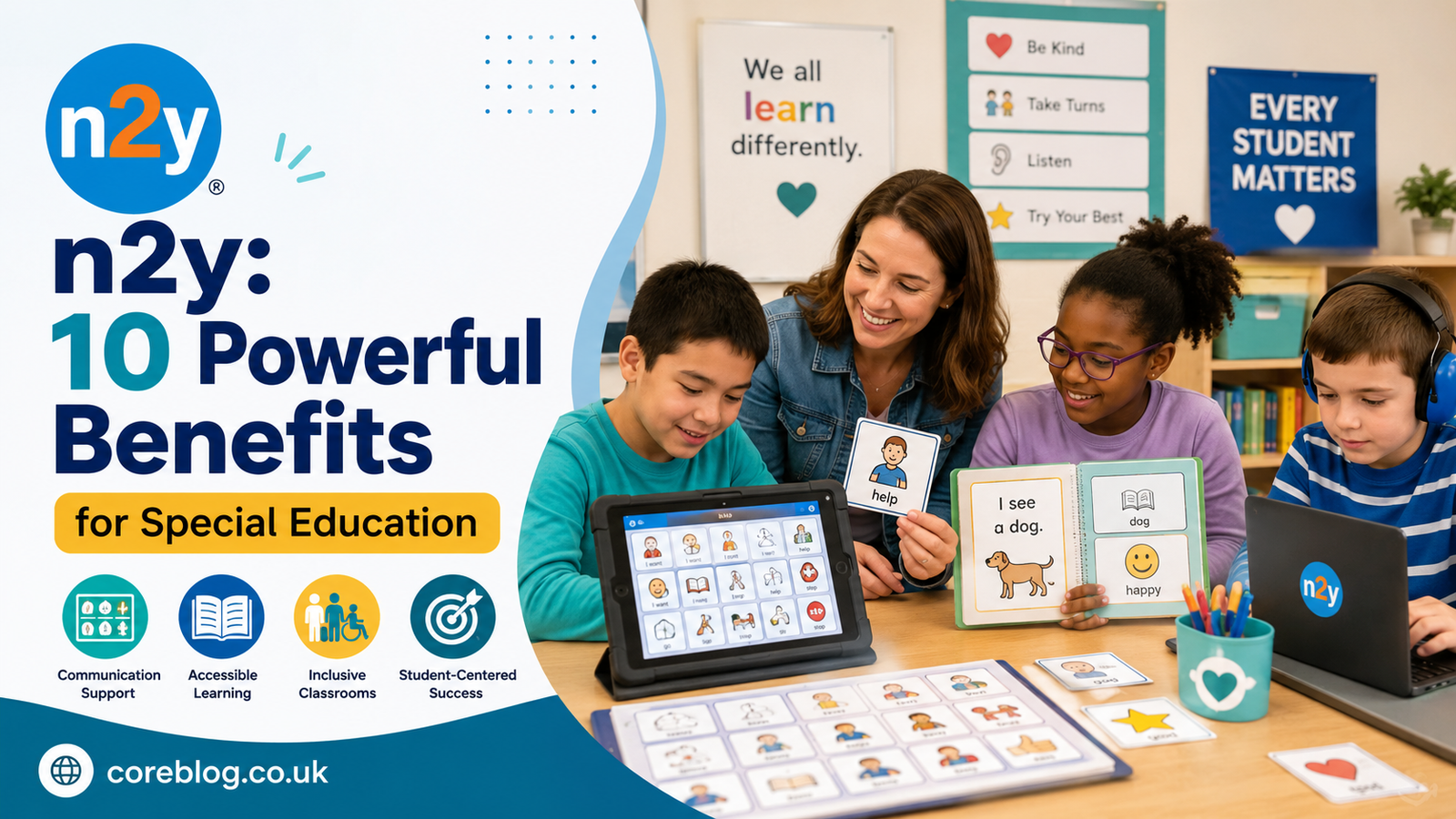
n2y: 10 Powerful Benefits for Special Education
Why n2y Matters in Special Education
Special education is not a one-size-fits-all world. Any teacher who has spent even one week in a diverse classroom knows this deeply. One student may need visual supports. Another may need repeated practice. A third may understand the lesson perfectly but struggle to express the answer in a traditional way.
That is where n2y becomes such a valuable name in special education.
For many schools, teachers, therapists, and support teams, n2y is more than just digital curriculum software. It is a practical classroom support system built around accessibility, differentiated learning, communication, progress tracking, and real student needs. In a busy special education classroom, where every child may have different goals, accommodations, and learning styles, having the right tools can make the day smoother and the learning more meaningful.
The biggest strength of n2y is that it helps teachers meet students where they are. It supports learners with disabilities, autism, communication challenges, developmental delays, cognitive differences, and complex learning needs. Instead of expecting every student to learn in the same way, n2y helps create flexible pathways.
And honestly, that is what good special education should do.
In this article, we will explore 10 powerful benefits of n2y for special education, why it matters for teachers, how it supports students, and why many classrooms use it as part of a more inclusive learning approach.
What Is n2y?
n2y is an educational platform designed to support special education classrooms with accessible learning tools, differentiated curriculum, visual supports, communication resources, behavior support, and data-driven instruction.
In simple words, n2y helps teachers plan, teach, adapt, and track learning for students who need extra support.
It is especially useful for:
- Special education teachers
- Students with disabilities
- Students with autism
- Nonverbal or minimally verbal learners
- Students with communication needs
- IEP teams
- Speech-language support staff
- Paraprofessionals
- School administrators
- Inclusive classroom teams
The goal is not just to deliver lessons. The goal is to make learning reachable.
That matters because special education teachers often handle many responsibilities at once. They write IEP goals, modify lessons, support behavior needs, collect data, communicate with families, and teach multiple subjects across different ability levels. n2y can reduce some of that pressure by giving teachers ready-made, adaptable resources.
Quick Overview of n2y Benefits
| Benefit | How It Helps Special Education |
|---|---|
| Differentiated lessons | Supports different ability levels in one classroom |
| Visual learning tools | Helps students understand through symbols and images |
| IEP support | Connects instruction with individual student goals |
| Time-saving resources | Reduces lesson planning stress for teachers |
| Data tracking | Helps monitor progress and learning growth |
| Communication support | Gives students more ways to express understanding |
| Accessible curriculum | Makes academic content easier to reach |
| Behavior support | Helps create structure and positive routines |
| Life skills learning | Supports daily living and transition skills |
| Inclusive learning | Encourages participation for every student |
1. n2y Supports Differentiated Instruction
One of the biggest benefits of n2y is differentiated instruction. In special education, students rarely work at the exact same academic level. A teacher may have one student reading simple sentences, another identifying pictures, and another working on grade-level comprehension with support.
That is a real classroom situation.
n2y helps by offering materials that can be adjusted for different learning levels. This means students can work on the same general topic but receive content in a way that matches their ability.
For example, if the class is learning about weather, one student may read a short adapted passage, another may answer symbol-supported questions, and another may match pictures to vocabulary words. The topic stays connected, but the level changes.
This is powerful because it keeps the classroom united. Students are not completely separated by ability. They are working around the same theme, but with the right support.
Why Differentiation Matters
Differentiation helps students feel included. It also helps teachers avoid creating completely separate lessons for every learner from scratch.
With n2y, teachers can support:
- Reading levels
- Communication needs
- Attention differences
- Comprehension challenges
- Motor skill needs
- Cognitive disabilities
- Language development
- Independent work habits
In addition, differentiated learning helps students build confidence. When a task feels possible, students are more likely to participate.
2. n2y Saves Teachers Valuable Planning Time
Special education teachers work hard. That is not an exaggeration. Between lesson planning, IEP meetings, data collection, behavior plans, parent communication, paperwork, and classroom instruction, the workload can feel endless.
n2y helps save time by providing ready-to-use lessons, activities, assessments, and classroom materials.
This does not mean teachers stop being creative. Actually, it gives them more room to focus on teaching instead of spending every evening building materials from zero.
A teacher can take a prepared lesson, adjust it for the class, and use it in a way that fits real student needs. That is much more practical than searching for random worksheets that may not align with IEP goals or accessibility needs.
Practical Time-Saving Advantages
n2y can help teachers save time with:
- Pre-made special education lessons
- Adapted reading materials
- Symbol-supported resources
- Printable classroom activities
- Digital learning options
- Assessment tools
- Monthly themes
- Progress monitoring support
- Structured lesson formats
For a teacher managing multiple grade levels or ability levels, this kind of support can make a big difference.
3. n2y Makes Learning More Accessible
Accessibility is at the heart of special education. A lesson is not truly effective if students cannot access it.
n2y helps make curriculum more accessible through simplified text, visuals, symbols, audio supports, adapted activities, and multiple response options. This is especially helpful for students who struggle with traditional worksheets, long reading passages, or verbal-only instruction.
Accessibility does not mean lowering expectations. It means removing barriers.
A student may understand a science concept but need picture choices to answer. Another student may know the correct response but need assistive technology to communicate it. Another may need text broken into smaller parts.
n2y supports this kind of flexible learning.
Accessible Learning Can Include
- Visual schedules
- Picture-supported vocabulary
- Simplified reading passages
- Symbol-based communication
- Interactive digital tasks
- Adapted assessments
- Audio support
- Repeated practice
- Clear routines
- Step-by-step instruction
When students can access the lesson, they can show what they know. That is the real win.
4. n2y Supports IEP Goals and Student Progress
Every special education student has unique needs. That is why the Individualized Education Program, or IEP, is so important. It gives the team a clear plan for instruction, accommodations, services, and measurable goals.
n2y can support IEP-based instruction by helping teachers connect classroom activities to student goals. This is useful because IEP goals should not sit in a folder and only appear during meetings. They should guide daily instruction.
For example, if a student has a goal related to reading comprehension, n2y resources can provide adapted reading materials and comprehension activities. If a student is working on communication, visual supports and symbol-based tools can help them participate.
Why IEP Alignment Is Helpful
IEP alignment helps teachers answer important questions:
- What skill is the student working on?
- How often are we practicing it?
- What support does the student need?
- Is the student making progress?
- What data do we have?
- Should we adjust the instruction?
This makes special education more focused and more accountable. Moreover, it helps families and school teams understand how classroom work connects to long-term growth.
5. n2y Encourages Communication for All Learners
Communication is not only speaking. Some students communicate with gestures, symbols, devices, pictures, facial expressions, writing, pointing, or eye gaze. A strong special education classroom respects all forms of communication.
n2y supports communication by offering visual and symbol-based learning tools that help students understand information and respond in different ways.
This is especially useful for nonverbal students, minimally verbal students, students with autism, and students who use AAC or other communication supports.
A student who cannot answer verbally may still be able to choose a picture, match a symbol, identify an object, or use a communication device. That participation matters.
Communication Support Builds Confidence
When students have a way to communicate, they often become more engaged. They may answer more questions, join group activities, follow routines better, and show stronger independence.
n2y can support classroom communication through:
- Symbol-supported vocabulary
- Visual choices
- Picture-based responses
- Adapted reading supports
- Communication-friendly activities
- Visual instructions
- Routine-based learning tools
In addition, communication support can reduce frustration. Many behavior challenges happen because a student cannot express a need, answer a question, or understand what is expected. Better communication tools can help.
6. n2y Helps Teachers Track Student Growth
Progress tracking is a major part of special education. Teachers need to know whether students are moving toward their goals. They also need useful data for IEP meetings, family updates, progress reports, and instructional decisions.
n2y supports data collection and progress monitoring, which helps teachers see how students are performing over time.
This is important because special education decisions should be based on more than a feeling. A teacher may feel that a student is improving, but data helps show the pattern clearly.
Why Data Matters in Special Education
Good data can help teachers:
- Track IEP goal progress
- Identify strengths
- Find learning gaps
- Adjust instruction
- Prepare for meetings
- Communicate with families
- Support service decisions
- Measure academic growth
- Monitor behavior and participation
However, data should not feel like extra paperwork that takes over the day. The best systems make data easier to collect and easier to understand. That is one reason many educators appreciate tools like n2y.
7. n2y Supports Visual Learning
Many special education students are strong visual learners. They may understand a picture faster than a paragraph. They may follow a visual schedule better than a spoken direction. They may remember a symbol more easily than a long explanation.
n2y supports visual learning with symbol-based materials, picture supports, visual cues, and accessible layouts.
This helps students connect words, ideas, and actions. For example, a student learning the word “community” may understand it better when paired with images of a school, store, park, and neighborhood.
Visual learning is not just helpful for young students. It can support learners of many ages, especially when they are working on life skills, reading comprehension, vocabulary, social understanding, and classroom routines.
Visual Supports Can Help With
- Understanding new vocabulary
- Following classroom directions
- Completing tasks
- Making choices
- Building independence
- Improving comprehension
- Supporting transitions
- Reducing anxiety
- Increasing participation
In special education, visuals are not decoration. They are teaching tools.
8. n2y Builds Structure and Routine
Structure is a quiet hero in special education. Many students learn better when they know what to expect. A clear routine can reduce stress, improve behavior, and help students move through the school day with more confidence.
n2y can support structure by giving teachers organized lesson formats, predictable activities, visual tools, and classroom resources that fit into daily routines.
For example, a teacher might use a daily news activity, a reading routine, a vocabulary warm-up, a math lesson, and a closing review. When students see a familiar pattern, they often become more independent over time.
Why Routine Helps Students
Routine can help students:
- Understand expectations
- Transition between activities
- Stay focused
- Build independence
- Reduce anxiety
- Practice skills regularly
- Improve classroom behavior
- Feel safe and prepared
Of course, no classroom day is perfect. There are interruptions, schedule changes, fire drills, absent staff, and unexpected moments. Still, having a structured system gives both teachers and students something steady to return to.
9. n2y Supports Life Skills and Transition Learning
Special education is not only about academic subjects. Many students also need support with life skills, social skills, communication skills, job readiness, daily routines, and independence.
n2y can support life skills and transition learning by helping students practice practical concepts in an accessible way.
This is especially important for older students who are preparing for adulthood, community participation, supported employment, or more independent daily living.
Life skills instruction may include topics like:
- Personal care
- Safety awareness
- Money skills
- Time management
- Community signs
- Social communication
- Vocational routines
- Daily living tasks
- Decision-making
- Problem-solving
These skills matter because they connect school learning to real life.
Why Life Skills Should Be Respected
Sometimes people talk about life skills as if they are less important than academics. That is a mistake. For many students, learning how to communicate needs, follow a schedule, make choices, stay safe, and complete daily tasks can be life-changing.
n2y helps bring these skills into instruction in a structured and student-friendly way.
10. n2y Helps Create More Inclusive Classrooms
Inclusion is not just placing a student in a room. Real inclusion means students can participate, communicate, learn, and feel like they belong.
n2y supports inclusion by making lessons more flexible and accessible. When students have adapted materials, visual supports, differentiated tasks, and communication options, they can take part more fully.
This benefits everyone in the classroom.
Teachers can plan with more confidence. Students can engage at their own level. Paraprofessionals can support instruction more clearly. Families can see progress. Administrators can better understand how special education instruction is being delivered.
Inclusion Looks Like Participation
An inclusive classroom may include:
- Students answering in different ways
- Adapted reading materials
- Visual choices
- Peer interaction
- Small-group learning
- Assistive technology
- Modified assignments
- Accessible assessments
- Respect for different learning styles
n2y can help teachers build this type of learning environment. And when students feel included, they are more likely to try, respond, and grow.
How n2y Helps Teachers in Real Classrooms
The best education tools are the ones that work in real classrooms, not just in perfect examples.
A special education teacher may have students with different grade levels, behaviors, communication needs, and support plans all in the same room. One student may need a sensory break. Another may need hand-over-hand support. Another may be ready for independent digital work. Meanwhile, the teacher still has to document progress and keep the lesson moving.
That is why n2y can feel practical. It gives teachers a framework.
It does not replace the teacher’s judgment. It supports it.
A skilled teacher still decides how to teach, when to adjust, what a student needs, and how to respond in the moment. n2y simply gives that teacher more organized tools to work with.
n2y and Student Engagement
Student engagement is one of the hardest parts of teaching special education. Some students may avoid work because it feels too difficult. Others may lose focus quickly. Some may struggle to understand the purpose of an activity.
n2y can improve engagement by making lessons more visual, interactive, predictable, and accessible.
When students see familiar formats and clear choices, they may feel less overwhelmed. When content is adapted to their level, they may be more willing to try. When they can answer using pictures, symbols, or digital tools, they may participate more often.
Engagement does not always look loud or excited. Sometimes it looks like a student pointing to the correct answer. Sometimes it looks like completing one more step than yesterday. Sometimes it looks like sitting with the group for five extra minutes.
Those moments count.
n2y for Parents and Families
Parents and caregivers want to know that their child is learning in a way that makes sense. They also want to understand progress without needing complicated educational language.
n2y can support family conversations by giving teachers clearer information about what students are working on and how they are growing.
For example, a teacher may explain that a student is practicing adapted reading comprehension, identifying symbols, answering “who” and “what” questions, or working on daily living vocabulary. When progress is tracked, families can see growth more clearly.
This builds trust.
Moreover, when families understand the tools being used in school, they may be better able to support learning at home.
Is n2y Right for Every Classroom?
n2y can be a strong support, but like any education tool, it works best when used thoughtfully.
It should not be treated as a magic solution. No program can replace a caring teacher, strong relationships, professional judgment, or individualized support. Special education still requires patience, creativity, flexibility, and teamwork.
However, n2y can make the job easier by giving teachers structured resources, accessible content, and useful learning supports.
It may be especially helpful for classrooms that need:
- Differentiated special education curriculum
- Visual learning materials
- IEP-aligned instruction
- Communication supports
- Data tracking tools
- Adapted academic lessons
- Life skills resources
- Consistent classroom routines
- Better planning support
The key is using n2y as a tool, not a script. The teacher still brings the heart, experience, and human understanding.
Tips for Using n2y Effectively
To get the most from n2y, teachers should use it with intention. A tool is only as strong as the way it is used.
Here are a few practical tips:
- Start with student needs, not just available lessons.
- Connect activities to IEP goals whenever possible.
- Use visual supports consistently.
- Adjust the level of difficulty for each learner.
- Combine digital and hands-on activities.
- Track progress regularly.
- Use routines so students know what to expect.
- Involve paraprofessionals in the lesson structure.
- Review data before making instructional changes.
- Celebrate small wins, because they matter.
These simple habits can help n2y become part of a strong classroom system.
Common Mistakes to Avoid
Even useful tools can be used poorly. Teachers and schools should avoid treating n2y as a complete replacement for personalized instruction.
Here are some mistakes to watch for:
- Using the same level for every student
- Skipping IEP alignment
- Relying only on digital activities
- Not reviewing student data
- Moving too quickly through lessons
- Ignoring communication needs
- Forgetting hands-on learning
- Using materials without adapting them
- Treating visuals as optional
- Not training support staff
The goal is not just to “use n2y.” The goal is to use it well.
Why n2y Stands Out in Special Education
n2y stands out because it understands something very important: special education needs flexibility. Students do not all learn the same way, and teachers need resources that respect that reality.
The platform supports academic learning, communication, visual instruction, IEP goals, progress tracking, life skills, and classroom structure. That combination makes it useful for many special education teams.
But the deeper value is this: n2y helps make learning feel possible.
For a student who struggles with reading, a symbol-supported lesson can open the door. For a student who cannot answer verbally, a picture choice can create a voice. For a teacher who feels overwhelmed, ready-made resources can bring relief. For a family, clear progress can bring hope.
That is why tools like n2y matter.
Final Thoughts: n2y Can Make Special Education More Meaningful
Special education is built on the belief that every student can learn. The path may look different, the pace may be slower, and the supports may be more detailed, but the potential is always there.
n2y helps bring that belief into daily classroom practice.
With differentiated lessons, visual supports, communication tools, IEP-focused instruction, data tracking, and life skills resources, n2y gives teachers practical ways to support diverse learners. It can save time, reduce stress, improve access, and help students participate more fully in their education.
Of course, the real magic still comes from teachers, support staff, families, and students themselves. n2y is a tool, but in the right hands, it can become a powerful part of a more inclusive and effective classroom.
If you work in special education, support a child with learning needs, or care about accessible education, n2y is worth understanding. And if this guide helped you, share it with another teacher, parent, or school team member who may find it useful.












Leave a Reply