

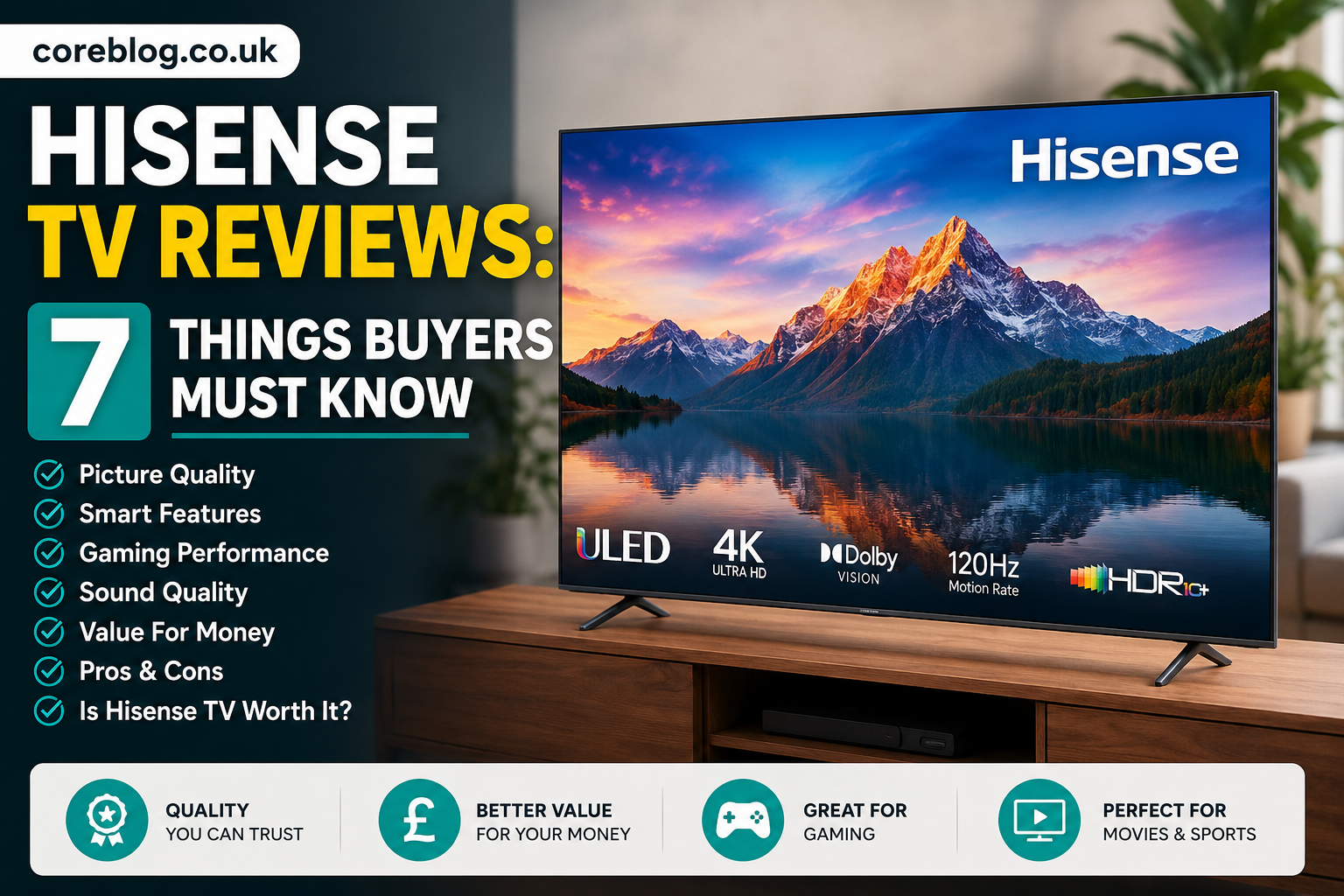
Why Hisense TVs Are Getting So Much Attention
Buying a new TV used to be simple. You walked into a store, picked a screen size, checked if the picture looked bright enough, and hoped it would last for years. Today, it feels a little more complicated. There are Mini-LED TVs, QLED displays, ULED models, Google TV, Fire TV, Dolby Vision, refresh rates, HDMI 2.1 ports, and more picture settings than most people will ever touch.
That is exactly why Hisense TV Reviews have become so popular among buyers. People are not just asking, “Is Hisense cheap?” anymore. They are asking a better question: “Is Hisense actually good enough to compete with bigger names?”
The honest answer is yes, in many cases. Hisense has built a strong reputation for giving shoppers big screens, bright pictures, strong contrast, gaming features, and smart TV functions at prices that often feel lower than expected. However, like any TV brand, it is not perfect. Some models are excellent value, while others are better suited for basic watching. Some Hisense TVs shine in bright living rooms, while others make more sense for bedrooms, casual streaming, or budget buyers.
This guide takes a real-world look at Hisense TV Reviews and breaks down the 7 things buyers must know before spending money. No confusing tech talk. No sales-style hype. Just clear, practical advice you can use before choosing your next TV.
1. Hisense Offers Strong Value for the Price
One of the biggest reasons people search for Hisense TV Reviews is simple: price. Hisense TVs often cost less than many Samsung, Sony, or LG models with similar screen sizes. That alone makes buyers curious.
But value is not only about being cheaper. A TV can be affordable and still disappointing. The good news is that many Hisense models offer features that feel above their price range.
You may find features such as:
- 4K Ultra HD resolution
- Mini-LED backlighting on higher models
- QLED or quantum dot color
- Dolby Vision support
- HDR10 and HDR10+
- Full array local dimming
- Google TV or Fire TV interface
- Voice control
- Game mode
- HDMI 2.1 on selected models
- High refresh rates on premium series
That is a strong package, especially for people who want a large screen without paying premium flagship prices.
Why Value Buyers Like Hisense
Hisense works well for buyers who want more screen for less money. For example, someone shopping for a 65-inch or 75-inch TV may find that Hisense gives them a better size-to-price ratio than many well-known competitors. This matters because screen size has a huge impact on home entertainment.
A 55-inch TV can look fine in a bedroom, but a 65-inch or 75-inch model can completely change the feel of a living room. Hisense understands that many families want a big-screen experience for movies, sports, gaming, and streaming without draining their budget.
The Catch Buyers Should Know
The lower price does not always mean every Hisense TV performs like a premium model. Entry-level Hisense TVs are usually best for casual viewing. Mid-range and upper-range Hisense TVs are where the brand becomes much more impressive.
So, when reading Hisense TV Reviews, do not judge the whole brand by one cheap model. The series matters. The panel type matters. The backlight technology matters. A basic Hisense 4K TV and a Hisense Mini-LED ULED TV can feel like completely different products.
2. Picture Quality Can Be Excellent, Especially on ULED Models
Picture quality is the heart of every TV review. A smart interface is nice. Gaming features are useful. Sound matters too. But if the picture looks dull, none of that saves the TV.
This is where Hisense has improved a lot over the years. Many Hisense TV Reviews praise the brand for bright images, rich colors, and strong contrast, especially in ULED and Mini-LED models.
What Makes Hisense Picture Quality Stand Out?
Higher-end Hisense TVs often use technologies like Mini-LED, quantum dot color, and full array local dimming. These features help improve brightness, black levels, and HDR performance.
In simple terms:
- Mini-LED helps the TV control brightness more precisely.
- QLED or quantum dot color helps create richer colors.
- Local dimming improves dark scenes by controlling light zones.
- HDR support makes bright highlights and shadow details more powerful.
- 4K resolution gives sharper detail for movies, shows, and sports.
When these features work together, the result can be very impressive for the price.
Great for Movies and Streaming
If you watch Netflix, Prime Video, Disney+, YouTube, or live TV, Hisense can deliver a strong experience. Colors often look punchy, especially in animated movies, sports broadcasts, travel videos, and nature documentaries.
Dark scenes also look better on the higher models than many buyers expect. This is important for movies, crime dramas, sci-fi shows, and nighttime scenes. A TV with weak contrast can make dark scenes look grey and flat. A better Hisense ULED model can give those scenes more depth.
Bright Rooms Are a Big Strength
Many homes have TVs in living rooms with windows, lamps, and daylight. In that kind of space, brightness matters. Some TVs look amazing at night but struggle during the day. Several Hisense models are known for strong brightness, which helps the screen stay clear in brighter rooms.
However, direct sunlight is still a challenge for almost any TV. If your TV faces a window, placement matters. Even a bright Hisense TV will look better when you reduce glare with curtains, blinds, or smarter room lighting.
3. Hisense Smart TV Software Is Easy to Use
A modern TV is not just a screen. It is also a streaming device. That is why smart TV software is a major part of Hisense TV Reviews.
Depending on the model and region, Hisense TVs may come with Google TV, Fire TV, Roku TV, or VIDAA. The exact platform depends on where you buy the TV and which series you choose.
Google TV on Hisense
Many Hisense buyers like Google TV because it feels familiar and simple. You can download popular apps, use voice search, and get content suggestions from different streaming platforms.
Google TV is especially useful if you already use Android phones, Google Assistant, YouTube, or Chromecast. It makes casting videos and finding content easier.
Fire TV and Other Platforms
Some Hisense models use Fire TV, which is great for people who already use Amazon Prime Video, Alexa, or other Amazon services. VIDAA is also found on some Hisense TVs and is designed to be lightweight and straightforward.
The important point is this: check the smart TV platform before buying. Two Hisense TVs with similar screen sizes may have different software experiences. This can affect app availability, speed, layout, and voice control.
Is the Interface Fast?
On better models, the smart interface usually feels smooth enough for daily use. On budget models, it may feel slower when opening apps, switching menus, or loading recommendations.
This is not only a Hisense issue. Many budget smart TVs from many brands can feel slower over time. If speed matters a lot to you, consider buying a stronger model or using an external streaming stick or box.
4. Gaming Features Are Surprisingly Strong
Gaming is one area where Hisense has become more competitive. Many buyers now read Hisense TV Reviews because they want to know whether these TVs work well with PlayStation, Xbox, Nintendo Switch, or gaming PCs.
The answer depends on the model, but many mid-range and premium Hisense TVs are very gaming-friendly.
Features Gamers Should Look For
When buying a Hisense TV for gaming, check for:
- Low input lag
- Game mode
- HDMI 2.1 ports
- 120Hz or higher refresh rate
- Variable Refresh Rate
- Auto Low Latency Mode
- 4K gaming support
- Smooth motion handling
- Good HDR brightness
These features help games feel more responsive and smooth. If you play racing games, shooters, sports games, or open-world titles, refresh rate and input lag matter a lot.
Hisense for Console Gaming
For PS5 and Xbox Series X users, a Hisense TV with 4K 120Hz support can be a great match. You get sharp detail, fluid motion, and better response. Some higher models also support even higher refresh rates for PC gaming, which is useful for serious gamers.
Casual Gamers Will Be Happy Too
Even if you only play occasionally, Hisense still makes sense. A budget 4K Hisense TV can be more than enough for Nintendo Switch, older consoles, or casual gaming. You do not always need the most expensive model unless you care about top-level performance.
5. Sound Quality Is Good, But Not Always Cinema-Level
Sound is one of the most overlooked parts of TV shopping. Many buyers focus on screen size and picture quality, then feel surprised when the built-in speakers sound thin.
Hisense TVs usually offer acceptable sound for everyday watching. News, YouTube, sitcoms, and casual shows sound fine. Dialogue is generally clear enough, especially in smaller rooms.
However, if you want a true home theater feel, a soundbar is a smart upgrade.
Why TV Speakers Have Limits
Modern TVs are slim. That looks beautiful on a wall or TV stand, but it leaves limited space for powerful speakers. This is not only a Hisense issue. Most thin TVs struggle to produce deep bass and wide sound.
So, while Hisense sound quality is fine for normal use, movie lovers may want extra audio gear.
When You Should Buy a Soundbar
Consider a soundbar if you:
- Watch lots of movies
- Enjoy action scenes
- Want stronger bass
- Struggle to hear dialogue
- Watch sports with a crowd atmosphere
- Play immersive games
- Have a large living room
A basic soundbar can make a big difference. You do not need to spend a fortune. Even an affordable soundbar can make voices clearer and explosions more powerful.
6. Not Every Hisense TV Is the Same
This may be the most important point in all Hisense TV Reviews: do not treat every Hisense TV as equal.
Hisense sells different series for different buyers. Some are simple budget TVs. Some are strong mid-range performers. Some are premium Mini-LED models designed to compete with bigger brands.
Quick Hisense TV Buying Table
| Buyer Type | Best Hisense Choice | Why It Makes Sense |
|---|---|---|
| Budget buyer | Entry-level 4K Hisense TV | Good for casual streaming and daily TV |
| Movie lover | ULED or Mini-LED model | Better contrast, brightness, and HDR |
| Gamer | 120Hz or higher model with HDMI 2.1 | Smoother gameplay and lower input lag |
| Sports fan | Bright TV with good motion handling | Clearer action and better daytime viewing |
| Big-screen shopper | 65-inch, 75-inch, or 85-inch Hisense | Strong screen size value |
| Bedroom user | Smaller 4K smart TV | Affordable and easy to use |
| Home theater fan | Higher ULED model plus soundbar | Better picture with upgraded sound |
Model Numbers Matter
Before buying, look carefully at the model number. A small difference in letters or numbers can mean a different panel, different brightness level, different refresh rate, or different smart platform.
This is why serious buyers read more than one review. A review for one Hisense model may not apply to another. For example, a Hisense ULED Mini-LED model may perform much better than a basic LED model from the same brand.
Screen Size Can Affect Performance
Sometimes the same TV series may perform slightly differently across screen sizes. A 55-inch model and a 75-inch model may not always use the same panel type or dimming zone count. This is another reason to check the exact size you plan to buy.
7. Hisense Is Best for Practical Buyers, Not Brand Snobs
Some people only want the most famous TV brand. That is fine. Sony, LG, and Samsung make excellent TVs. However, many shoppers are no longer buying based on logo alone. They want performance, features, screen size, and fair pricing.
That is where Hisense fits beautifully.
Who Should Buy a Hisense TV?
A Hisense TV is a strong choice for:
- Families who want a large living room TV
- Buyers who want 4K without overspending
- Sports fans who need a bright screen
- Streamers who use Netflix, YouTube, and Prime Video daily
- Gamers who want modern features at a better price
- Movie lovers who choose a ULED or Mini-LED model
- Budget shoppers who still care about quality
Who Might Skip Hisense?
Hisense may not be the best fit for everyone. You may want to compare other brands if you need:
- The widest possible viewing angles
- The most polished motion processing
- The best built-in sound
- Premium OLED black levels
- A luxury brand name
- Perfect out-of-the-box color accuracy
That does not mean Hisense is bad. It simply means different buyers have different needs. A smart purchase is not about choosing the most expensive TV. It is about choosing the right TV for your room, habits, and budget.
Hisense TV Reviews: Pros and Cons
Here is a simple breakdown for buyers who want a quick answer.
Pros
- Strong value for money
- Bright picture on many models
- Good 4K detail
- Impressive Mini-LED options
- Strong gaming features on selected models
- Big screen sizes at competitive prices
- Good HDR support
- Smart TV platforms are easy to use
- Great for streaming and sports
- Many choices for different budgets
Cons
- Budget models can feel basic
- Sound may need a soundbar
- Viewing angles can vary by model
- Some models handle reflections better than others
- Smart interface speed may differ
- Picture settings may need adjustment
- Model numbers can be confusing
How to Choose the Right Hisense TV
Reading Hisense TV Reviews is helpful, but you should also match the TV to your own space. A TV that is perfect for one person may not be perfect for another.
For a Bright Living Room
Choose a brighter Hisense model, preferably with Mini-LED or strong local dimming. This helps the screen stay clear during the day. Also, avoid placing the TV directly opposite a sunny window.
For Movie Nights
Pick a ULED or Mini-LED Hisense TV with good contrast and HDR support. Dolby Vision is a nice bonus because many streaming movies support it.
For Gaming
Look for HDMI 2.1, 120Hz or higher refresh rate, VRR, ALLM, and low input lag. These features are worth paying for if gaming is a big part of your routine.
For Casual Watching
A simple 4K Hisense smart TV may be enough. If you mostly watch news, dramas, YouTube, and regular streaming, you do not always need the most advanced model.
For Sports
Choose a TV with high brightness, good motion handling, and a larger screen size. Sports look better when the picture is bright, smooth, and easy to see from across the room.
Best Picture Settings Tips for Hisense TVs
Many TVs look too bright, too blue, or too sharp right out of the box. Hisense is no different. A few small setting changes can make the picture look more natural.
Try these simple tips:
- Use Cinema, Theater, or Filmmaker mode for movies.
- Turn down sharpness if edges look fake.
- Use Game Mode when playing games.
- Adjust brightness based on your room lighting.
- Turn off extreme motion smoothing if movies look unnatural.
- Keep HDR settings enabled for supported content.
- Update the TV software after setup.
These settings can vary by model, but the idea is simple. Do not judge the TV only by store mode or default settings. A Hisense TV can look much better after small adjustments.
Common Questions About Hisense TV Reviews
Are Hisense TVs reliable?
Many buyers report good long-term use, especially when they choose the right model and keep software updated. As with any electronics brand, reliability can vary by model, usage, and care. Buying from a trusted seller with a proper warranty is always smart.
Is Hisense better than TCL?
Hisense and TCL compete closely in the value TV market. Hisense often stands out for brightness and ULED models, while TCL also offers strong Mini-LED and QLED options. The better choice depends on the exact model, not just the brand name.
Is Hisense good for Netflix?
Yes, Hisense TVs are generally good for Netflix and other streaming apps. Higher models with Dolby Vision and strong HDR make movies and shows look more impressive.
Is Hisense good for PS5?
Selected Hisense models are very good for PS5, especially those with HDMI 2.1, 4K 120Hz, VRR, and low input lag. Always check the exact model before buying.
Do Hisense TVs need a soundbar?
Not always, but a soundbar is recommended if you want richer sound, deeper bass, or a more cinematic experience.
Final Verdict: Should You Buy a Hisense TV?
After looking through Hisense TV Reviews from a practical buyer’s point of view, the answer is clear: Hisense is a smart choice for many people, especially if you want strong features without paying luxury prices.
The brand is especially appealing if you care about big screens, bright pictures, modern gaming support, smart TV apps, and good overall value. Higher-end Hisense ULED and Mini-LED TVs can feel surprisingly premium, while budget models work well for casual users who just want a simple 4K smart TV.
However, the key is choosing carefully. Do not buy only because the box says Hisense and the price looks low. Check the series, screen size, refresh rate, panel type, HDR support, smart platform, and gaming features. Read Hisense TV Reviews for the exact model you want, not just the brand in general.
If you want a TV that gives you a lot for your money, Hisense deserves a serious look. It may not always beat every premium TV from Sony, Samsung, or LG, but it often delivers more than buyers expect at its price.
In the end, a good TV is the one that fits your room, your viewing habits, and your budget. Hisense does that very well for a wide range of buyers. If you found this guide helpful, share it with someone who is shopping for a new TV, and feel free to comment with the Hisense model you are considering.







Leave a Reply