

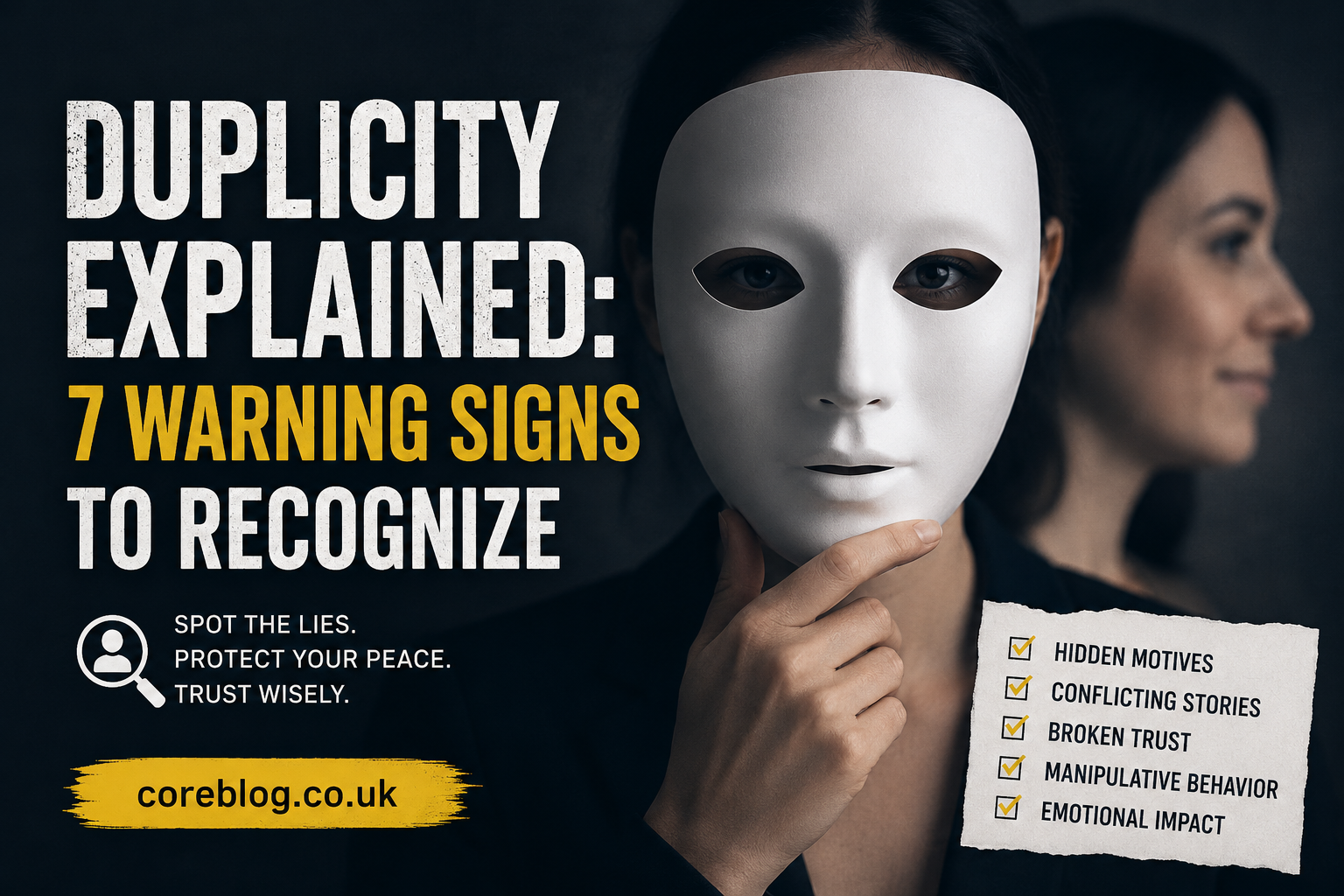
Duplicity Explained: 7 Warning Signs to Recognize
Have you ever spoken to someone whose words sounded sincere, yet something about their behavior felt wrong? Perhaps they promised to support you but quietly worked against you. Maybe they told different versions of the same story depending on who was listening.
That uncomfortable gap between words and actions may be a sign of duplicity.
Duplicity is not always dramatic. It does not always involve a major betrayal, an obvious lie, or a carefully planned scheme. In many cases, it appears through small contradictions, half-truths, hidden motives, and repeated changes in behavior.
Understanding it can help you protect your relationships, reputation, confidence, and peace of mind.
In this guide, Duplicity Explained means looking beyond a simple dictionary definition. We will explore what double-dealing behavior looks like, why people use it, and how you can respond without becoming suspicious of everyone around you.
What Does Duplicity Mean?
Duplicity refers to deliberate dishonesty or double-dealing. A duplicitous person may present one face to you while showing a very different face to someone else.
They may pretend to be loyal while acting against your interests. They might offer praise in public but criticize you privately. They may also hide important facts while technically avoiding a direct lie.
In simple terms, duplicity involves two conflicting intentions.
One intention is shown openly. The other remains hidden.
That is what makes this behavior difficult to recognize. A person using deception may appear friendly, helpful, trustworthy, or concerned. Their real motives often become clear only after a pattern develops.
When discussing Duplicity Explained, it is important to separate intentional deception from ordinary human inconsistency. Everyone changes their mind. Everyone forgets details. People sometimes communicate badly or act differently under pressure.
Duplicity, however, usually involves awareness and purpose. The person knows they are creating a false impression.
Duplicity Is More Than Telling a Lie
A lie is a false statement. Duplicity is often broader.
It can include:
- Hiding key information
- Giving different stories to different people
- Making promises without intending to keep them
- Pretending to support someone
- Using charm to hide selfish motives
- Shifting blame to avoid accountability
- Manipulating emotions for personal gain
- Acting loyal while secretly creating harm
A single lie does not always prove duplicity. However, repeated dishonesty combined with hidden intentions should not be ignored.
Why Recognizing Duplicity Matters
Trust is the foundation of healthy relationships. This applies to friendships, families, romantic partnerships, workplaces, and business arrangements.
When someone acts with integrity, their words, values, and actions usually match. You may not agree with every decision they make, but their behavior remains understandable and consistent.
Duplicity damages that sense of safety.
It can leave you questioning your judgment. You may wonder whether you misunderstood the situation or overreacted. In some cases, the deceptive person may encourage that doubt through denial, blame shifting, or gaslighting.
Recognizing the pattern early allows you to make informed decisions. It does not mean you must immediately end the relationship. It simply means you stop ignoring evidence that deserves attention.
The purpose of Duplicity Explained is not to create fear. It is to help you notice unhealthy behavior while remaining fair, calm, and grounded.
A Quick Overview of the Seven Warning Signs
| Warning Sign | What It May Look Like |
|---|---|
| Words and actions do not match | Promises are made repeatedly but rarely kept |
| Stories change often | Important details shift depending on the audience |
| Excessive secrecy | Normal questions are met with defensiveness |
| Different personalities | The person changes values to impress others |
| Blame shifting | Responsibility is placed on everyone else |
| Strategic charm | Kindness appears only when something is wanted |
| Your instincts stay unsettled | Repeated patterns create ongoing doubt |
One warning sign alone may have an innocent explanation. Several signs appearing together, however, can reveal a serious pattern.
1. Their Words and Actions Rarely Match
The clearest warning sign of duplicity is a repeated gap between what someone says and what they actually do.
They may say they value honesty, yet regularly hide information. They may promise loyalty but share your private details with others. They might claim they respect your time while constantly breaking commitments without explanation.
Actions reveal priorities more clearly than polished words.
Look for Repeated Contradictions
Anyone can fail to keep a promise once. Life becomes busy. Plans change. Emergencies happen.
The concern begins when inconsistency becomes normal.
For example, a colleague may repeatedly tell you that your project is going well while privately blaming you for delays. A friend may insist they support your success but react with jealousy whenever something good happens.
In Duplicity Explained, patterns matter more than isolated incidents.
Ask yourself:
- Does this person regularly make promises they do not keep?
- Do their private actions conflict with their public image?
- Do they offer apologies without changing their behavior?
- Do they expect trust without showing reliability?
An honest person may make mistakes, but they usually accept responsibility and try to repair the damage. A duplicitous person often focuses on protecting their image instead.
2. Their Stories Change Depending on the Audience
People naturally adjust how they speak in different settings. You may explain a work problem differently to your manager than you would to a close friend.
That is normal communication.
Duplicity appears when the facts themselves keep changing.
A deceptive person may tell one version of an event to you and another version to someone else. They may remove important details, exaggerate their role, or rewrite the story to gain sympathy.
Small Details May Reveal a Bigger Pattern
Pay attention when explanations become confusing.
You might notice:
- Dates or timelines keep shifting
- The person denies making statements you clearly remember
- Their role in a conflict changes from one story to another
- They present themselves as the victim in every version
- They become angry when asked for clarification
People sometimes forget minor details. However, constant contradictions can signal dishonesty, image management, or a hidden agenda.
Before making an accusation, consider the context. Ask simple questions and listen carefully. Honest explanations usually become clearer. Deceptive explanations often become more complicated.
3. They Use Secrecy as a Tool
Privacy is healthy. Everyone has the right to personal space, private conversations, and individual boundaries.
Secrecy is different.
Secrecy becomes a warning sign when it is used to control information, hide misconduct, or prevent others from comparing facts.
Someone showing duplicity may keep people separated. They may tell you not to discuss a conversation with anyone else. They might claim that others cannot be trusted while asking you to trust them without question.
Watch for Defensive Reactions
A person with something to hide may react strongly to reasonable questions.
They could:
- Change the subject
- Attack your character
- Accuse you of being controlling
- Give vague or incomplete answers
- Pretend not to understand the question
- Create a new argument to distract you
This does not mean every private person is deceptive. Some people are naturally reserved. Others may have experienced betrayal and need time to feel safe.
The difference is that healthy privacy respects boundaries. Manipulative secrecy creates confusion and gives one person unfair control.
4. They Become a Different Person Around Different People
Most people adjust their tone based on the setting. A relaxed conversation with friends will sound different from a formal business meeting.
The warning sign is not flexibility. It is a complete change in values, opinions, or loyalty.
A duplicitous person may agree with everyone in the room, even when those views conflict. They may criticize someone privately and then act like that person’s closest friend in public.
When Duplicity Explained is applied to social behavior, this shape-shifting quality deserves attention.
Notice How They Speak About Absent People
One useful clue is how someone discusses people who are not present.
If they constantly reveal secrets, mock friends, or criticize colleagues behind their backs, they may eventually treat you the same way.
A trustworthy person can express frustration without becoming cruel or disloyal. They do not build closeness by tearing someone else down.
Ask yourself whether the person has stable principles. Do they stand by their values when it is inconvenient? Or do their opinions change based on who has the most influence?
Consistency does not require perfection. It requires a basic connection between stated beliefs and actual conduct.
5. They Shift Blame and Avoid Accountability
Accountability is uncomfortable, but emotionally mature people can admit when they are wrong.
A person using duplicity often avoids that discomfort at any cost.
They may blame circumstances, coworkers, family members, former partners, or even you. When presented with evidence, they might focus on your tone rather than their behavior.
Common Blame-Shifting Statements
You may hear phrases such as:
- “You made me do it.”
- “I only lied because you would have overreacted.”
- “Everyone else does the same thing.”
- “You are too sensitive.”
- “That is not what happened.”
- “You misunderstood me.”
- “Why are you attacking me?”
Some of these statements may be valid in certain situations. Context always matters.
However, when every discussion ends with you apologizing for questioning their conduct, manipulation may be taking place.
A sincere apology normally includes recognition, responsibility, regret, and changed behavior. Without those elements, the apology may simply be another way to end the conversation.
6. Their Charm Appears When They Need Something
Charm is not a negative quality. Warm, friendly, persuasive people can bring energy to any room.
The concern begins when kindness feels calculated.
A duplicitous person may become unusually attentive before asking for a favor. They may offer praise when they need your agreement and withdraw affection when you refuse.
This pattern is sometimes called strategic charm.
Pay Attention to Conditional Kindness
Healthy kindness does not disappear the moment you set a boundary.
Consider how the person responds when you say no.
Do they remain respectful? Or do they become cold, angry, insulting, or distant?
A person with hidden motives may treat relationships like transactions. They invest attention when they expect a reward. Once they get what they want, their interest fades.
In the context of Duplicity Explained, charm should be judged alongside consistency. Genuine warmth remains fairly steady. Manipulative charm often follows a cycle of praise, pressure, reward, and withdrawal.
7. Your Instincts Keep Warning You
Intuition is not magical. It is often your brain noticing patterns before you can clearly explain them.
Perhaps the person’s tone changes when a certain subject appears. Maybe their stories contain small gaps. You might notice that you feel tense, confused, or emotionally drained after every conversation.
One uneasy feeling does not prove deception. Anxiety, past experiences, and misunderstanding can also affect perception.
However, repeated discomfort deserves investigation.
Trust Your Feelings, Then Check the Facts
The safest approach combines intuition with evidence.
Do not ignore your instincts, but do not treat them as a final verdict either.
Instead:
- Write down specific incidents.
- Separate facts from assumptions.
- Look for repeated patterns.
- Ask calm, direct questions.
- Notice whether the explanation remains consistent.
- Speak with a trusted, neutral person.
- Decide which boundaries would protect your wellbeing.
This balanced approach helps you avoid two extremes: blind trust and constant suspicion.
Duplicity vs. Simple Miscommunication
Not every contradiction is proof of bad character.
Sometimes people communicate poorly. They may forget what they said, feel embarrassed, or struggle to explain themselves. Stress can also lead to inconsistent behavior.
The following comparison can help.
Signs of Miscommunication
- The person welcomes clarification
- They admit confusion or error
- Their explanation becomes clearer
- They show concern for your feelings
- They make a reasonable effort to improve
Signs of Duplicity
- The contradictions continue
- Questions lead to anger or personal attacks
- Evidence is denied without explanation
- Responsibility is always redirected
- The person benefits from your confusion
- Their behavior changes only when consequences appear
The key difference is usually intent combined with repetition.
That is why a fair discussion of Duplicity Explained must include context. Labeling someone too quickly can damage a relationship. Ignoring a clear pattern can harm you as well.
Why Do People Behave With Duplicity?
There is no single cause.
Some people use deception to avoid conflict. Others fear rejection, punishment, or embarrassment. They may believe honesty will cost them approval.
In other cases, the motive is more calculated. A person may want money, influence, attention, control, status, or access to information.
Common reasons include:
- Fear of consequences
- Insecurity
- Desire for social approval
- Personal ambition
- Jealousy
- Shame
- Conflict avoidance
- Need for control
- Lack of empathy
- Habitual dishonesty
- Protection of reputation
- Financial or professional gain
Understanding the motive may explain the behavior, but it does not excuse it.
Someone can have a painful past and still be responsible for how they treat others. Compassion and boundaries can exist at the same time.
How Duplicity Affects Relationships
Duplicity weakens emotional security.
When you cannot rely on someone’s words, every interaction becomes harder. You may start checking messages, questioning memories, or looking for hidden meanings.
Over time, this can lead to anxiety, resentment, low confidence, and emotional exhaustion.
In Romantic Relationships
Deception may appear through secret communication, false promises, emotional manipulation, financial secrecy, or conflicting stories.
Trust can sometimes be rebuilt, but only when the dishonest behavior stops and genuine accountability begins.
In Friendships
A two-faced friend may share private information, compete in unhealthy ways, spread rumors, or act supportive while quietly undermining you.
Friendship requires mutual respect. Without it, closeness becomes unsafe.
In the Workplace
Workplace duplicity may involve taking credit, withholding information, making false claims, shifting blame, or agreeing with different sides of a conflict.
Documentation is especially useful in professional settings. Keep important decisions, deadlines, and responsibilities in writing.
Within Families
Family relationships can contain long histories, emotional pressure, and unspoken expectations. Duplicity may appear through guilt, favoritism, secret alliances, or selective storytelling.
Clear boundaries can help reduce confusion even when you cannot change the other person.
How to Respond to Duplicitous Behavior
Once you notice a pattern, your next step should be thoughtful rather than impulsive.
Stay Calm and Gather Information
Strong emotions are understandable, especially when betrayal is involved. Still, reacting immediately may give the other person an opportunity to distract from the issue.
Write down what happened. Save relevant messages. Record dates and details where appropriate.
The goal is not to build a case against everyone. It is to protect yourself from confusion and memory disputes.
Ask Direct Questions
Use clear and neutral language.
For example:
- “You told me something different yesterday. Can you explain?”
- “I noticed that the details have changed. Which version is accurate?”
- “Why did you ask me not to discuss this with anyone?”
- “What responsibility do you accept in this situation?”
A direct question gives the person a fair opportunity to respond.
Set Practical Boundaries
Boundaries are not punishments. They are decisions about what you will accept and how you will protect yourself.
You may decide to:
- Share less personal information
- Confirm agreements in writing
- Refuse to participate in gossip
- Limit contact
- Avoid lending money
- Include another person in important meetings
- End a relationship that remains harmful
Your boundary should match the level of risk.
Watch for Change, Not Promises
A person may respond with tears, anger, charm, gifts, or dramatic promises.
Those reactions are not the same as change.
Real improvement appears through honesty, consistent behavior, respect for boundaries, and accountability over time.
This is one of the most important lessons in Duplicity Explained: trust should be rebuilt through evidence, not pressure.
How to Avoid Becoming Overly Suspicious
Learning about deception can make ordinary behavior seem threatening. That is why balance matters.
Do not analyze every pause, forgotten detail, or changed plan as proof of dishonesty.
Instead, focus on clear patterns.
Try to:
- Consider innocent explanations
- Ask questions before reaching conclusions
- Avoid relying only on body language
- Check your own assumptions
- Seek outside perspective
- Judge repeated conduct rather than one mistake
- Respect privacy while protecting your boundaries
Body language alone is not reliable proof. Someone may avoid eye contact because they are shy, anxious, tired, or uncomfortable.
Facts, consistency, context, and behavior over time provide a stronger foundation.
Can Trust Be Rebuilt After Duplicity?
Sometimes it can.
Rebuilding trust requires more than an apology. The person must acknowledge what happened without minimizing it. They must answer reasonable questions, accept consequences, and behave differently.
The process may take time.
Trust is more likely to return when the person:
- Tells the full truth
- Stops blaming others
- Shows sincere regret
- Respects new boundaries
- Becomes more transparent
- Accepts that forgiveness cannot be rushed
- Maintains consistent behavior
However, reconciliation is not always the healthiest choice. You are not required to restore access to someone who repeatedly harms you.
Forgiveness, distance, and trust are separate decisions.
Final Thoughts on Duplicity Explained
Duplicity can be difficult to recognize because it often hides behind charm, excuses, friendly words, and carefully managed appearances.
Yet patterns eventually speak.
When words and actions repeatedly clash, stories keep changing, secrecy creates confusion, blame replaces responsibility, and kindness becomes conditional, it is reasonable to pay closer attention.
The goal of Duplicity Explained is not to make you distrust everyone. It is to help you trust wisely.
Stay curious. Ask direct questions. Look for evidence. Give people a fair chance to explain themselves, but do not abandon your judgment simply to keep the peace.
Healthy relationships do not require constant investigation. They grow through honesty, respect, transparency, accountability, and consistent care.
Have you ever noticed one of these warning signs in a friendship, relationship, family situation, or workplace? Share your experience in the comments, and pass this article along to someone who may need help recognizing the difference between an honest mistake and a harmful pattern of deception.














Leave a Reply