

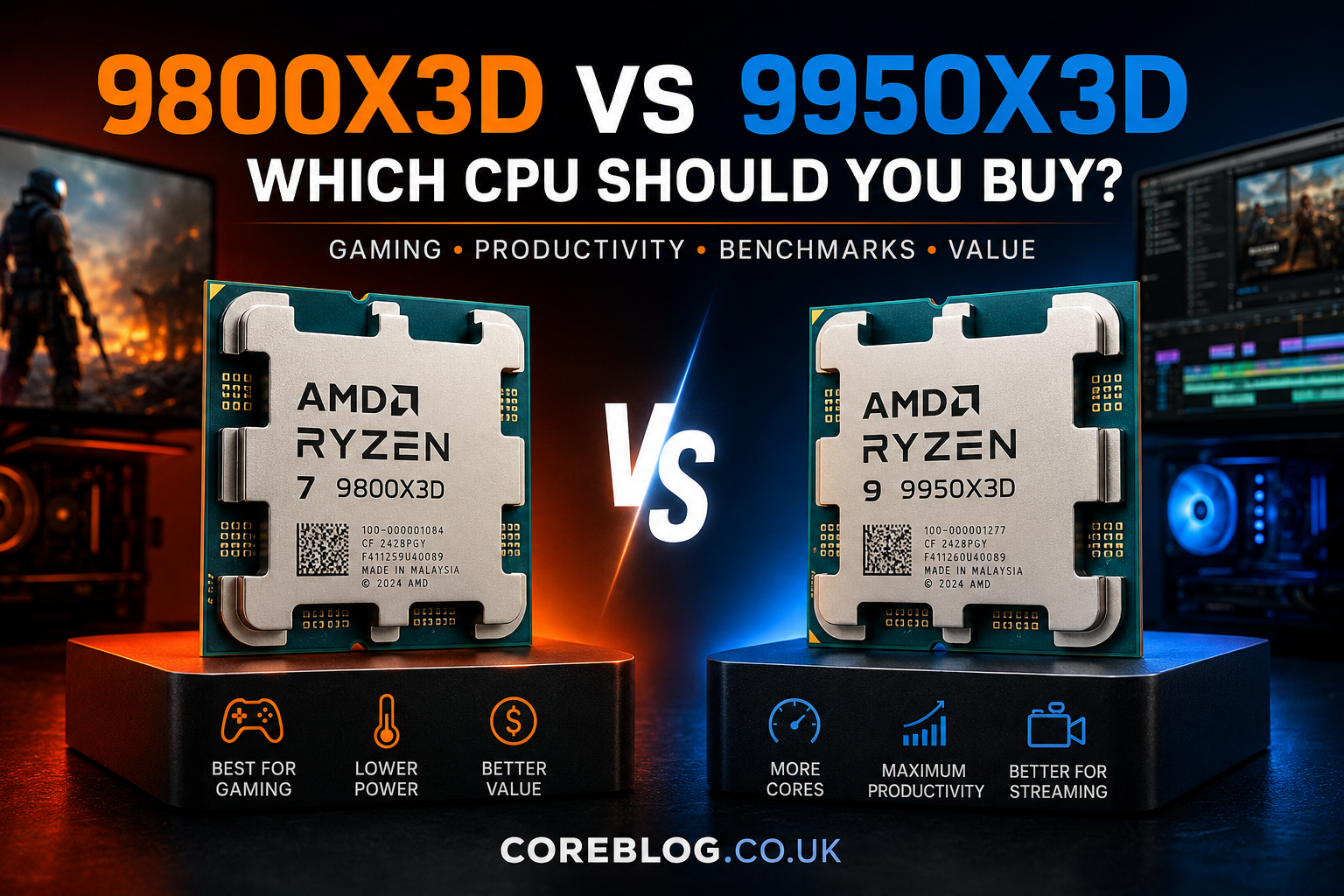
9800X3D vs 9950X3D: Which CPU Should You Buy?
Choosing a new processor has never been more confusing. Every year, manufacturers release faster chips with better efficiency, higher clock speeds, and improved gaming technology. Yet sometimes, the biggest question isn’t whether a processor is good—it’s whether it’s the right one for you.
That is exactly the case with the 9800X3D vs 9950X3D comparison.
Both processors belong to AMD’s impressive Ryzen lineup and feature the company’s revolutionary 3D V-Cache technology. On paper, they look incredibly powerful. However, they target different users. One focuses almost entirely on gaming excellence, while the other aims to deliver top-tier gaming alongside workstation-level productivity.
If you’re building a new PC, upgrading your gaming rig, or trying to decide where your money is best spent, this detailed guide will help you make the right decision. We’ll compare gaming performance, productivity, thermals, power consumption, specifications, value for money, and much more.
By the end, you’ll know exactly which CPU deserves a place inside your next computer.
Quick Comparison Table
| Feature | Ryzen 7 9800X3D | Ryzen 9 9950X3D |
|---|---|---|
| Architecture | Zen 5 | Zen 5 |
| Cores | 8 | 16 |
| Threads | 16 | 32 |
| 3D V-Cache | Yes | Yes |
| Gaming Performance | Outstanding | Outstanding |
| Productivity | Excellent | Exceptional |
| Content Creation | Very Good | Elite |
| Streaming | Excellent | Excellent |
| Power Draw | Lower | Higher |
| Price | More affordable | Premium |
Understanding AMD’s X3D Technology
Before diving deeper into the 9800X3D vs 9950X3D debate, it’s important to understand why AMD’s X3D processors have become so popular.
AMD’s 3D V-Cache stacks additional cache memory directly on top of the processor die. This allows games to access frequently used data much faster than traditional CPUs.
The benefits include:
- Higher gaming FPS
- Better frame consistency
- Reduced CPU bottlenecks
- Improved performance in cache-sensitive games
- Excellent efficiency
Unlike ordinary processors that rely mainly on clock speed, X3D chips gain a significant advantage through smarter memory access.
Ryzen 7 9800X3D Overview
The Ryzen 7 9800X3D is built for gamers first.
With eight Zen 5 cores and sixteen threads, it delivers remarkable gaming performance without unnecessary complexity.
Many modern games still don’t fully utilize more than eight cores, making the 9800X3D incredibly efficient for gaming-focused builds.
Its biggest strengths include:
- Excellent gaming FPS
- Lower temperatures
- Better energy efficiency
- Easier cooling
- Strong value
For someone whose primary goal is gaming, this processor checks nearly every box.
Ryzen 9 9950X3D Overview
The Ryzen 9 9950X3D represents AMD’s flagship desktop processor.
Instead of stopping at gaming excellence, AMD added sixteen cores and thirty-two threads, creating a processor capable of handling virtually every workload imaginable.
This CPU excels at:
- Video editing
- 3D rendering
- Software development
- Professional streaming
- AI workloads
- Virtual machines
- Heavy multitasking
The 9800X3D vs 9950X3D comparison becomes interesting because the gaming gap between them is surprisingly small, while the productivity difference is enormous.
Gaming Performance Comparison
Gaming is where most buyers begin their research.
Fortunately, both processors deliver incredible frame rates.
Competitive Esports
Games like:
- Counter-Strike 2
- Valorant
- Rainbow Six Siege
- Fortnite
- Apex Legends
primarily reward strong single-core performance and large cache sizes.
Both CPUs perform exceptionally well, often producing frame rates that exceed what even high-refresh-rate monitors can display.
The Ryzen 7 9800X3D frequently performs nearly identically to its larger sibling.
AAA Games
Modern blockbuster titles include:
- Cyberpunk 2077
- Hogwarts Legacy
- Starfield
- Alan Wake 2
- Black Myth: Wukong
- Assassin’s Creed Shadows
These games benefit from additional CPU cache but rarely require sixteen cores.
In most gaming benchmarks, the FPS difference between the two processors remains very small.
That’s one reason why the 9800X3D vs 9950X3D discussion often ends with gamers choosing the less expensive chip.
Productivity Performance
This is where everything changes.
Applications like Adobe Premiere Pro, Blender, DaVinci Resolve, Autodesk Maya, Cinema 4D, Visual Studio, Unreal Engine, and large code compilation projects thrive on additional CPU cores.
Here, the Ryzen 9 9950X3D dominates.
It offers:
- Faster rendering
- Shorter export times
- Better multitasking
- Improved encoding
- Superior compilation performance
- Faster simulations
If your PC earns money through professional work, the additional investment often pays for itself.
Streaming While Gaming
Modern streamers rarely just play games.
Many simultaneously:
- Stream
- Record
- Chat
- Edit clips
- Use Discord
- Monitor analytics
- Run browser tabs
The Ryzen 9 9950X3D has enough cores to comfortably handle every one of these tasks simultaneously.
The Ryzen 7 9800X3D also streams exceptionally well, but under heavier multitasking loads, the Ryzen 9 offers noticeably more breathing room.
Single-Core Performance
Single-core performance remains critical.
Many games and everyday applications still rely heavily on one or two fast cores.
Both CPUs use AMD’s latest Zen 5 architecture, delivering excellent IPC improvements and impressive boost frequencies.
As a result, both processors feel incredibly responsive during:
- Windows usage
- Gaming
- Web browsing
- Office work
- Programming
- Everyday multitasking
Multi-Core Performance
The biggest difference in the 9800X3D vs 9950X3D battle comes down to core count.
| Workload | Winner |
|---|---|
| Gaming | Slight edge to 9800X3D value |
| Video editing | 9950X3D |
| Blender rendering | 9950X3D |
| Software compiling | 9950X3D |
| Virtual machines | 9950X3D |
| AI workloads | 9950X3D |
| Productivity | 9950X3D |
Sixteen cores simply provide far more processing power for demanding applications.
Power Consumption
Efficiency matters.
Lower power draw means:
- Reduced electricity costs
- Less heat
- Quieter fans
- Smaller power supply requirements
The Ryzen 7 9800X3D generally consumes less power during gaming.
Meanwhile, the Ryzen 9 9950X3D naturally requires more energy, especially when every core is active during rendering or content creation.
Cooling Requirements
Another practical consideration is cooling.
The Ryzen 7 9800X3D is easier to cool.
A quality air cooler or mid-range AIO liquid cooler is often sufficient.
The Ryzen 9 9950X3D performs best with:
- 280mm AIO
- 360mm liquid cooler
- Premium tower cooler
Heavy workloads generate significantly more heat due to the additional cores.
Gaming Benchmarks
Although exact numbers vary depending on the graphics card and game, benchmark trends remain remarkably consistent.
At 1080p:
- Both CPUs produce outstanding FPS.
- Differences are often within a few percentage points.
- GPU choice usually matters more.
At 1440p:
Performance becomes even closer.
At 4K:
The graphics card becomes the primary limitation, making CPU differences almost impossible to notice.
Best GPU Pairings
Both processors pair beautifully with modern graphics cards.
Recommended combinations include:
- RTX 5070
- RTX 5080
- RTX 5090
- Radeon RX 9070 XT
- Radeon RX 9080 XT
High-end GPUs allow these processors to demonstrate their full gaming potential.
Motherboard Compatibility
Both CPUs use the AM5 platform.
Popular motherboard choices include:
- B650
- B650E
- X670
- X670E
- X870
- X870E
The long-term support of the AM5 socket also makes future upgrades easier.
DDR5 Memory Recommendations
Memory can noticeably influence gaming performance.
For the best experience, consider:
- DDR5-6000
- Low latency memory
- Dual-channel configuration
- EXPO profiles
These settings typically offer an ideal balance between speed and stability.
PCIe Support
Both processors support modern PCIe technology.
Benefits include:
- Faster NVMe SSDs
- High-speed graphics cards
- Future expansion
- Improved storage bandwidth
This ensures your build remains relevant for years.
Price Comparison
Price often determines the winner.
The Ryzen 7 9800X3D usually costs significantly less.
The Ryzen 9 9950X3D commands a premium because of its additional cores and professional capabilities.
If gaming is your only priority, spending the difference on a faster graphics card often produces better overall performance.
Value for Money
Value depends entirely on your workload.
Choose the Ryzen 7 9800X3D if you:
- Mostly play games
- Want maximum FPS
- Prefer lower temperatures
- Want better efficiency
- Have a limited budget
Choose the Ryzen 9 9950X3D if you:
- Edit videos regularly
- Create 3D content
- Compile software
- Stream professionally
- Use demanding creative applications
- Need workstation performance
Everyday Experience
Beyond benchmarks, both CPUs provide an outstanding user experience.
Applications launch instantly.
Windows feels incredibly responsive.
Multitasking is effortless.
Fast NVMe storage, quality DDR5 RAM, and a powerful GPU complete the package, ensuring a smooth computing experience.
Future-Proofing
Many buyers want hardware that lasts several years.
Fortunately, both processors are excellent long-term investments.
The 9800X3D offers exceptional gaming longevity thanks to its advanced cache technology.
Meanwhile, the 9950X3D provides extra headroom for future software that increasingly benefits from higher core counts.
Either choice should remain highly capable for years of gaming, content creation, and everyday computing.
Pros and Cons
Ryzen 7 9800X3D
Pros
- Outstanding gaming performance
- Excellent power efficiency
- Easier cooling
- Lower price
- Fantastic value
Cons
- Fewer cores for heavy workloads
- Not ideal for professional rendering
Ryzen 9 9950X3D
Pros
- Incredible productivity
- Elite multitasking
- Top-tier gaming
- Excellent streaming performance
- Professional-grade capabilities
Cons
- Higher price
- Greater power consumption
- Requires stronger cooling
Frequently Asked Questions
Is the 9950X3D faster than the 9800X3D for gaming?
In most games, performance differences are very small. The extra cores mainly benefit productivity rather than gaming.
Which CPU is better for video editing?
The Ryzen 9 9950X3D is clearly the stronger option thanks to its sixteen cores and thirty-two threads.
Is the 9800X3D enough for streaming?
Absolutely. It handles gaming and streaming very well, especially when paired with a modern GPU.
Which CPU offers better value?
For gamers, the 9800X3D generally offers the best value. For professionals and creators, the 9950X3D justifies its higher price with significantly better multi-core performance.
Should I upgrade from an older Ryzen processor?
If you’re coming from an older Zen 3 or early Zen 4 processor, either chip provides substantial improvements in gaming performance, efficiency, and overall responsiveness.
Final Verdict: 9800X3D vs 9950X3D
After comparing every major category, the answer becomes surprisingly straightforward.
The 9800X3D vs 9950X3D decision depends less on benchmark charts and more on how you actually use your PC.
If gaming is your primary passion, the Ryzen 7 9800X3D is arguably the smarter purchase. It delivers exceptional gaming performance, excellent efficiency, lower temperatures, and outstanding value, leaving more room in your budget for a faster graphics card or additional storage.
On the other hand, if your computer is also a workstation for video editing, 3D rendering, software development, AI tasks, professional streaming, or heavy multitasking, the Ryzen 9 9950X3D stands out as the better long-term investment. Its extra cores dramatically improve productivity while still offering elite gaming performance.
Ultimately, neither processor is a bad choice. Both represent some of the finest desktop CPUs available today, and either one can power a high-end gaming or creative PC for years to come.
Which processor would you choose in the 9800X3D vs 9950X3D debate? Share your thoughts, build plans, or upgrade experience in the comments, and don’t forget to share this guide with anyone planning their next PC build.















Leave a Reply