

Introduction
Managing a fleet involves far more than knowing where vehicles are. Fleet managers also need to monitor driver behavior, control fuel costs, schedule maintenance, improve productivity, protect valuable equipment and keep up with compliance requirements. As fleets become more connected and data-driven, fleet management software can bring these responsibilities together in one place.
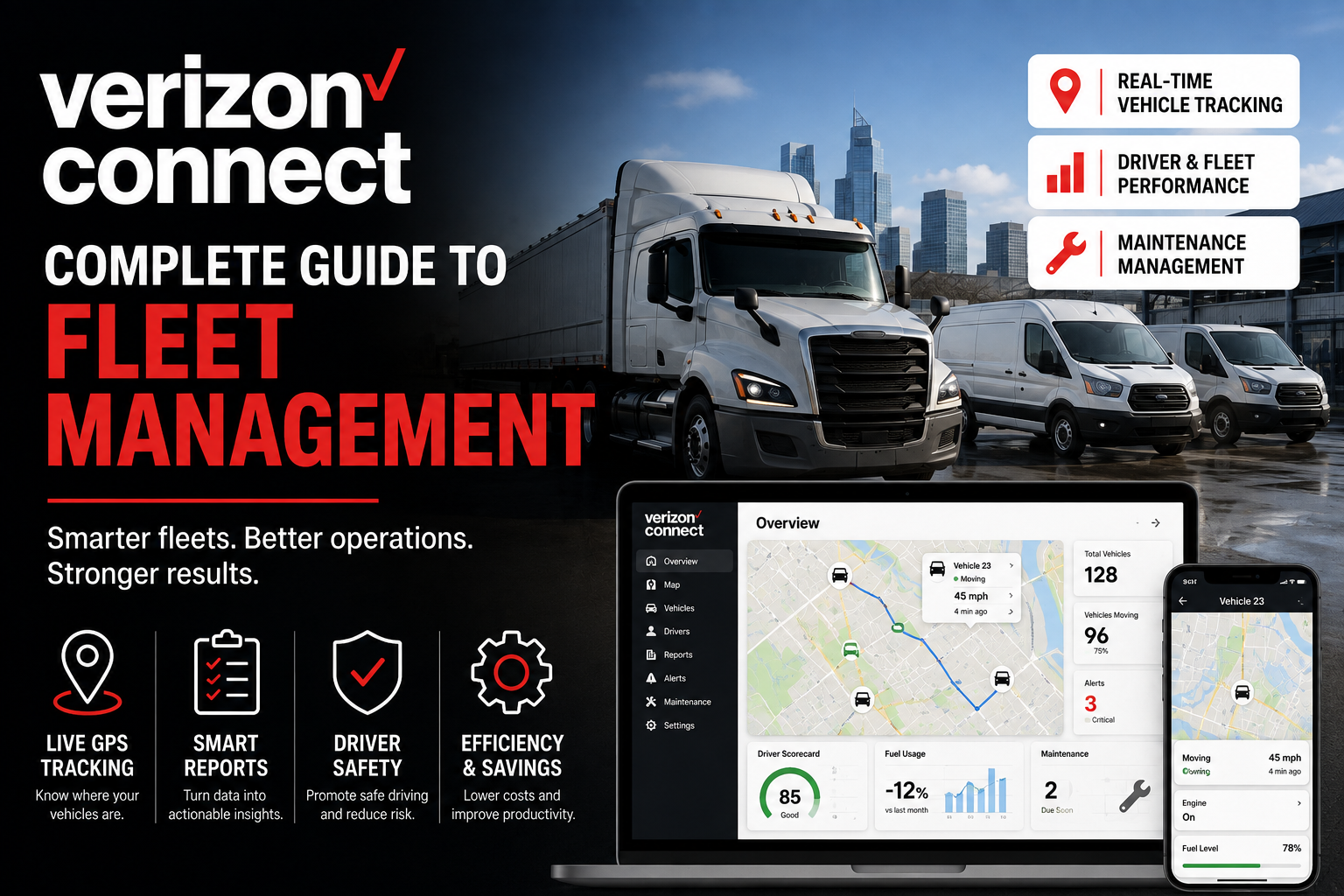
Verizon Connect is a fleet management technology platform designed to help businesses monitor vehicles and assets, improve operational visibility and make better decisions using telematics data. Its solutions include GPS fleet tracking, asset tracking, fleet maintenance tools, compliance capabilities, dashboards and reports, electric vehicle management, and video-based safety solutions.
For a business considering fleet tracking software, understanding what Verizon Connect does is more useful than simply looking at a list of features. The real question is how those features can fit into daily operations and whether the platform makes sense for a particular fleet.
This guide explains how Verizon Connect works, what it offers, its main benefits, potential considerations, and the types of businesses that may benefit from using it.
Key Takeaways
- Verizon Connect provides fleet management and telematics solutions for monitoring vehicles, drivers and assets.
- Its capabilities include GPS tracking, alerts, reporting, maintenance, compliance, asset tracking and fleet safety tools.
- Businesses can use near real-time vehicle data to improve visibility, productivity, customer service and operational decision-making.
- The platform can support different fleet types, including small businesses, mid-market organizations, enterprises and government fleets.
- Additional capabilities can include EV tracking, dashcams, driver safety analytics and integrations with other business systems.
- The best solution depends on fleet size, operational needs, regulatory requirements, vehicle types and the level of visibility a business needs.
What Is Verizon Connect?
Verizon Connect is a fleet management and telematics provider that helps organizations manage vehicles, drivers and mobile assets.
At its core, the platform collects information from connected vehicles and tracking devices and presents that information through software. Fleet managers can then use location data, vehicle information, alerts, reports and other operational insights to understand what is happening across their fleet.
Verizon Connect offers customizable GPS tracking solutions that can provide near real-time visibility into vehicle location, driver behavior and other fleet information. Its broader portfolio also includes asset tracking, compliance tools, electric vehicle management and integrated video solutions.
The purpose is not simply to put a GPS tracker on every vehicle. The larger goal is to turn fleet data into information that managers can use for operational decisions.
For example, a fleet manager might use location information to determine which technician is closest to a new service call. Another manager could review excessive idling data to identify opportunities to reduce fuel consumption. Maintenance teams may use vehicle diagnostics and mileage information to plan service before a problem becomes a major source of downtime.
How Verizon Connect Fleet Management Works
A modern fleet management system generally combines hardware, connectivity and software.
A vehicle or asset can be equipped with an appropriate tracking device. The device collects relevant information and transmits it to the fleet management platform. Managers can then access the information through dashboards, maps, reports and alerts.
With Verizon Connect, the available data can include information such as:
- Vehicle location
- Vehicle movement
- Ignition status
- Driver activity
- Speeding events
- Idling
- Harsh driving events
- Vehicle diagnostics
- Mileage
- Fuel-related information
- Maintenance information
- Asset utilization
- Geofence activity
The exact information available depends on the solution, hardware, vehicle and configuration.
Verizon Connect describes its GPS tracking as near real-time rather than simply static location reporting. Its official information states that some GPS devices can update vehicle locations as often as every 30 seconds.
That distinction matters for businesses where conditions can change quickly. A dispatcher managing field technicians, for example, may need current vehicle information rather than yesterday’s route history.
Key Verizon Connect Features
GPS Fleet Tracking
GPS fleet tracking is one of the central capabilities of Verizon Connect.
Managers can use fleet maps to view vehicle locations and operational information from a single interface. Historical information can also help businesses review previous journeys and understand patterns in fleet activity.
This visibility can support several everyday tasks:
- Locating vehicles
- Monitoring field operations
- Reviewing historical routes
- Responding to customer inquiries
- Supporting dispatch decisions
- Identifying unnecessary stops
- Monitoring vehicle utilization
For field-service companies, location information can be especially valuable because dispatchers can make decisions based on where vehicles actually are.
Fleet Dashboards and Reporting
Raw telematics data is not particularly useful if managers cannot interpret it.
Verizon Connect provides dashboards and reports designed to organize fleet information into useful operational views. Its reporting capabilities can cover areas such as fuel consumption, idling, safety metrics, vehicle utilization and vehicle activity.
Reports can help managers identify trends instead of relying entirely on individual incidents.
For example, one instance of excessive idling may not mean much. A report showing that the same vehicles consistently spend large amounts of time idling can reveal a broader operational issue.
This makes reporting particularly valuable for fleet managers who need to move from reactive problem-solving toward continuous improvement.
Alerts and Notifications
Fleet managers cannot watch every vehicle continuously. Alerts help bring important events to their attention.
Depending on the configuration, notifications can be used for situations such as:
- Speeding
- Excessive idling
- Maintenance requirements
- Geofence activity
- Certain driving events
- Vehicle issues
Verizon Connect says alerts can be delivered through channels such as text, email and its fleet management software.
The practical benefit is simple: managers can focus on exceptions rather than manually checking every vehicle.
Driver Safety Monitoring
Driver safety is another important area of fleet management.
Telematics can provide information about driving behaviors such as speeding, harsh driving and other events. Managers can use this information to identify patterns and support driver coaching.
A useful safety program should not treat technology as a replacement for good management. Instead, the data can give managers a more objective basis for conversations with drivers.
For example, if a particular route repeatedly produces harsh-braking events, the manager can investigate whether the issue is driver behavior, route design, traffic conditions or another operational factor.
Verizon Connect also offers integrated video solutions designed to combine dashcam footage with telematics and driver safety information.
Fleet Maintenance
Vehicle downtime can quickly become expensive, especially when a vehicle is essential to generating revenue.
Fleet maintenance capabilities can help organizations monitor vehicle health, schedule preventive maintenance and identify potential issues.
Verizon Connect’s GPS fleet tracking solution includes maintenance functionality that can use vehicle information such as engine data, mileage and diagnostic information to support maintenance planning.
A preventive approach can help businesses move away from relying entirely on breakdown-based maintenance.
For instance, instead of waiting for a vehicle to develop a serious problem, a fleet team can establish maintenance schedules around mileage or engine hours and respond to relevant diagnostic alerts.
The result can be better planning, fewer surprises and potentially improved vehicle uptime.
Asset Tracking With Verizon Connect
Not every valuable fleet asset has four wheels.
Construction companies, utilities, contractors and other organizations may operate trailers, heavy equipment, generators and other mobile assets that require monitoring.
Verizon Connect offers GPS asset tracking designed to help businesses monitor equipment location, utilization and maintenance.
Asset tracking can answer practical questions such as:
- Where is a piece of equipment?
- How frequently is it being used?
- Is it sitting idle?
- Has it moved outside an approved area?
- When does it require maintenance?
- Could another job site use it more effectively?
This information can improve asset utilization and help businesses identify equipment that may be underused.
Geofencing and Location Monitoring
Geofencing allows businesses to create virtual boundaries around geographic areas.
For example, a company could establish a geofence around a customer location, warehouse, construction site or restricted area. When a tracked vehicle or asset enters or leaves the defined area, the system can generate relevant information or alerts.
Verizon Connect says geofencing can be used to monitor job-site visits, time spent at locations, asset activity and unauthorized movement.
This can be useful beyond security.
A field-service business, for example, could use geofence information to help verify when a technician arrived at a job site. A construction company could monitor equipment movement between locations.
Verizon Connect for Fleet Compliance
Compliance can be one of the more complicated parts of operating commercial fleets.
Depending on the business and jurisdiction, fleets may have obligations involving hours of service, electronic logging devices, driver vehicle inspection reports and other requirements.
Verizon Connect offers compliance capabilities that can support areas such as HOS, ELD and DVIR management.
However, fleet management software should not be viewed as a substitute for understanding applicable regulations. Businesses remain responsible for determining which requirements apply to their operations and ensuring that their processes are appropriate.
The value of software is that it can reduce manual administrative work and make relevant information easier to manage.
Electric Vehicle Fleet Management
As businesses introduce electric vehicles, fleet managers need different information from what they may have traditionally monitored with gasoline or diesel vehicles.
Battery status, charging activity and vehicle availability become operational considerations.
Verizon Connect provides EV fleet capabilities that can show information such as EV location, battery level and charging status. Its solutions are also designed to allow mixed fleets containing electric and conventional vehicles to be monitored within the broader fleet management environment.
This can help managers answer questions such as:
- Which EVs are charged and ready?
- Which vehicles are currently charging?
- How much battery capacity remains?
- Where are EVs located?
- How are charging patterns affecting utilization?
For businesses transitioning gradually to electrification, having a unified view of different vehicle types can simplify fleet planning.
Dashcams and Video-Based Fleet Safety
GPS tracking can tell a fleet manager where a vehicle was and how it was moving. Video can provide another layer of context.
Verizon Connect offers integrated video and dashcam solutions that can combine video footage with telematics and driver safety information.
This can be useful when investigating incidents, coaching drivers or reviewing disputed events.
For example, a harsh-driving alert might indicate that a significant event occurred. Video can potentially provide additional context about what happened on the road.
Businesses considering video should also establish clear policies covering driver privacy, data access, retention and appropriate use.
Benefits of Using Verizon Connect
The value of fleet management software ultimately comes from what a business can do with the information.
Better Operational Visibility
A centralized view of vehicles and assets can reduce uncertainty.
Managers can spend less time calling drivers for location updates and more time making decisions based on available fleet information.
Improved Productivity
Location and utilization data can help managers identify inefficient routes, unnecessary idle time and underused assets.
For field-service operations, better visibility can also support dispatch decisions and improve the ability to respond to changing schedules.
Potential Fuel Savings
Fuel is a major operating expense for many fleets.
Monitoring idling, routes, driving behavior and fuel-related information can help managers identify opportunities to reduce unnecessary consumption. Verizon Connect specifically highlights fuel efficiency and idling data among its fleet management capabilities.
The actual savings will depend on how a company uses the information and how its fleet operates.
Stronger Maintenance Planning
Maintenance data can help organizations schedule service more systematically.
Instead of relying only on fixed calendars or driver reports, managers can incorporate mileage, engine hours and diagnostic information into maintenance processes.
Better Customer Communication
For businesses that send technicians, delivery vehicles or service crews to customer locations, fleet visibility can support more accurate arrival estimates.
It can also help answer customer questions about whether a vehicle has arrived or when a technician is likely to reach a site.
Improved Asset Utilization
Businesses can invest significant amounts of money in vehicles and equipment.
Tracking utilization can reveal whether assets are being used effectively or spending too much time inactive.
Who Can Benefit From Verizon Connect?
Verizon Connect is relevant to a broad range of organizations, but the value is particularly clear for businesses with mobile workers or multiple vehicles.
Potential users include:
| Business Type | Potential Use |
|---|---|
| Construction | Vehicle and equipment tracking |
| Field service | Dispatch and technician visibility |
| Transportation | Fleet tracking and driver management |
| Logistics | Operational monitoring and reporting |
| Utilities | Vehicle, equipment and workforce visibility |
| Government fleets | Vehicle tracking and compliance support |
| Delivery businesses | Route and vehicle visibility |
| Contractors | Asset utilization and job-site monitoring |
Verizon Connect also has offerings for small businesses, mid-market organizations, enterprises and government fleets.
Is Verizon Connect Right for Every Business?
Not necessarily.
Fleet management software can be valuable, but the right platform depends on the organization’s needs.
A very small business with only one or two vehicles and minimal operational complexity may not need the same depth of functionality as a company operating hundreds of vehicles across multiple regions.
Before choosing a platform, businesses should consider:
- Fleet size: How many vehicles and assets need monitoring?
- Vehicle types: Are they cars, trucks, trailers, heavy equipment or EVs?
- Compliance needs: Are HOS, ELD, DVIR or other requirements relevant?
- Safety priorities: Does the business need driver behavior monitoring or video?
- Maintenance: How important is proactive vehicle health monitoring?
- Integrations: Does the platform need to connect with existing business systems?
- Reporting: What information does management need to measure?
- Scalability: Will the solution still work as the fleet grows?
The best buying decision comes from matching the platform’s capabilities to real operational problems rather than selecting software based only on the number of features.
How to Get More Value From Verizon Connect
Buying fleet management software is only the first step. Effective implementation matters just as much.
Define Your Goals First
Start by identifying the problems the business wants to solve.
For example, goals could include:
- Reducing excessive idling
- Improving vehicle utilization
- Strengthening driver safety
- Reducing unplanned downtime
- Improving dispatch efficiency
- Monitoring equipment
- Simplifying compliance workflows
Clear goals make it easier to determine which data actually matters.
Establish Useful Fleet KPIs
Avoid measuring everything simply because the software makes it possible.
Instead, identify a manageable set of key performance indicators, such as:
- Fuel consumption
- Idle time
- Vehicle utilization
- Maintenance downtime
- Safety events
- Job completion rates
- Mileage
- Asset utilization
Reviewing the same metrics consistently makes trends easier to identify.
Train Managers and Drivers
Technology works best when the people using it understand its purpose.
Managers should know how to interpret alerts and reports, while drivers should understand company policies regarding telematics and safety monitoring.
Training can also reduce resistance because employees are more likely to accept new technology when expectations are clearly communicated.
Turn Data Into Action
A dashboard does not improve a fleet by itself.
The important step is connecting information to action.
If reports show repeated idling, investigate why. If maintenance alerts reveal a recurring issue, address the underlying problem. If a driver consistently demonstrates risky behavior, provide appropriate coaching.
The software becomes valuable when data changes decisions.
Verizon Connect Pricing and Plans
The cost of Verizon Connect can vary depending on the solution, fleet requirements, hardware, features and other factors.
Because fleet management needs differ significantly between businesses, prospective customers should evaluate pricing based on their specific requirements rather than relying on a single generic figure.
Verizon Connect provides plans and pricing information through its sales process and offers options designed for different fleet sizes and use cases.
When comparing costs, businesses should consider the total value of the solution, including:
- Software subscription costs
- Tracking hardware
- Installation requirements
- Optional video equipment
- Additional services
- Integrations
- Support and implementation
- Contract terms
A lower subscription price is not automatically the cheaper option if a platform lacks capabilities the business needs.
Verizon Connect vs. Basic GPS Tracking
It is useful to distinguish full fleet management from basic GPS tracking.
A simple GPS tracker may primarily answer one question: Where is the vehicle?
A broader fleet management platform can answer many more questions:
| Basic GPS Tracking | Full Fleet Management |
|---|---|
| Vehicle location | Vehicle and asset visibility |
| Basic location history | Detailed historical reporting |
| Limited alerts | Configurable operational alerts |
| Limited vehicle data | Telematics and diagnostics |
| Location-focused | Safety, maintenance and productivity |
| Minimal reporting | Dashboards and analytics |
| Individual vehicle focus | Fleet-wide management |
For businesses with operationally complex fleets, the additional data can be much more valuable than location alone.
Frequently Asked Questions
What is Verizon Connect used for?
Verizon Connect is used for fleet management, GPS vehicle tracking, asset monitoring, driver safety, maintenance management, compliance support, reporting and other fleet operations. The exact capabilities depend on the selected solution.
Is Verizon Connect a GPS tracking service?
Yes. GPS fleet tracking is a core part of Verizon Connect’s fleet management offering. The platform can provide near real-time visibility into vehicle locations and historical activity.
What can Verizon Connect track?
Depending on the solution and installed equipment, Verizon Connect can track vehicles and assets and provide information related to location, movement, driving behavior, mileage, diagnostics, utilization and other operational data.
Does Verizon Connect support fleet maintenance?
Yes. Verizon Connect provides fleet maintenance capabilities that can use information such as vehicle diagnostics, mileage and engine data to support preventive maintenance and help identify potential issues.
Can Verizon Connect track electric vehicles?
Yes. Verizon Connect offers EV fleet management capabilities that can provide information about EV location, battery status and charging activity.
Does Verizon Connect offer dashcams?
Yes. Verizon Connect offers integrated video and dashcam solutions designed to combine video with telematics and driver safety information.
Is Verizon Connect suitable for small businesses?
It can be. Verizon Connect offers solutions for different organization sizes, including small businesses, mid-market fleets and enterprises. Whether it is suitable depends on the fleet’s size, complexity and operational requirements.
Does Verizon Connect replace a fleet manager?
No. Fleet management software provides information, automation and visibility, but people still need to interpret the data, establish policies, manage employees, maintain vehicles and make operational decisions.
Conclusion
Verizon Connect is more than a vehicle location tracker. It is a broader fleet management platform that brings together GPS tracking, telematics, reporting, alerts, maintenance, asset management, compliance capabilities, EV monitoring and safety tools.
Its greatest value comes from connecting fleet data with practical business decisions. A manager can use location information to improve dispatch, maintenance data to plan service, safety information to coach drivers and utilization reports to identify underused assets.
At the same time, no fleet management platform is automatically the right choice for every organization. Businesses should evaluate their fleet size, vehicle types, compliance requirements, safety priorities, maintenance processes, reporting needs and budget before selecting a solution.
For organizations that need deeper visibility into vehicles, drivers and mobile assets, Verizon Connect can provide a centralized way to understand fleet operations and turn telematics data into more informed decisions.









Leave a Reply