

What Is an Independent Variable? Examples Explained
Understanding variables is one of the most important foundations of scientific research, experiments, and data analysis. Whether you are a student learning basic science concepts or a researcher designing a study, knowing how variables work helps you interpret results correctly.
A common question in research and education is: What Is an Independent Variable? An independent variable is the factor that a researcher intentionally changes or controls to observe how it affects another factor. It plays a central role in experiments because it helps researchers investigate cause-and-effect relationships.
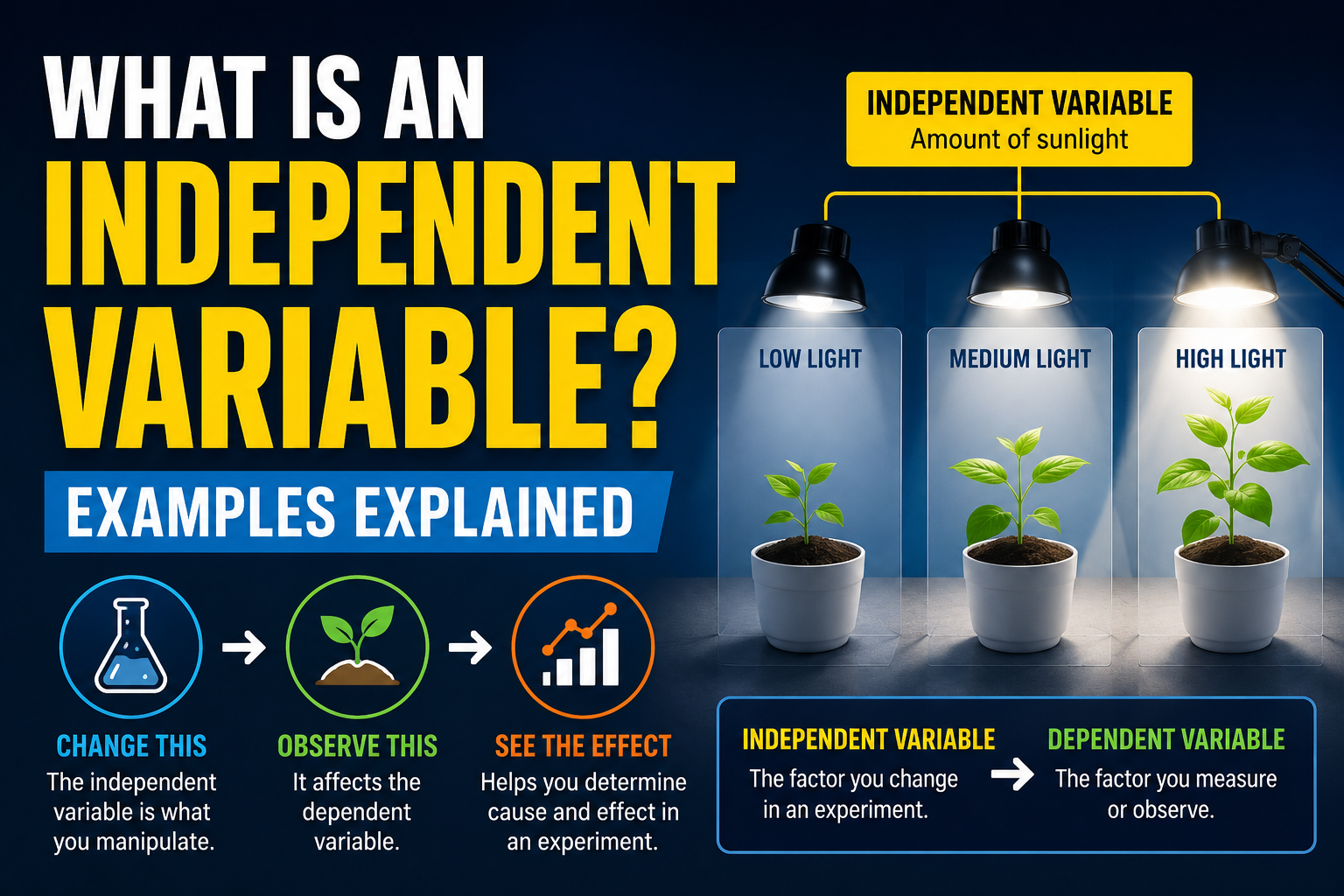
For example, if a scientist wants to study whether sunlight affects plant growth, the amount of sunlight given to plants is the independent variable. The scientist changes the sunlight exposure while measuring plant growth to see if there is a relationship.
This guide explains the meaning of an independent variable, how it differs from other types of variables, how it is used in experiments, and real-world examples to make the concept easier to understand.
Key Takeaways
- An independent variable is the factor a researcher changes or controls during an experiment.
- It is used to study whether a specific change causes an effect on another variable.
- The dependent variable is the result or outcome measured after changing the independent variable.
- Independent variables are common in scientific experiments, psychology studies, business research, and data analysis.
- Identifying variables correctly helps create reliable and meaningful research conclusions.
What Is an Independent Variable?
An independent variable is a variable that researchers deliberately manipulate, adjust, or select to examine its impact on another variable. It is called “independent” because its value does not depend on another variable within the experiment.
In simple terms, the independent variable is the cause or the input in a cause-and-effect relationship.
Researchers change the independent variable and then observe what happens to the dependent variable.
For example:
- A teacher tests whether different study methods affect exam scores.
- The study method is the independent variable.
- The exam score is the dependent variable.
The teacher changes the study method while measuring the results to determine whether the method influences student performance.
How Does an Independent Variable Work in an Experiment?
In a scientific experiment, researchers usually examine whether one factor influences another. The independent variable is the factor they intentionally change.
The basic relationship looks like this:
Independent Variable → Effect on Dependent Variable
The process usually follows these steps:
- Identify a research question.
- Choose the independent variable that may influence the outcome.
- Change or control the independent variable.
- Measure changes in the dependent variable.
- Analyze the results.
For example, a researcher may ask:
“Does exercise duration affect heart rate?”
In this experiment:
| Variable Type | Example |
|---|---|
| Independent Variable | Amount of exercise time |
| Dependent Variable | Heart rate after exercise |
| Controlled Variables | Age, fitness level, exercise type |
The researcher changes exercise duration while keeping other conditions consistent to understand its effect.
Independent Variable vs Dependent Variable
Many people confuse independent and dependent variables because they are closely connected. The easiest way to remember the difference is:
- The independent variable is what you change.
- The dependent variable is what you measure.
| Independent Variable | Dependent Variable |
|---|---|
| Controlled or changed by the researcher | Observed and measured by the researcher |
| Represents the possible cause | Represents the possible effect |
| Comes first in an experiment | Changes because of the independent variable |
| Example: Amount of fertilizer | Example: Plant growth |
For example, if a farmer studies how fertilizer affects crop production:
- Fertilizer amount = independent variable
- Crop growth = dependent variable
The farmer changes fertilizer levels and measures plant growth to determine the effect.
Examples of Independent Variables
Independent variables appear in many areas, including science, education, psychology, medicine, and business.
Example 1: Plant Growth Experiment
Research question:
“Does the amount of water affect plant growth?”
Variables:
- Independent variable: Amount of water provided
- Dependent variable: Plant height
- Controlled variables: Plant type, soil, sunlight, and temperature
The researcher changes the water amount and observes plant growth.
Example 2: Education Research
Research question:
“Does studying with background music affect test performance?”
Variables:
- Independent variable: Presence or type of background music
- Dependent variable: Test scores
- Controlled variables: Study time, difficulty level, and learning materials
The researcher examines whether music influences learning outcomes.
Example 3: Health and Fitness Study
Research question:
“Does exercise frequency improve physical fitness?”
Variables:
- Independent variable: Number of exercise sessions per week
- Dependent variable: Fitness measurement
- Controlled variables: Diet, age, and starting fitness level
The study explores whether increased exercise leads to better fitness results.
Example 4: Business Research
Research question:
“Does advertising spending increase product sales?”
Variables:
- Independent variable: Advertising budget
- Dependent variable: Sales revenue
- Controlled variables: Product price, market conditions, and customer demand
Companies often use this type of research to make better marketing decisions.
Types of Independent Variables
Independent variables can appear in different forms depending on the research design.
Experimental Independent Variables
These are variables that researchers actively manipulate.
Example:
A scientist changes the temperature of water to observe how quickly sugar dissolves.
Independent variable:
- Water temperature
Dependent variable:
- Dissolving speed
Categorical Independent Variables
These variables involve different groups or categories.
Examples:
- Type of teaching method
- Brand of product
- Medication type
- Diet category
Researchers compare groups to identify differences.
Continuous Independent Variables
These variables can have many possible values.
Examples:
- Temperature
- Time
- Distance
- Amount of pressure
A researcher can adjust these variables across a range of measurements.
Why Are Independent Variables Important?
Independent variables are essential because they allow researchers to test relationships and understand how changes influence outcomes.
They help researchers:
Identify Cause and Effect
By changing one factor while controlling others, researchers can determine whether a specific variable influences a result.
Design Better Experiments
A clearly defined independent variable creates a structured research process and improves accuracy.
Make Predictions
Understanding relationships between variables allows scientists and organizations to predict possible outcomes.
Solve Real-World Problems
Independent variables are used to improve healthcare treatments, education methods, technology, and business strategies.
How to Identify an Independent Variable
Finding the independent variable becomes easier by asking the right questions.
Use these steps:
Ask What Is Being Changed
The factor intentionally changed by the researcher is usually the independent variable.
Example:
“Does sleep duration affect memory?”
The researcher changes sleep duration.
Independent variable:
Sleep duration
Ask What Causes the Change
The independent variable is often the possible cause behind the outcome.
Example:
“Does fertilizer type affect plant growth?”
Possible cause:
Fertilizer type
Look for the Input
In many experiments, the independent variable is the input that produces a measurable result.
Common Mistakes When Identifying Independent Variables
Understanding variables can be challenging, especially for beginners. Some common mistakes include:
Confusing the Independent Variable With the Outcome
A common error is identifying the result as the independent variable.
Incorrect:
Exam scores are the independent variable in a study about study methods.
Correct:
Study method is the independent variable because it is changed by the researcher.
Changing Multiple Variables at Once
If researchers change several factors simultaneously, it becomes difficult to determine which factor caused the result.
A good experiment changes one main independent variable while keeping other conditions controlled.
Ignoring Controlled Variables
Controlled variables are factors kept the same throughout an experiment.
They help ensure that changes in the dependent variable are caused by the independent variable.
Independent Variables in Different Fields
Independent variables are used across many professional fields.
Science
Scientists use independent variables to test theories and understand natural processes.
Examples:
- Temperature
- Chemical concentration
- Light exposure
Psychology
Psychologists study how different conditions influence human behavior.
Examples:
- Sleep amount
- Stress level
- Learning environment
Medicine
Medical researchers use independent variables in clinical studies.
Examples:
- Medication dosage
- Treatment type
- Exercise routine
Economics
Economists analyze how changes affect markets and consumer behavior.
Examples:
- Interest rates
- Tax policies
- Pricing strategies
Difference Between Independent Variables and Controlled Variables
Although both are important in experiments, they serve different purposes.
| Independent Variable | Controlled Variable |
|---|---|
| Changed intentionally | Kept constant |
| Tested for its effect | Prevents outside influence |
| Helps answer research questions | Improves experiment reliability |
For example, in a plant experiment:
- Independent variable: Amount of sunlight
- Controlled variables: Soil type, water amount, plant species
Conclusion
Understanding what is an independent variable is essential for learning how experiments, research studies, and data analysis work. The independent variable represents the factor researchers change to investigate whether it creates an effect on another variable.
From testing plant growth and studying human behavior to improving business strategies and medical research, independent variables help professionals discover relationships and make evidence-based decisions.
By correctly identifying independent variables, dependent variables, and controlled variables, students and researchers can design stronger experiments and better understand the world around them. A clear understanding of this basic concept provides a strong foundation for scientific thinking and effective problem-solving.















Leave a Reply