

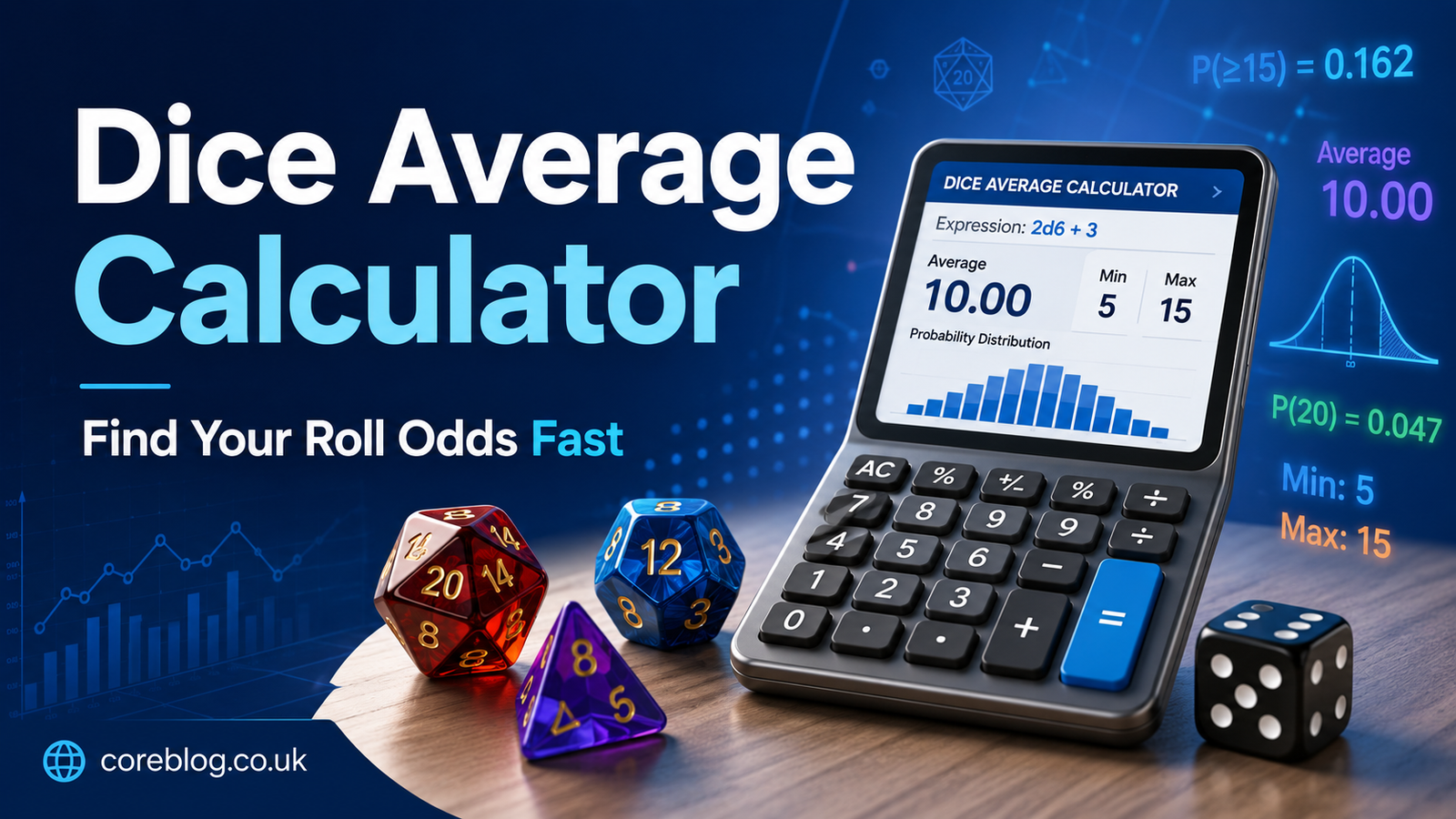
Dice Average Calculator: Find Your Roll Odds Fast
Anyone who has ever rolled dice knows the feeling. You shake them in your hand, let them fly across the table, and for one tiny moment, anything feels possible. Maybe you need a six to win. Maybe you are building a tabletop character and want fair stats. Or maybe you are just curious about why some dice rolls feel lucky while others seem painfully unfair.
That is where a Dice Average Calculator becomes surprisingly useful.
At first, dice look simple. A standard die has six sides, each with a number from 1 to 6. Roll it once, and you get a random result. Easy enough. But when you start rolling multiple dice, adding modifiers, comparing averages, or planning game outcomes, the math can get messy fast. A Dice Average Calculator helps you cut through that confusion and find your expected roll value in seconds.
Whether you play board games, tabletop RPGs, casino-style games, classroom math activities, or probability-based strategy games, knowing the average dice roll can give you a real edge. It does not guarantee a win, of course. Dice are still random. However, it helps you understand what is likely, what is rare, and what numbers you should expect over time.
In this guide, we will break everything down in plain English. No stiff math lecture. No confusing formulas thrown at you without context. Just a clear, useful look at how a Dice Average Calculator works, why it matters, and how you can use it to make smarter decisions when dice are involved.
What Is a Dice Average Calculator?
A Dice Average Calculator is a simple tool that finds the average expected result of one or more dice rolls. In other words, it tells you what number you are most likely to average if you roll the same dice many times.
For example, if you roll one standard six-sided die, the possible results are:
| Die Type | Possible Results | Average Roll |
|---|---|---|
| 1d6 | 1, 2, 3, 4, 5, 6 | 3.5 |
| 2d6 | 2 to 12 | 7 |
| 3d6 | 3 to 18 | 10.5 |
| 1d20 | 1 to 20 | 10.5 |
| 2d20 | 2 to 40 | 21 |
The “d” simply means die or dice. So 1d6 means one six-sided die. 2d6 means two six-sided dice. 1d20 means one twenty-sided die, which is common in tabletop role-playing games.
A Dice Average Calculator uses this same idea but does the work instantly. You enter the number of dice, the number of sides, and sometimes bonuses or modifiers. Then it gives you the expected average roll.
This is helpful because humans are not always great at judging probability by feel. A number may seem common when it is not. A roll may feel unlucky even when it is normal. With a calculator, you get a clearer picture.
Why Dice Averages Matter More Than You Think
Dice games often feel like pure luck, but there is a quiet layer of math underneath every roll. The more you understand that layer, the better you can plan.
For casual players, dice averages help explain why certain results show up more often. For serious players, averages can shape strategy, character builds, betting decisions, and risk management.
Let’s say you are playing a game where you can choose between rolling 1d12 or 2d6. Both can reach similar high numbers, but they behave very differently.
A 1d12 roll has equal odds for every number from 1 to 12. A 2d6 roll, however, is more likely to land near 7 because there are more dice combinations that create middle results. So even though both options look similar at first, 2d6 is usually more reliable.
A Dice Average Calculator makes these differences easier to see. It gives you a starting point for smarter choices.
How Does a Dice Average Calculator Work?
The basic idea is simple. To find the average value of a die, you add the lowest possible roll and the highest possible roll, then divide by two.
For a standard six-sided die:
1 + 6 = 7
7 ÷ 2 = 3.5
So the average roll of 1d6 is 3.5.
For a twenty-sided die:
1 + 20 = 21
21 ÷ 2 = 10.5
So the average roll of 1d20 is 10.5.
When you roll multiple dice, you multiply the average of one die by the number of dice.
For 2d6:
3.5 + 3.5 = 7
For 4d6:
3.5 × 4 = 14
A Dice Average Calculator follows this same logic. The difference is that it can handle bigger dice pools, unusual dice sizes, and added modifiers much faster than doing it by hand.
Basic Dice Average Formula
For one die, the formula is:
Average = (lowest number + highest number) ÷ 2
For most dice, the lowest number is 1. So a quick version is:
Average = (1 + number of sides) ÷ 2
For multiple dice:
Total Average = number of dice × average of one die
If you add a bonus, just add it to the final average.
For example:
2d6 + 3
Average of 2d6 = 7
Add 3
Final average = 10
That is exactly the kind of result a Dice Average Calculator gives you.
Common Dice Types and Their Average Rolls
Different games use different dice. Some use only regular six-sided dice. Others use polyhedral dice with 4, 8, 10, 12, or 20 sides.
Here is a quick table for common dice:
| Dice Roll | Minimum | Maximum | Average |
|---|---|---|---|
| 1d4 | 1 | 4 | 2.5 |
| 1d6 | 1 | 6 | 3.5 |
| 1d8 | 1 | 8 | 4.5 |
| 1d10 | 1 | 10 | 5.5 |
| 1d12 | 1 | 12 | 6.5 |
| 1d20 | 1 | 20 | 10.5 |
| 1d100 | 1 | 100 | 50.5 |
This table is useful for quick checks, but a Dice Average Calculator becomes more useful when you start adding several dice together.
For example:
| Dice Roll | Average |
|---|---|
| 2d4 | 5 |
| 2d6 | 7 |
| 3d6 | 10.5 |
| 4d6 | 14 |
| 5d8 | 22.5 |
| 6d10 | 33 |
| 8d12 | 52 |
Once the numbers get larger, doing mental math becomes annoying. That is why players, teachers, game designers, and probability learners often use a Dice Average Calculator instead.
Dice Average vs Dice Probability
A dice average tells you the expected middle result over many rolls. Dice probability tells you the chance of getting a specific result or range of results.
These two ideas are connected, but they are not the same.
For example, the average of 2d6 is 7. That does not mean you will always roll 7. It means that if you roll 2d6 hundreds or thousands of times, your long-term average should move close to 7.
Probability goes deeper. It asks questions like:
- What are the odds of rolling exactly 7 on 2d6?
- What is the chance of rolling 10 or higher?
- How likely is it to roll double sixes?
- What are the odds of failing a target number?
- How often will a player beat a difficulty check?
A Dice Average Calculator mainly answers the average roll question. Some advanced calculators also include dice probability, roll distribution, success chance, minimum roll, maximum roll, and expected value.
If you are only trying to understand the typical result, average is enough. However, if you are building a game system or planning a serious strategy, probability matters too.
Why 2d6 Feels Different From 1d12
This is one of the best examples of why dice averages can be tricky.
A 1d12 and 2d6 can both produce numbers in a similar range. A 1d12 gives you 1 to 12. A 2d6 gives you 2 to 12. Their average is close too. 1d12 has an average of 6.5, while 2d6 has an average of 7.
But the real difference is consistency.
With 1d12, every result has the same chance. A 1 is just as likely as a 12. A 6 is just as likely as an 11.
With 2d6, middle numbers show up more often. There are many ways to roll a 7:
- 1 and 6
- 2 and 5
- 3 and 4
- 4 and 3
- 5 and 2
- 6 and 1
But there is only one way to roll a 2:
- 1 and 1
And only one way to roll a 12:
- 6 and 6
So 2d6 creates a bell-shaped pattern where average results happen more often and extreme results happen less often. This is why a Dice Average Calculator is helpful, but it is even better when you understand the shape behind the numbers.
Who Should Use a Dice Average Calculator?
A Dice Average Calculator is useful for more people than you might think. It is not just for math students or hardcore gamers.
Tabletop RPG Players
If you play games like fantasy role-playing campaigns, dungeon adventures, sci-fi RPGs, or homebrew tabletop systems, dice averages matter all the time.
You may need to compare weapon damage, spell effects, healing rolls, skill checks, attack rolls, saving throws, or character stats. A Dice Average Calculator can help you choose between two options that look similar but perform differently.
For example, a weapon that deals 1d12 damage has an average of 6.5. A weapon that deals 2d6 damage has an average of 7. More importantly, 2d6 is more consistent. That can affect how reliable your character feels in play.
Board Game Players
Many board games use dice for movement, combat, resources, or random events. Understanding average dice rolls helps players make better decisions.
If you know that 2d6 usually lands around 7, you can plan movement or risk more carefully. If you know that high rolls are rare, you may avoid depending on them unless the reward is worth it.
Game Designers
Game designers use dice averages constantly. A small change in dice mechanics can completely change how a game feels.
For example, changing damage from 1d10 to 2d5 may create a similar average but a different roll pattern. Adding a +2 modifier may make success too easy. Using exploding dice may increase dramatic moments but also raise the average outcome.
A Dice Average Calculator helps designers test ideas quickly before running full playtests.
Teachers and Students
Dice are one of the easiest ways to teach probability because they are simple, physical, and fun. Students can roll dice, record results, compare averages, and see probability in action.
A Dice Average Calculator can support lessons on mean, expected value, random outcomes, sample size, combinations, and data collection.
Casual Players
Even if you are not deep into math or gaming, the tool is still handy. Sometimes you just want to know whether a roll is good, bad, common, or rare. A calculator gives you that answer quickly.
How to Use a Dice Average Calculator Step by Step
Most dice average tools are very easy to use. The layout may vary, but the process is usually the same.
Step 1: Choose the Number of Dice
First, enter how many dice you want to roll. For example, if your roll is 3d6, the number of dice is 3.
Step 2: Choose the Number of Sides
Next, enter how many sides each die has. For 3d6, each die has 6 sides. For 2d20, each die has 20 sides.
Step 3: Add Any Modifier
Some games add a bonus or penalty to the roll. For example:
- 1d20 + 5
- 2d6 + 3
- 4d8 – 2
A good Dice Average Calculator should let you include these modifiers.
Step 4: Read the Average Result
After entering the values, the calculator shows your average roll. It may also show the minimum result, maximum result, and sometimes probability details.
Step 5: Compare Your Options
The real value comes when you compare different rolls.
For example:
| Option | Average | Notes |
|---|---|---|
| 1d12 | 6.5 | More swingy |
| 2d6 | 7 | More reliable |
| 1d10 + 2 | 7.5 | Higher average |
| 2d4 + 3 | 8 | Very steady |
This kind of comparison helps you make better choices instead of guessing.
Practical Examples of Dice Average Calculations
Let’s look at a few simple examples.
Example 1: Standard Board Game Roll
You roll 2d6.
Each d6 has an average of 3.5.
Two dice average 7.
So the expected result is 7.
This is why many board games built around two six-sided dice often make 7 an important number.
Example 2: RPG Weapon Damage
A weapon deals 1d8 + 3 damage.
Average of 1d8 = 4.5
Add 3
Average damage = 7.5
A Dice Average Calculator would show that this weapon deals 7.5 average damage per hit.
Example 3: Comparing Two Attacks
Attack A deals 2d6 damage.
Attack B deals 1d12 damage.
2d6 average = 7
1d12 average = 6.5
Attack A has a slightly better average and is more consistent. Attack B is more unpredictable.
Example 4: Big Dice Pool
You roll 6d10.
One d10 averages 5.5.
6 × 5.5 = 33
So 6d10 has an average roll of 33.
This is where a Dice Average Calculator really saves time.
Common Mistakes People Make With Dice Averages
Dice averages are simple once you understand them, but a few mistakes are very common.
Mistake 1: Thinking the Average Is the Most Common Result
With one die, every number is equally likely. The average of 1d6 is 3.5, but you cannot roll a 3.5. It is a mathematical midpoint, not an actual result.
With multiple dice, the average may also be the most common area, but not always in the way people expect.
Mistake 2: Ignoring Roll Distribution
Two dice rolls can have the same or similar average but feel very different.
For example, 1d12 and 2d6 are close in average, but 2d6 is more stable. If you only look at the average, you miss that important detail.
Mistake 3: Forgetting Modifiers
A +2 or +3 bonus can change the expected result a lot. Always include modifiers when using a Dice Average Calculator.
Mistake 4: Expecting Short-Term Results to Match the Average
The average becomes more accurate over many rolls. In a small number of rolls, anything can happen. You might roll low five times in a row. That does not mean the calculator is wrong. It just means randomness is doing what randomness does.
Mistake 5: Comparing Maximum Rolls Only
Players often get tempted by the highest possible number. However, the maximum roll may be rare. A reliable average can be more useful than a flashy top result.
Dice Average Calculator for Game Strategy
A Dice Average Calculator is not just a math helper. It can also shape smarter play.
If you are choosing between two moves, ask yourself:
- Which option has the better average?
- Which option has the safer minimum result?
- Which option has the higher maximum result?
- Do I need reliability or risk?
- Is a big reward worth a low chance?
- How often will this roll succeed?
For example, if your character has low health, a steady damage option may be better than a risky one. However, if you need one huge hit to win, a swingy roll may be worth trying.
That is the fun part. Dice averages do not remove luck. They help you understand it.
Dice Average Calculator and Expected Value
Expected value is a fancy phrase, but the idea is simple. It means the long-term average outcome of a random event.
A Dice Average Calculator gives you expected value for dice rolls.
If you roll 1d6 one time, you may get any number from 1 to 6. But if you roll it thousands of times, the average result should move toward 3.5.
Expected value is useful because it helps you judge choices over time. In games, this can help you see which action is better in the long run.
For example, one attack might deal a lot of damage sometimes but miss often. Another attack might deal less damage but hit more often. To compare them well, you need both dice average and success chance.
Manual Dice Average Cheat Sheet
Here is a quick cheat sheet you can use when you do not have a calculator nearby:
| Roll | Average |
|---|---|
| 1d4 | 2.5 |
| 1d6 | 3.5 |
| 1d8 | 4.5 |
| 1d10 | 5.5 |
| 1d12 | 6.5 |
| 1d20 | 10.5 |
| 2d6 | 7 |
| 3d6 | 10.5 |
| 4d6 | 14 |
| 5d6 | 17.5 |
| 6d6 | 21 |
For quick mental math, remember this:
Average of one die = half the die size plus 0.5
So:
- d6 average = 3 + 0.5 = 3.5
- d8 average = 4 + 0.5 = 4.5
- d20 average = 10 + 0.5 = 10.5
Then multiply by the number of dice.
What Makes a Good Dice Average Calculator?
Not every calculator is equally helpful. A good Dice Average Calculator should be simple, fast, and flexible.
Here are the features that matter:
- Supports common dice like d4, d6, d8, d10, d12, d20, and d100
- Allows multiple dice
- Includes bonuses and penalties
- Shows minimum and maximum roll
- Gives clear average results
- Works well on mobile and desktop
- Offers probability details if needed
- Handles custom dice sizes
- Has a clean interface without confusion
For most users, speed and clarity matter most. You should not need a math degree to use the tool. Enter the dice, add your modifier, and get the result.
Dice Average Calculator for Dungeons, Battles, and Damage Rolls
In tabletop role-playing games, damage rolls are one of the most common uses for a Dice Average Calculator. Players often compare weapons, spells, class features, and special attacks.
Let’s say you are comparing these damage options:
| Damage Roll | Average Damage |
|---|---|
| 1d8 + 4 | 8.5 |
| 2d6 + 3 | 10 |
| 1d12 + 2 | 8.5 |
| 3d4 + 1 | 8.5 |
At first glance, several of these look similar. However, they do not feel the same during play.
3d4 + 1 is more consistent because rolling three dice pulls results toward the middle. 1d12 + 2 is more swingy because one die can land anywhere across a wider range.
A Dice Average Calculator lets you see the numbers, but your play style decides what matters most. Some players love reliable results. Others enjoy big, dramatic rolls.
Can a Dice Average Calculator Predict Your Next Roll?
No, and this is important.
A Dice Average Calculator cannot predict the exact number you will roll next. Dice rolls are random, assuming the dice are fair. The calculator only shows what should happen on average over many rolls.
Think of it like weather. If a forecast says the average temperature in a city is 75 degrees, that does not mean every day will be exactly 75. Some days will be hotter. Some will be cooler. The average just gives you a useful guide.
The same is true with dice.
You might roll above average. You might roll below average. You might have a lucky streak or a terrible streak. But over a large number of rolls, the average becomes more meaningful.
Fair Dice, Loaded Dice, and Real-World Rolling
Most dice calculators assume fair dice. That means each side has an equal chance of landing face up.
In real life, dice can be slightly imperfect. Cheap dice, damaged dice, uneven dice, or poorly balanced novelty dice may not roll perfectly fairly. The difference is usually small, but it can matter in serious testing or competitive play.
If you are using dice for casual games, this is not a big concern. However, if you are testing probability or designing a game, use fair dice and roll on a flat surface.
A Dice Average Calculator gives the mathematical expectation. Real-world results may vary, especially with small sample sizes.
How Dice Averages Help With Better Decisions
The real benefit of using a Dice Average Calculator is confidence. You stop guessing and start understanding.
Instead of saying, “This roll feels better,” you can say, “This roll has a higher average,” or “This one is more consistent,” or “This option is risky but has a better maximum.”
That helps in many situations:
- Choosing the best weapon in a game
- Balancing enemies in a tabletop campaign
- Teaching probability to students
- Designing fair board game mechanics
- Comparing risk and reward
- Understanding long-term outcomes
- Planning smarter moves in dice-based games
The calculator does not make the decision for you. It gives you better information so your decision makes sense.
Simple Tips for Reading Dice Averages Like a Pro
Here are a few practical tips that make dice averages easier to use:
Look Beyond the Average
Average is important, but do not ignore the minimum and maximum result. A roll with a lower average may still be useful if it has a better chance of hitting a needed target.
Consider Consistency
More dice usually create more stable results. Fewer dice with more sides usually create more dramatic swings.
Include All Bonuses
Always add modifiers, bonuses, penalties, and special rules. Leaving them out gives you an incomplete result.
Think About Your Goal
Sometimes you need steady performance. Other times, you need a lucky breakthrough. The “best” roll depends on what you are trying to do.
Use Averages Over Time
Do not judge a dice formula based on one unlucky roll. Averages work best over repeated rolls.
Frequently Asked Questions
What is the average roll of one six-sided die?
The average roll of one six-sided die is 3.5. You find this by adding 1 and 6, then dividing by 2.
What is the average roll of 2d6?
The average roll of 2d6 is 7. Since each d6 averages 3.5, two of them average 7 together.
Is a Dice Average Calculator useful for RPG games?
Yes, a Dice Average Calculator is very useful for RPG games. It helps players compare damage rolls, healing rolls, spell effects, and other dice-based outcomes.
Does the calculator show exact future rolls?
No. It shows the expected average, not the exact next roll. Dice are random, so short-term results can vary a lot.
Why do multiple dice feel more reliable?
Multiple dice create more possible combinations around the middle numbers. That makes average results more common and extreme results less common.
Is 2d6 better than 1d12?
It depends on your goal. 2d6 has a slightly higher average and more consistent results. 1d12 is more unpredictable and has a wider swing.
Conclusion
A Dice Average Calculator may seem like a small tool, but it can change the way you understand dice rolls. Instead of relying only on luck, guesses, or gut feeling, you get a clear view of the average result, expected value, minimum roll, maximum roll, and overall dice behavior.
For players, it makes game choices smarter. For game designers, it helps balance rules and mechanics. For students, it turns probability into something easy to see. And for anyone who simply enjoys dice, it adds a new layer of insight to every roll.
The key thing to remember is simple: a Dice Average Calculator does not remove randomness. It helps you read it better. Once you understand average rolls, dice probability, roll distribution, and modifiers, every choice becomes a little clearer.
So the next time you roll for damage, movement, success, or pure fun, take a moment to check the average. You might be surprised by what the numbers reveal. And if this guide helped you understand dice odds better, share it with a fellow player or leave a comment with your favorite dice roll to calculate.













Leave a Reply