

What Is an SSL Certificate Chain and Why It Matters
You know that small padlock icon next to a website address? Most people see it and think, “Okay, this site is safe.” But behind that tiny symbol, there is a lot happening in the background. One of the most important parts of that process is the SSL Certificate Chain.
The SSL Certificate Chain is what helps your browser decide whether a website can be trusted or not. It connects the website’s SSL certificate to a trusted authority that browsers already recognize. Without this chain, even a real SSL certificate may trigger warnings, errors, or trust issues.
That can be a serious problem.
Visitors may leave your website. Search engines may treat your site as less reliable. Payments, login forms, contact pages, and customer data can feel unsafe. For businesses, bloggers, online stores, SaaS platforms, and agencies, this is not a small technical detail. It directly affects user trust, website security, and online reputation.
The good news is that the idea is not as complicated as it sounds. Once you understand how the SSL Certificate Chain works, you can see why it matters so much for secure browsing, HTTPS, data protection, and professional website management.
Let’s break it down in plain English.
What Is an SSL Certificate Chain?
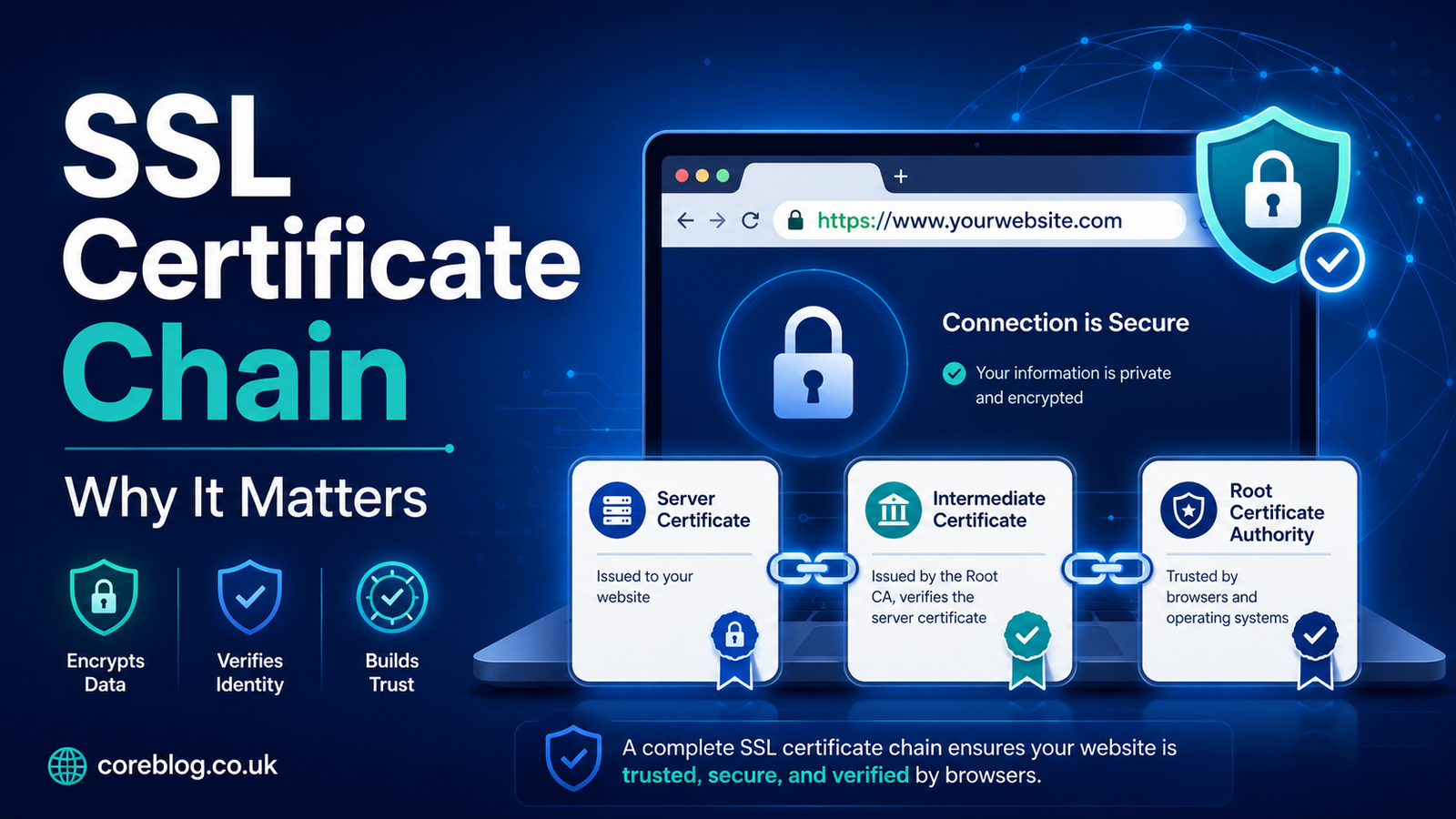
An SSL Certificate Chain is a series of digital certificates that connects your website’s SSL certificate to a trusted root certificate authority. In simple words, it is a trust path.
When someone visits your website, the browser does not blindly trust your SSL certificate. It checks where that certificate came from. It asks, “Who issued this certificate?” Then it checks who issued the next certificate above it, and so on, until it reaches a trusted root certificate.
This chain usually includes three main parts:
| Certificate Type | Role in the Chain |
|---|---|
| Server Certificate | Issued to your website domain |
| Intermediate Certificate | Connects your website certificate to the root authority |
| Root Certificate | Trusted by browsers and operating systems |
The server certificate is the one installed for your domain. For example, it may secure example.com and allow HTTPS to work.
The intermediate certificate sits between your website certificate and the trusted root. It acts like a bridge.
The root certificate belongs to a certificate authority, often called a CA. Browsers and operating systems already trust many major root certificates. That trust is built into systems like Chrome, Firefox, Safari, Edge, Windows, macOS, Android, and iOS.
So, the SSL Certificate Chain is basically proof that your website certificate can be traced back to a trusted source.
Why the SSL Certificate Chain Exists
The internet needs trust. Without it, anyone could create a fake certificate and pretend to be a bank, an email provider, or an online store.
That is why certificate authorities exist. They verify ownership, issue digital certificates, and help browsers confirm whether a website is authentic.
However, root certificates are extremely important. If a root certificate is misused, the damage can be huge. Because of this, certificate authorities do not usually sign every website certificate directly with the root certificate. Instead, they use intermediate certificates.
This gives the system more safety and flexibility.
If an intermediate certificate has a problem, it can be revoked without destroying the trust of the entire root certificate. This structure helps protect the public key infrastructure, also known as PKI.
In short, the SSL Certificate Chain exists to make online trust safer, more organized, and easier to manage at scale.
How an SSL Certificate Chain Works
Let’s imagine your website has an SSL certificate installed. A visitor types your domain into their browser. The site loads over HTTPS. Now the browser needs to confirm the certificate is valid.
Here is what happens in the background:
- The browser connects to your website.
- Your server sends its SSL certificate.
- The browser checks the certificate details.
- It looks for the intermediate certificate.
- It follows the chain up to a trusted root certificate.
- It verifies that none of the certificates are expired, revoked, or mismatched.
- If everything checks out, the browser shows the secure padlock.
This all happens very quickly. Most users never notice it. But if something is wrong with the SSL Certificate Chain, the browser may show a warning such as “Your connection is not private” or “This site’s certificate is not trusted.”
That warning can scare visitors away within seconds.
The Three Main Parts of an SSL Certificate Chain
Server Certificate
The server certificate is the certificate issued for your specific website. It includes important information such as:
- Domain name
- Public key
- Certificate issuer
- Validity period
- Signature algorithm
- Subject alternative names
- Certificate authority details
This certificate proves that the website has been issued a digital identity. If you run a website, this is the certificate most hosting dashboards refer to when they say “SSL certificate.”
The server certificate is also sometimes called the end-entity certificate or leaf certificate.
Intermediate Certificate
The intermediate certificate is the middle layer of the SSL Certificate Chain. It connects your server certificate to the trusted root certificate.
This part is very important because many SSL errors happen when the intermediate certificate is missing or installed incorrectly.
Think of it like a recommendation letter. Your website certificate says, “I am valid.” The intermediate certificate says, “I can confirm this certificate was issued by a trusted authority.” Then the root certificate says, “Browsers already trust me.”
Without the intermediate certificate, the browser may not be able to complete the chain.
Root Certificate
The root certificate is the top-level certificate. It belongs to a trusted certificate authority. Browsers, devices, and operating systems keep a list of trusted root certificates.
If the SSL Certificate Chain reaches a trusted root, the browser can accept the connection as secure.
Root certificates are usually valid for a long time, but they are carefully controlled. Certificate authorities protect them because they are the foundation of digital trust on the web.
Why the SSL Certificate Chain Matters for Website Security
The SSL Certificate Chain matters because it helps confirm that a website is truly connected to a trusted certificate authority. This is a key part of secure communication online.
When a website uses HTTPS, data between the visitor and the server is encrypted. This helps protect sensitive information such as:
- Passwords
- Credit card numbers
- Email addresses
- Contact form details
- Personal information
- Session cookies
- Account data
- Payment details
However, encryption alone is not enough. The browser must also verify the website’s identity. That is where the SSL Certificate Chain becomes important.
If the chain is broken, the browser cannot fully trust the site. Even if the connection is encrypted, users may still see a warning.
For a business website, that can damage trust fast.
SSL Certificate Chain and Browser Trust
Browsers are strict for a reason. They are the first line of defense for everyday users. When a browser checks an SSL Certificate Chain, it is trying to protect users from fake websites, phishing pages, man-in-the-middle attacks, and unsafe connections.
A complete certificate chain tells the browser:
- The website certificate was issued properly.
- The issuer is connected to a trusted certificate authority.
- The certificate is still valid.
- The domain name matches the certificate.
- The certificate has not been revoked.
- The connection can be treated as secure.
If the chain is incomplete, browsers may not give your site the benefit of the doubt. Instead, they may display a security warning.
And let’s be honest. Most visitors will not stop to understand the technical reason. They will simply leave.
Common SSL Certificate Chain Errors
SSL errors can feel confusing, especially if you are not a developer. But many of them are linked to certificate chain problems.
Here are some common issues:
| SSL Error Issue | What It Usually Means |
|---|---|
| Missing intermediate certificate | Browser cannot build a complete trust chain |
| Expired certificate | One certificate in the chain is no longer valid |
| Wrong certificate order | Certificates are installed in the wrong sequence |
| Self-signed certificate warning | Certificate is not trusted by default |
| Domain mismatch | Certificate does not match the website domain |
| Revoked certificate | Certificate has been cancelled by the issuer |
| Untrusted root | Browser does not trust the root authority |
One of the most common problems is an incomplete SSL Certificate Chain. This usually happens when the server certificate is installed, but the intermediate certificate is missing.
The website owner may think SSL is active, but some browsers, devices, or tools may still report errors.
Why an Incomplete SSL Certificate Chain Is a Problem
An incomplete SSL Certificate Chain can cause different results for different users. One visitor may see your site as secure, while another may see a warning.
This can happen because some browsers cache intermediate certificates. Others do not. Some operating systems may already have the missing certificate. Older devices may not.
That inconsistency is dangerous for website owners.
You may test your site on your own laptop and see no issue. But a customer using another device may get a browser warning and leave before your homepage even loads.
An incomplete chain can affect:
- User trust
- Conversion rates
- Search engine confidence
- Payment page reliability
- Login security
- Mobile browsing
- API connections
- Email server security
- Application integrations
So, even if your website “looks fine” on your end, you should still make sure the SSL Certificate Chain is properly configured.
SSL Certificate Chain and SEO
Google wants users to have safe browsing experiences. HTTPS is a standard expectation now, not a luxury feature. While SSL alone will not magically rank a weak website, it is part of a trustworthy technical foundation.
A valid SSL Certificate Chain supports SEO in several ways.
First, it helps your website load without browser warnings. A security warning can increase bounce rate and reduce engagement. If users quickly leave because they feel unsafe, your site performance signals can suffer.
Second, HTTPS is important for modern web standards. Secure pages are expected for forms, checkout pages, membership areas, and any website that handles personal data.
Third, trust matters. A website that looks secure feels more professional. That can improve clicks, leads, sales, and return visits.
In addition, many tools, crawlers, and third-party services expect a properly configured HTTPS setup. If your SSL Certificate Chain is broken, technical SEO audits may flag it as an issue.
For site owners who care about organic traffic, this is worth fixing.
SSL Certificate Chain and User Experience
Security is not just a backend topic. It affects how people feel when they land on your website.
When users see a secure padlock and a clean HTTPS connection, they feel more comfortable browsing. They are more likely to fill out a form, create an account, download a file, or make a purchase.
However, when they see a warning, the reaction is immediate. They may think your site is hacked, fake, outdated, or unsafe.
That may not be true, of course. The issue could simply be a missing intermediate certificate. But users do not care about the technical details. They care about feeling safe.
A proper SSL Certificate Chain helps create a smooth, trustworthy experience.
Real-Life Example of an SSL Certificate Chain
Imagine you are applying for a job. You say you have experience. The employer asks for proof. You show a certificate from a training center. Then they ask, “Is this training center recognized?” The training center is connected to a larger education board, and that board is officially trusted.
That is similar to how an SSL Certificate Chain works.
Your website certificate says, “This domain is secure.”
The intermediate certificate says, “This certificate was issued under our authority.”
The root certificate says, “Browsers already trust us.”
When all three connect properly, trust is established.
SSL Certificate Chain vs SSL Certificate
Many people use the terms “SSL certificate” and “SSL Certificate Chain” as if they are the same thing. They are related, but they are not exactly the same.
An SSL certificate is the certificate issued to your website. The SSL Certificate Chain is the full path of trust that includes your website certificate, intermediate certificates, and the trusted root.
Here is a simple comparison:
| Term | Meaning |
|---|---|
| SSL Certificate | The digital certificate for your website |
| SSL Certificate Chain | The full trust path from your certificate to the root |
| Intermediate Certificate | The bridge between website certificate and root |
| Root Certificate | The trusted certificate authority certificate |
| HTTPS | Secure web connection using SSL/TLS |
So, when someone says your SSL is installed, that does not always mean your SSL Certificate Chain is complete. Both need to be correct.
SSL and TLS: Is There a Difference?
Technically, most modern websites use TLS, not the old SSL protocol. TLS stands for Transport Layer Security. It is the newer and more secure version of SSL.
However, most people still say “SSL certificate” because the term is widely used. Hosting companies, website owners, SEO tools, and even many developers use SSL as the common phrase.
So, when we talk about an SSL Certificate Chain, we are usually talking about the certificate chain used in modern TLS connections.
In simple terms, SSL is the popular name, while TLS is the modern technology behind secure HTTPS connections.
How to Check an SSL Certificate Chain
You do not need to be a cybersecurity expert to check whether your SSL Certificate Chain is working. Many hosting panels and SSL testing tools can show whether the chain is complete.
You can also look for signs such as:
- Your website loads with HTTPS.
- The browser shows a padlock.
- No “connection not private” warning appears.
- The certificate details show a valid issuer.
- The certificate is not expired.
- The domain name matches the certificate.
- SSL testing tools show a complete chain.
- Mobile and desktop browsers both trust the site.
If you manage a business website, it is smart to check this after installing or renewing an SSL certificate.
Best Practices for a Healthy SSL Certificate Chain
A secure website needs more than just installing a certificate once and forgetting about it. SSL certificates expire, certificate authorities update policies, and servers change.
Here are some helpful best practices:
- Use a trusted certificate authority.
- Install the full certificate bundle.
- Include intermediate certificates.
- Keep the certificate order correct.
- Renew certificates before they expire.
- Use HTTPS across the entire website.
- Redirect HTTP pages to HTTPS.
- Avoid mixed content errors.
- Check SSL after server migration.
- Test SSL on mobile and desktop.
- Monitor expiry dates.
- Keep your hosting environment updated.
These steps may sound technical, but most good hosting providers make them easy. Many platforms now offer automatic SSL installation and renewal. Still, it is worth checking that the SSL Certificate Chain is complete.
What Happens When a Certificate Expires?
When a certificate expires, browsers stop trusting it. That means users may see security warnings even if your website was working perfectly the day before.
An expired certificate can break trust immediately.
Sometimes the server certificate expires. Other times, an intermediate or root certificate may become outdated. In either case, the chain may fail.
This is why certificate renewal is so important. Website owners should never wait until the last minute. A missed renewal can affect sales, leads, traffic, and brand reputation.
For eCommerce websites, the impact can be even worse because customers may abandon checkout pages.
What Is Certificate Revocation?
Certificate revocation means a certificate has been cancelled before its normal expiry date. This can happen if a private key is compromised, a certificate was issued incorrectly, or the certificate authority finds a serious problem.
Browsers may check revocation status using systems like OCSP or CRL. These help confirm whether a certificate is still trustworthy.
If one part of the SSL Certificate Chain is revoked, the browser may reject the connection. This protects users from unsafe or compromised certificates.
Why Website Owners Should Care
Some website owners think SSL is only a developer’s problem. That is a mistake.
If you own a website, SSL affects your brand.
A broken SSL Certificate Chain can make a professional website look careless.
On the other hand, a clean HTTPS setup shows that you care about security, privacy, and user experience. It sends a quiet but powerful message: this website is maintained properly.
That matters, especially in competitive industries.
SSL Certificate Chain for eCommerce Websites
For online stores, an SSL Certificate Chain is critical. Customers enter names, addresses, phone numbers, payment details, and account passwords. They expect that information to stay protected.
If a checkout page shows an SSL warning, most shoppers will leave. Some may never return.
A secure certificate chain helps protect:
- Product pages
- Login accounts
- Shopping carts
- Checkout pages
- Payment gateways
- Customer dashboards
- Order forms
- Admin panels
Trust is one of the biggest factors in online buying. A complete SSL Certificate Chain helps support that trust from the first click to final payment.
SSL Certificate Chain for Blogs and Content Websites
Even if you run a simple blog, SSL still matters. You may not process payments, but you still want readers to feel safe.
Blogs often collect email subscribers, comments, contact form messages, and analytics data. In addition, modern browsers expect HTTPS on almost every type of site.
A secure SSL Certificate Chain helps your blog look professional. It also prevents browser warnings that could hurt your traffic and credibility.
For content websites that depend on organic search, this is an easy technical win.
SSL Certificate Chain for Businesses and Agencies
Business websites often act as the first impression for potential clients. If the site has an SSL warning, it creates doubt before the visitor even reads the homepage.
For agencies, consultants, law firms, finance brands, healthcare websites, SaaS companies, and local businesses, trust is everything.
A proper SSL Certificate Chain helps support:
- Lead generation
- Brand credibility
- Secure forms
- Client portals
- Online bookings
- Private dashboards
- Professional reputation
It is one of those technical details that users may not notice when it works, but they definitely notice when it fails.
Common Myths About SSL Certificate Chains
“If I have HTTPS, everything is fine”
Not always. A website may appear to use HTTPS but still have chain problems on certain devices or browsers. You need a complete SSL Certificate Chain, not just a certificate installed somewhere on the server.
“Only online stores need SSL”
This is outdated thinking. Today, almost every website should use HTTPS. Even blogs, portfolios, and service websites benefit from secure browsing.
“Free SSL certificates are not trustworthy”
Many free SSL certificates can be trustworthy when issued by a recognized certificate authority and installed correctly. The key is proper setup, renewal, and chain completion.
“SSL improves rankings by itself”
SSL supports SEO, but it is not a magic ranking button. You still need quality content, good user experience, fast loading speed, strong internal linking, and helpful pages.
Signs Your SSL Certificate Chain Needs Attention
You may need to review your SSL setup if you notice:
- Browser security warnings
- SSL errors in audit tools
- HTTPS works on desktop but fails on mobile
- Your site works in one browser but not another
- Users report “not secure” messages
- Payment gateway errors
- API connection failures
- Expired certificate alerts
- Mixed content warnings
- Redirect problems from HTTP to HTTPS
These signs should not be ignored. Even one SSL problem can affect trust.
How Hosting Providers Handle SSL Certificate Chains
Many modern hosting providers automatically install SSL certificates and intermediate certificates. This is helpful for beginners. However, mistakes can still happen during migrations, renewals, DNS changes, CDN setup, or manual certificate installation.
If your host provides SSL management, check whether it includes the full certificate bundle. Some dashboards may ask for:
- Certificate
- Private key
- CA bundle
- Intermediate certificate
The CA bundle is especially important because it often contains the intermediate certificates needed to complete the SSL Certificate Chain.
Final Thoughts Before You Check Your Website
The SSL Certificate Chain may sound like a deep technical topic, but its purpose is simple: trust.
It helps browsers verify that your website’s certificate is connected to a recognized certificate authority. It protects visitors, supports secure HTTPS, prevents browser warnings, and gives users more confidence in your site.
For website owners, this is not just about security. It is about credibility. It is about giving people a reason to stay, read, subscribe, contact you, or buy from you.
Conclusion
So, what is an SSL Certificate Chain and why does it matter? It is the trust path that links your website’s SSL certificate to a trusted root certificate authority. Without it, browsers may not fully trust your site, even if you have an SSL certificate installed.
A complete SSL Certificate Chain helps protect user data, reduce SSL errors, improve website trust, support SEO, and create a smoother browsing experience. Whether you run a blog, business website, online store, agency site, or SaaS platform, SSL should never be treated as an afterthought.
Take a few minutes to check your website’s SSL setup. Make sure the certificate is valid, the intermediate certificates are installed, and the chain is complete. It is a small step that can make a big difference in how visitors and search engines view your website.
If this guide helped you understand SSL more clearly, share it with someone who manages a website or leave a comment with your own SSL questions.











Leave a Reply