

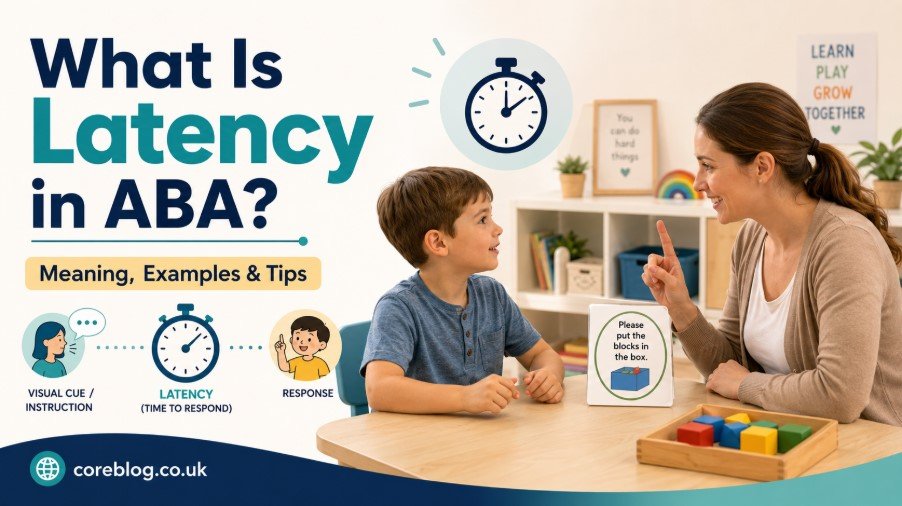
Have you ever asked a child to do something and then waited… and waited… before they finally responded? Maybe you said, “Come here,” and they looked around for a few seconds before walking over. Or perhaps a teacher asked a student to start writing, but the student paused, stared at the paper, and only began after a long delay.
That waiting time matters.
In Applied Behavior Analysis, also known as ABA, professionals often look closely at what happens before and after a behavior. One important measurement they use is called Latency in ABA. It may sound like a technical term at first, but the idea is actually simple. Latency means the amount of time between an instruction, cue, or event and the beginning of a response.
Understanding Latency in ABA can help parents, teachers, behavior technicians, and therapists better understand how quickly someone responds. It can also show whether a child needs more support, better motivation, clearer instructions, or extra practice.
The good news? You do not need to be a behavior expert to understand this concept. Once you see a few real-life examples, it becomes much easier to notice latency in daily routines, therapy sessions, classrooms, and home activities.
What Is Latency in ABA?
Latency in ABA refers to the time that passes between a specific prompt, instruction, or signal and the start of a behavior.
In simple words, it answers this question:
How long does it take for the person to begin responding after something happens?
For example, if a therapist says, “Touch your head,” and the child touches their head after 4 seconds, the latency is 4 seconds. If a teacher says, “Line up,” and a student starts walking to the line after 10 seconds, the latency is 10 seconds.
This type of behavior measurement is useful because it does not only tell us whether the behavior happened. It tells us how quickly it happened.
That difference is important.
A child may eventually follow an instruction, but if the delay is very long, the team may want to understand why. Is the instruction unclear? Is the child distracted? Is the task too hard? Is the child avoiding the activity? Or does the child simply need more time to process language?
This is why Latency in ABA is often used when professionals want to track response speed, task initiation, compliance, attention, and skill development.
Why Latency Matters in ABA Therapy
Latency gives helpful information that simple yes-or-no data cannot always show.
For example, imagine two children both complete the same task. One begins within 2 seconds. The other begins after 45 seconds. If you only record that both completed the task, the results look the same. But in real life, the difference is huge.
The first child responded quickly. The second child may have struggled with attention, motivation, understanding, or transition time.
That is why Latency in ABA can help identify patterns that might otherwise be missed.
Latency Can Show Progress
In therapy, improvement is not always about whether a behavior happens. Sometimes progress means the person starts faster.
For example, a learner may take 30 seconds to follow a simple direction at the beginning of therapy. After several weeks of practice, they may begin responding within 5 seconds. That is meaningful progress.
The behavior may be the same, but the response time has improved.
Latency Can Reveal Barriers
A long delay may tell the therapist that something needs to change. The learner may need:
- A clearer instruction
- A visual support
- A simpler task
- More reinforcement
- A break
- More processing time
- Fewer distractions
- A different teaching strategy
In this way, Latency in ABA helps the team make better decisions instead of guessing.
Simple Definition of Latency in ABA
A simple definition of Latency in ABA is:
The amount of time between a cue or instruction and the beginning of the learner’s response.
The key word here is beginning. Latency ends when the behavior starts, not when it finishes.
For example, if you say, “Put on your shoes,” latency ends when the child starts moving toward the shoes, picks them up, or begins the first step of the task. It does not end after both shoes are fully on.
That is a common mistake. Latency is about response start time, not task completion time.
Latency vs Duration in ABA
Latency and duration are often confused, but they measure different things.
| ABA Measurement | What It Measures | Simple Example |
|---|---|---|
| Latency | Time before a behavior starts | Child begins homework 20 seconds after being told |
| Duration | How long the behavior lasts | Child works on homework for 15 minutes |
| Frequency | How many times behavior happens | Child raises hand 5 times |
| Rate | How often behavior happens in a time period | Child asks 3 questions in 10 minutes |
| Interresponse Time | Time between two responses | Time between one question and the next |
Let’s make it even clearer.
If a teacher says, “Start reading,” and the student begins after 8 seconds, that 8 seconds is latency. If the student reads for 6 minutes, that 6 minutes is duration.
Both measurements can be useful, but they answer different questions.
Examples of Latency in ABA
Real examples make Latency in ABA much easier to understand. Below are common situations where latency may be measured.
Example 1: Following an Instruction
A behavior technician says, “Clap your hands.”
The child claps after 3 seconds.
The latency is 3 seconds.
This type of example is common in skill acquisition programs, especially when teaching receptive language, imitation, or simple directions.
Example 2: Starting Homework
A parent says, “Please start your math homework.”
The child opens the notebook after 2 minutes.
The latency is 2 minutes.
This information may help parents and therapists understand whether the child struggles with task initiation, motivation, transitions, or avoidance.
Example 3: Responding to a Name
A therapist calls the learner’s name.
The learner turns toward the therapist after 5 seconds.
The latency is 5 seconds.
Tracking this over time can show whether the learner is responding more quickly to social cues.
Example 4: Transitioning Between Activities
A teacher says, “It’s time to clean up.”
The student starts putting toys away after 15 seconds.
The latency is 15 seconds.
If the student usually takes 2 minutes to start cleaning but now starts within 15 seconds, that may show real improvement.
Example 5: Beginning a Replacement Behavior
A child is taught to ask for a break instead of crying or leaving the table.
The therapist presents a difficult task.
The child says, “Break please,” after 6 seconds.
The latency is 6 seconds.
In this case, Latency in ABA helps measure how quickly the child uses a more appropriate communication skill.
When Should Latency Be Measured?
Latency is helpful when the timing of a response matters. It is not always the best measurement for every behavior, but it can be very useful in certain situations.
Latency Is Useful For Measuring:
- Following directions
- Starting tasks
- Responding to name
- Transitioning between activities
- Answering questions
- Using communication skills
- Beginning self-help routines
- Responding to safety instructions
- Starting academic work
- Reducing delays in daily routines
For example, if a child eventually completes all tasks but takes a very long time to begin, latency data may show that task initiation is the real issue.
Latency May Not Be Best For:
- Behaviors that happen too quickly to time accurately
- Behaviors with unclear starting points
- Behaviors that occur without a clear cue
- Ongoing behaviors with no obvious beginning
- Situations where frequency or duration gives better information
For latency measurement to work well, there should be a clear starting signal and a clear beginning of the response.
How to Measure Latency in ABA
Measuring Latency in ABA is usually simple, but it must be done carefully.
Here is the basic process:
- Give the instruction or wait for the trigger event.
- Start timing immediately.
- Stop timing when the target behavior begins.
- Record the amount of time.
- Repeat across sessions to look for patterns.
For example, a therapist gives the instruction, “Sit down.” The timer starts as soon as the instruction is finished. The timer stops when the learner begins to sit.
The recorded latency might be 2 seconds, 7 seconds, or 30 seconds depending on the response.
What Counts as the Start of Behavior?
This depends on the behavior being measured. Before collecting data, the team should define the behavior clearly.
For example:
- For “sit down,” the start may be bending knees or moving toward the chair.
- For “write your name,” the start may be picking up the pencil.
- For “come here,” the start may be walking toward the adult.
- For “answer the question,” the start may be the first spoken sound or sign.
- For “clean up,” the start may be picking up the first item.
Clear definitions help everyone collect data the same way.
Practical Tips for Measuring Latency Accurately
Latency data is only useful when it is measured consistently. A few small habits can make the data much more reliable.
Use a Timer
Guessing is not enough. Use a stopwatch, phone timer, data collection app, or digital tool. Even a few seconds can matter when tracking progress.
Define the Cue Clearly
The cue may be a verbal instruction, a visual signal, a natural event, or a teacher’s direction. Everyone should know exactly when timing begins.
For example, does timing start when the adult begins speaking or when the instruction ends? Usually, it is cleaner to start timing after the instruction is delivered.
Define the Behavior Clearly
Before measuring Latency in ABA, decide what counts as the start of the behavior. This avoids confusion later.
Keep the Environment Similar
A child may respond differently in a quiet therapy room than in a noisy classroom. That does not mean the data is wrong, but context matters. Write notes when the environment changes.
Do Not Prompt Too Quickly
If the goal is to measure independent response time, prompting too soon can affect the data. The team should decide how long to wait before giving help.
Record Notes When Needed
Numbers are helpful, but short notes can explain the story behind the data. For example:
- “Child looked tired today.”
- “Room was noisy.”
- “Task was new.”
- “Instruction had to be repeated.”
- “Child was excited after recess.”
These details make latency data easier to understand.
What High Latency May Mean
High latency means the person takes longer to begin responding after a cue or instruction. This does not always mean refusal or noncompliance. That is important to remember.
A long delay can happen for many reasons.
Possible Reasons for High Latency
- The learner did not understand the instruction
- The task was too difficult
- The learner needed more processing time
- The environment was distracting
- The learner was tired
- The instruction was too long
- The learner lacked motivation
- The task had a history of being unpleasant
- The learner was anxious
- The reinforcement was not strong enough
- The transition was too sudden
This is why good ABA practice looks at the whole situation. Latency in ABA should never be viewed as just a number. It is a clue.
What Low Latency May Mean
Low latency means the person begins responding quickly after the cue.
This can be a good sign, especially when the goal is faster task initiation, smoother transitions, or quicker response to safety instructions.
For example, if a child responds to “Stop” within 1 second near a road or parking lot, that quick response can be very important.
Low latency may suggest:
- The learner understands the instruction
- The skill is becoming fluent
- The task is motivating
- The environment supports success
- The learner has practiced enough
- The prompt is clear
- Reinforcement is effective
However, fast responses are not always the only goal. Some learners need extra processing time, and that should be respected. The goal is not to rush every child. The goal is to understand what the data means for that individual.
Latency in ABA and Skill Building
Many ABA programs focus on teaching new skills. These may include communication, social behavior, daily living skills, classroom routines, and safety skills.
Latency in ABA can help show whether a skill is becoming easier and more automatic.
For example, a child learning to request help may first need 20 seconds and several prompts. Later, the child may ask for help within 3 seconds. That shorter latency suggests the skill is becoming stronger.
Common Skills Where Latency Matters
Communication Skills
Latency can show how quickly a learner asks for help, requests a break, answers a question, or responds to their name.
Daily Living Skills
Tasks like brushing teeth, washing hands, getting dressed, or putting away toys often involve instructions. Measuring latency can show whether the learner starts these routines more independently.
Academic Skills
In classrooms, latency may be used to measure how quickly a student starts reading, writing, solving problems, or joining group work.
Social Skills
A therapist may measure how long it takes a learner to greet someone, respond to a peer, join a game, or answer a social question.
Latency and Behavior Reduction
Latency is not only used for teaching new skills. It may also be helpful when working with challenging behavior.
For example, a behavior team may measure how long it takes for a tantrum to begin after a demand is placed. If a therapist presents a worksheet and crying starts after 10 seconds, the latency is 10 seconds.
Over time, if the latency increases from 10 seconds to 2 minutes, that may show improvement. It may mean the child is tolerating the task longer before engaging in challenging behavior.
However, the goal should not simply be to delay distress. A strong ABA plan should also teach useful replacement behaviors, such as asking for help, requesting a break, or saying “I need more time.”
Parent-Friendly Example of Latency in ABA
Let’s say a parent is trying to improve the morning routine.
The parent says, “Please put on your shoes.”
On Monday, the child starts after 90 seconds.
On Tuesday, the child starts after 70 seconds.
On Wednesday, the child starts after 45 seconds.
On Thursday, the child starts after 20 seconds.
On Friday, the child starts after 10 seconds.
That pattern suggests improvement. The child is beginning the task faster.
Now, imagine the parent added a visual schedule, gave a 5-minute warning before leaving, and praised the child for starting quickly. These supports may have helped reduce latency.
That is the real value of Latency in ABA. It helps families and professionals see whether strategies are working.
Common Mistakes When Measuring Latency
Even though latency is simple, mistakes can happen. Here are a few to avoid.
Mistake 1: Timing the Whole Task
Latency is not the full time it takes to finish a task. It is only the time before the behavior starts.
Mistake 2: Using Unclear Instructions
If the instruction is confusing, the latency data may not tell the full story. Clear, simple directions work best.
Mistake 3: Changing the Definition
If one person stops the timer when the child looks at the task, but another stops it when the child touches the task, the data will not be consistent.
Mistake 4: Ignoring Context
A long delay during a noisy birthday party is different from a long delay in a calm therapy room. Context matters.
Mistake 5: Assuming Delay Means Defiance
This is a big one. A delayed response does not always mean the learner is being difficult. They may be processing, confused, tired, overwhelmed, or unsure.
How Therapists Use Latency Data
ABA therapists use latency data to make decisions. They may look at whether response times are getting shorter, staying the same, or getting longer.
If latency decreases, the current teaching plan may be working. If latency stays high, the team may adjust the plan.
Possible changes may include:
- Shorter instructions
- Better reinforcement
- More visual supports
- Easier first steps
- More practice
- Task choices
- Clearer prompts
- Better transition warnings
- Functional communication training
- Environmental changes
Good data helps create better support. It also helps parents and professionals avoid relying only on opinion.
Tips to Reduce Latency in ABA Programs
Reducing latency does not mean forcing a learner to respond instantly. It means helping them start important tasks with less delay when appropriate.
Give Clear Instructions
Use simple, direct language. Instead of saying, “Can you maybe go ahead and start cleaning this area up now?” say, “Clean up the blocks.”
Use Visual Supports
Some learners respond better when they can see what is expected. Visual schedules, picture cards, written checklists, and first-then boards can help.
Offer Choices
Choice can increase cooperation. For example:
- “Do you want to start with math or reading?”
- “Do you want the blue pencil or red pencil?”
- “Do you want to clean blocks or cars first?”
When learners feel some control, they may begin faster.
Reinforce Quick Starts
Praise and rewards can help when used well. For example, “Nice job starting right away,” tells the learner exactly what they did well.
Break Tasks Into Smaller Steps
A big task can feel overwhelming. A smaller first step is easier to start.
Instead of “Clean your room,” try “Put the books on the shelf.”
Give Transition Warnings
Some learners need time to shift from one activity to another. A warning like “Two more minutes, then homework” can reduce delays.
Teach Replacement Skills
If a learner delays because they need help or feel overwhelmed, teach them what to say or do.
Examples include:
- “Help please.”
- “I need a break.”
- “Can I have more time?”
- “I don’t understand.”
- “One more minute?”
These skills are more useful than simply waiting in silence.
Latency in ABA at Home
Parents can use the idea of latency without turning home life into a therapy session. The goal is not to time every little thing. That would feel stressful for everyone.
Instead, parents can notice patterns.
For example:
- Does the child take longer to respond before school?
- Are delays longer during homework?
- Does the child start faster when given a visual schedule?
- Are transitions harder after screen time?
- Does praise help the child begin more quickly?
These observations can help parents understand what supports their child best.
Latency in ABA in the Classroom
Teachers may also benefit from understanding latency. In a classroom, delayed responses can affect learning, transitions, group work, and independence.
A student who takes 3 minutes to begin each assignment may lose a lot of learning time across the day. But with the right support, that delay may improve.
Helpful classroom strategies include:
- Clear directions
- Visual timers
- Written instructions
- Preferential seating
- Transition cues
- Shorter work chunks
- Positive reinforcement
- Peer modeling
- Calm reminders
When teachers and ABA professionals work together, latency data can support better classroom planning.
Is Latency Always a Problem?
No. Latency is not automatically bad.
Some people naturally need more time to process information. Some learners think carefully before answering. Others may need extra time because of language delays, anxiety, sensory needs, or attention challenges.
The point of measuring Latency in ABA is not to pressure someone to respond like a robot. It is to understand behavior better.
In some situations, fast responding is important, such as safety instructions. In other situations, a few extra seconds may be perfectly fine.
A thoughtful ABA approach respects the learner while still helping them build useful skills.
Final Thoughts on Latency in ABA
Latency in ABA is one of those terms that sounds more complicated than it really is. At its core, it simply means the time between a cue and the start of a response. But even though the definition is simple, the information it gives can be powerful.
Latency can show whether a learner is responding faster, struggling to begin tasks, needing more support, or becoming more independent. It can help parents understand morning routines, help teachers improve classroom transitions, and help therapists fine-tune behavior plans.
The most important thing is to look at latency with curiosity, not judgment. A delayed response is not always defiance. It may be communication. It may be confusion. It may be stress. It may be a sign that the instruction, environment, or task needs to change.
When used carefully, Latency in ABA helps create better teaching, kinder support, and clearer progress. Whether you are a parent, teacher, therapist, or beginner learning ABA terms, understanding latency gives you one more practical tool for seeing behavior more clearly.
If this guide helped you understand Latency in ABA, share it with someone who works with children, supports learners, or wants to better understand behavior in everyday life.















Leave a Reply