

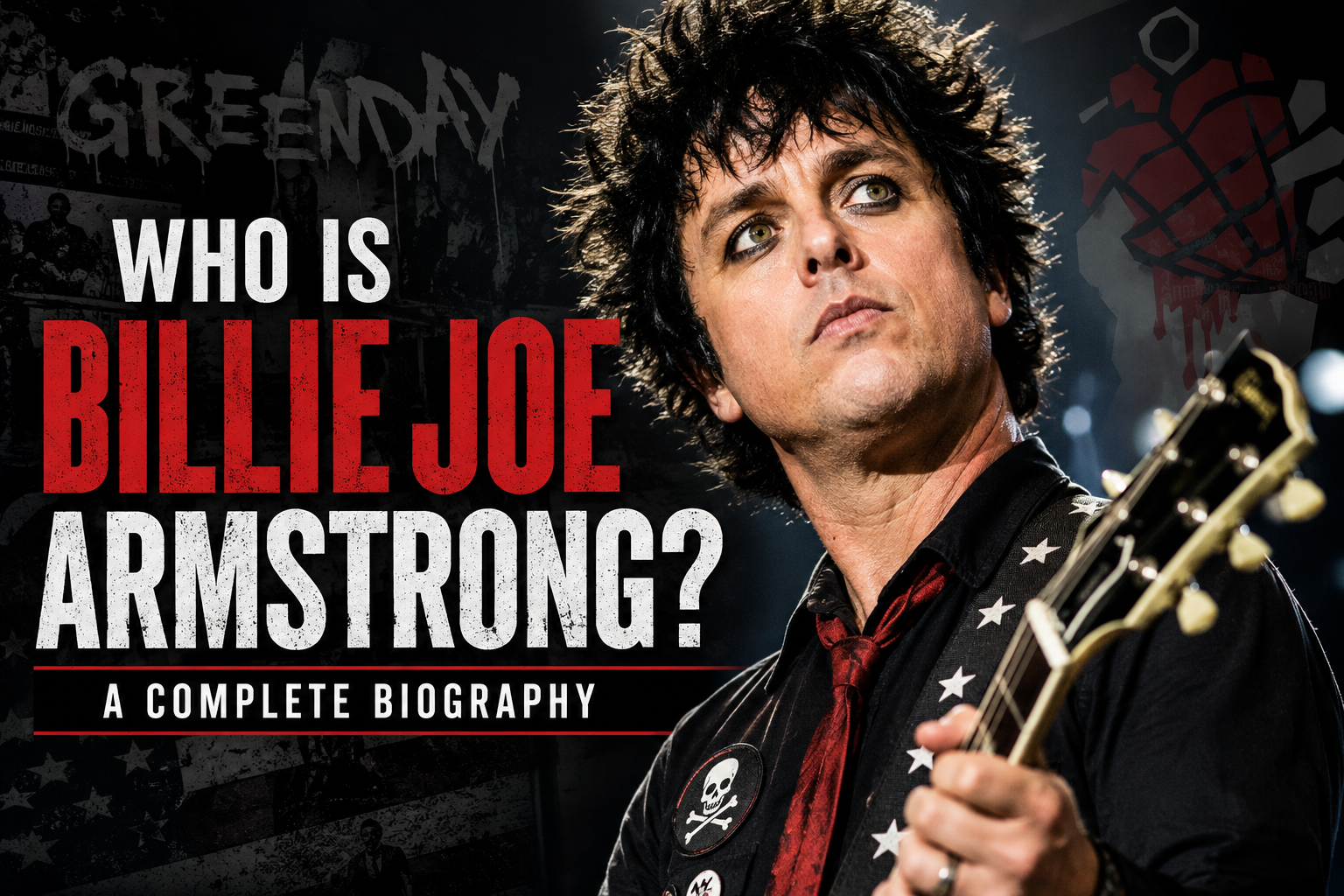
Who Is Billie Joe Armstrong? A Complete Biography
Billie Joe Armstrong is one of the defining figures in modern punk rock. As the lead vocalist, guitarist, and principal songwriter of Green Day, he helped bring the energy of the California punk scene to a worldwide audience without losing the genre’s rebellious spirit.
Born on October 17, 1972, in Oakland, California, Armstrong developed an interest in music at a young age. His career took a decisive turn when he formed a musical partnership with Mike Dirnt during his teenage years. That partnership eventually became the foundation of Green Day, one of the most commercially successful and influential punk bands of its generation.
From the independent releases of Green Day’s early years to the international success of Dookie and American Idiot, Armstrong’s career has covered several decades. He has also worked on Broadway, released music outside Green Day, and continued to evolve as a songwriter and performer.
This biography explores Billie Joe Armstrong’s early life, rise to fame, Green Day career, songwriting style, major achievements, family, and broader influence on rock music.
Key Takeaways
- Billie Joe Armstrong was born on October 17, 1972, in Oakland, California.
- He is best known as Green Day’s lead vocalist, guitarist, and primary songwriter.
- Green Day’s 1994 album Dookie transformed the band into international stars.
- American Idiot expanded Armstrong’s songwriting into ambitious political and theatrical territory.
- Green Day was inducted into the Rock & Roll Hall of Fame in 2015.
- Armstrong has also pursued projects outside Green Day, including the solo album No Fun Mondays.
Biography Table
| Detail | Information |
|---|---|
| Full Name | Billie Joe Armstrong |
| Date of Birth | October 17, 1972 |
| Age | 53 years old as of August 2026 |
| Birthplace | Oakland, California, United States |
| Nationality | American |
| Profession | Musician, singer, songwriter, guitarist, actor |
| Education | Attended Carquinez Middle School and John Swett High School |
| Years Active | 1980s–present |
| Known For | Green Day, punk rock, songwriting, guitar and vocals |
| Major Achievements | International success with Green Day; Rock & Roll Hall of Fame induction in 2015 |
| Estimated Net Worth | Not included because widely circulated estimates vary and are not reliably documented |
Early Life and Musical Beginnings
Billie Joe Armstrong grew up in the East Bay area of California in a musical family. His father, Andrew Armstrong, was a jazz musician and truck driver, while his mother, Ollie, worked as a waitress and was also a singer.
Music became important to Armstrong while he was still a child. He recorded a song called “Look for Love” when he was only five years old, an early indication of the musical direction his life would eventually take.
His childhood was also marked by the death of his father when Armstrong was young. That experience later became part of the emotional background of some of his songwriting.
During his teenage years, Armstrong became increasingly interested in punk rock. The East Bay’s underground music culture provided an important environment for young musicians, and Armstrong found inspiration in bands that combined fast guitars, direct lyrics, and energetic performances.
Meeting Mike Dirnt
One of the most important relationships in Armstrong’s career began during his school years when he met bassist Mike Dirnt.
The two developed a close friendship and musical partnership. They played together in local groups before forming the band that would eventually become Green Day.
Their partnership became central to Green Day’s identity. Armstrong’s guitar and vocals combined with Dirnt’s bass playing created the foundation of the band’s sound, while drummer Tré Cool later completed the classic lineup.
The Rock & Roll Hall of Fame describes Green Day as a group that helped bring authentic punk rock into the mainstream while maintaining its rebellious character.
The Formation of Green Day
Green Day’s origins can be traced to the late 1980s in the East Bay punk scene. Armstrong and Dirnt initially performed under the name Sweet Children before adopting the name Green Day.
The band’s early music was rooted in punk rock but also featured catchy melodies and straightforward songwriting. That combination would eventually become one of Green Day’s defining characteristics.
The band’s early releases included the 1989 EP 1,000 Hours, followed by the album 39/Smooth in 1990. Their second album, Kerplunk!, arrived in 1992 and helped establish the band within the independent punk community.
At this stage, Green Day was successful within the underground scene but had not yet become a mainstream phenomenon.
Breakthrough With Dookie
Everything changed with Dookie.
Released in 1994, the album introduced Green Day to a massive international audience. Its combination of fast punk arrangements, memorable melodies, humorous observations, and youthful frustration proved exceptionally accessible.
Songs such as “Basket Case,” “Longview,” and “When I Come Around” became major hits.
Armstrong’s songwriting played a central role in that success. His lyrics often presented ordinary experiences through a distinctly punk perspective, allowing listeners to connect with themes such as anxiety, boredom, relationships, alienation, and growing up.
The Rock & Roll Hall of Fame identifies Dookie as Green Day’s breakthrough and highlights the band’s ability to combine an edgy punk identity with accessible songwriting.
The success of Dookie also helped change the public perception of punk rock. Green Day demonstrated that punk could reach huge audiences without completely abandoning its underground attitude.
Green Day’s Evolution After Dookie
Rather than simply repeating the formula of their breakthrough album, Armstrong and Green Day continued experimenting.
Albums such as Insomniac, Nimrod, and Warning showed different sides of the band’s songwriting.
Nimrod, released in 1997, included “Good Riddance (Time of Your Life),” an acoustic song that became one of Green Day’s most recognizable recordings. Its quieter sound demonstrated that Armstrong could write songs that reached beyond traditional punk-rock arrangements.
Warning, released in 2000, continued that exploration. The album incorporated broader musical influences and placed considerable emphasis on songwriting.
Green Day’s official store describes Warning as an important part of the band’s catalog, noting its commercially successful singles and Armstrong’s songwriting.
American Idiot and a New Creative Era
In 2004, Green Day released American Idiot, arguably the most ambitious project of Armstrong’s career.
The album moved beyond a collection of conventional punk songs and presented a loosely connected narrative involving characters, political frustration, suburban alienation, and the search for identity.
The title track, “American Idiot,” immediately established the album’s confrontational tone. Other major songs included “Boulevard of Broken Dreams,” “Holiday,” “Wake Me Up When September Ends,” and “Jesus of Suburbia.”
The project demonstrated Armstrong’s growth from a punk songwriter into a more ambitious rock composer.
The Rock & Roll Hall of Fame notes that American Idiot expanded Green Day’s reach and eventually became the basis for a Broadway production.
Billie Joe Armstrong and Broadway
The success of American Idiot eventually moved Armstrong into musical theater.
The stage adaptation of American Idiot premiered on Broadway in 2010. Armstrong became involved with the production and played the role of St. Jimmy for a limited period.
The Broadway project demonstrated how Green Day’s music could be reinterpreted in a theatrical setting while retaining its rock identity.
It also reinforced Armstrong’s reputation as a songwriter capable of working across different formats.
Billie Joe Armstrong’s Songwriting Style
Armstrong’s songwriting is one of the most important reasons for his longevity.
His writing often combines simple musical structures with emotionally direct lyrics. Instead of relying entirely on technical complexity, he frequently builds songs around memorable guitar riffs, strong choruses, and conversational language.
Several recurring themes appear throughout his work:
- Growing up and feeling out of place
- Relationships and emotional uncertainty
- Anxiety and isolation
- Political frustration
- Youth culture
- Personal identity
- Rebellion against social expectations
- Nostalgia and changing circumstances
His ability to make relatively personal experiences feel universal has helped Green Day connect with multiple generations of listeners.
Major Green Day Albums
Armstrong’s career can be understood through several particularly important Green Day releases.
| Album | Year | Why It Matters |
|---|---|---|
| 39/Smooth | 1990 | Established Green Day’s early punk sound |
| Kerplunk! | 1992 | Expanded the band’s underground following |
| Dookie | 1994 | Breakthrough album and international success |
| Insomniac | 1995 | Continued the band’s aggressive punk direction |
| Nimrod | 1997 | Demonstrated broader musical experimentation |
| Warning | 2000 | Emphasized songwriting and musical variety |
| American Idiot | 2004 | Turned Green Day into a larger-scale rock and theatrical act |
| 21st Century Breakdown | 2009 | Continued the band’s ambitious album-oriented approach |
| Revolution Radio | 2016 | Returned to a direct, energetic rock sound |
| Saviors | 2024 | Continued Green Day’s long-running creative partnership |
The Rock & Roll Hall of Fame highlights recordings ranging from “Longview” and “Good Riddance” to “American Idiot” when describing Green Day’s musical impact.
Other Musical Projects
Although Green Day remains Armstrong’s best-known musical identity, he has worked outside the band.
One notable project was The Longshot, a side project that allowed him to explore music outside Green Day’s main framework.
He also formed or participated in other projects over the years, including Foxboro Hot Tubs.
During the period when touring was paused in 2020, Armstrong began releasing cover songs online as part of a project called No Fun Mondays. The collection eventually became a full album featuring 14 covers.
The project offered a different perspective on Armstrong’s musical interests because it focused on songs written and performed by other artists rather than exclusively on his own compositions.
Billie Joe Armstrong’s Guitar Style
Armstrong’s guitar playing is closely associated with Green Day’s sound.
His approach generally favors memorable riffs, power chords, energetic rhythm playing, and economical arrangements. Rather than making technical virtuosity the centerpiece, his guitar work supports the songs and reinforces their rhythmic momentum.
That approach has also made many Green Day songs accessible to beginning guitarists.
Tracks such as “When I Come Around,” “Basket Case,” and “American Idiot” are particularly recognizable examples of Armstrong’s guitar-driven songwriting.
Awards and Major Achievements
Billie Joe Armstrong’s most significant accomplishments are closely connected with Green Day.
One of the band’s biggest honors came in 2015, when Green Day was inducted into the Rock & Roll Hall of Fame in its first year of eligibility. Armstrong, Mike Dirnt, and Tré Cool are represented as the band’s core members in the Hall’s materials.
Green Day’s achievements also include major commercial success, international tours, Grammy Awards, and a lasting influence on punk and alternative rock.
The band’s career is particularly notable because it bridged the gap between underground punk culture and mainstream rock without completely abandoning the musical identity that defined its early work.
Billie Joe Armstrong’s Family
Armstrong married Adrienne Nesser in 1994. The couple have two sons, Joseph and Jakob.
Family and personal experiences have occasionally influenced Armstrong’s songwriting, although he generally maintains a distinction between his public career and his private life.
One of the clearest examples of personal experience entering his music is “Wake Me Up When September Ends,” a song connected to the death of his father.
Why Billie Joe Armstrong Matters to Punk Rock
Armstrong’s importance extends beyond his role as a frontman.
Before Green Day became globally famous, punk rock was often associated with smaller venues and underground communities. Green Day helped demonstrate that punk could become commercially successful while maintaining its emphasis on direct expression, energetic performances, and skepticism toward conventional expectations.
The band’s influence can be seen in later pop-punk and alternative-rock artists. The Rock & Roll Hall of Fame specifically describes Green Day as an important influence on numerous bands that followed.
Armstrong’s contribution is therefore not simply about record sales. His songwriting helped establish a model in which punk could be melodic, commercially accessible, emotionally vulnerable, and politically outspoken at the same time.
Frequently Asked Questions
How old is Billie Joe Armstrong?
Billie Joe Armstrong was born on October 17, 1972. As of August 2026, he is 53 years old.
What is Billie Joe Armstrong famous for?
He is best known as the lead vocalist, guitarist, and principal songwriter of Green Day, the American punk-rock band behind albums such as Dookie and American Idiot.
Is Billie Joe Armstrong still in Green Day?
Yes. Armstrong remains a member of Green Day alongside Mike Dirnt and Tré Cool.
When did Billie Joe Armstrong start Green Day?
Armstrong and Mike Dirnt began playing together as teenagers in California. Their early group evolved into Green Day, which developed from the East Bay punk scene in the late 1980s.
What is Billie Joe Armstrong’s most famous song?
There is no single universally agreed-upon answer, but songs associated strongly with Armstrong and Green Day include “Basket Case,” “Good Riddance (Time of Your Life),” “American Idiot,” “Boulevard of Broken Dreams,” and “When I Come Around.”
Was Billie Joe Armstrong involved in American Idiot on Broadway?
Yes. Armstrong participated in the Broadway production of American Idiot and performed the role of St. Jimmy for a limited run.
Is Billie Joe Armstrong a songwriter as well as a singer?
Yes. Songwriting is one of his central contributions to Green Day. He has written or co-written much of the band’s catalog and is closely associated with its lyrics, melodies, and guitar arrangements.
Is Green Day in the Rock & Roll Hall of Fame?
Yes. Green Day was inducted into the Rock & Roll Hall of Fame in 2015.
Conclusion
Billie Joe Armstrong’s career is a story of punk rock evolving without losing its sense of identity.
From his early years in California’s East Bay punk scene to Green Day’s breakthrough with Dookie, he helped turn a style once associated primarily with underground venues into a worldwide musical force. Albums such as Nimrod, Warning, and American Idiot also showed that his songwriting could grow beyond the fast, compact punk songs of Green Day’s early years.
His career has included major albums, international performances, Broadway, side projects, and recognition from the Rock & Roll Hall of Fame. Yet his lasting contribution may be simpler: Armstrong helped show that punk songs could be catchy without becoming empty, ambitious without losing their energy, and personal while still speaking to millions of listeners.
For that reason, Billie Joe Armstrong remains an important figure in the history of modern rock and one of the most recognizable songwriters to emerge from the punk movement.



Leave a Reply